
South Asia (1396–1539 CE) Sultanates, Temple-States, …
Years: 1396 - 1539
South Asia (1396–1539 CE)
Sultanates, Temple-States, and the Monsoon World on the Eve of Cannon Empires
Geography & Environmental Context
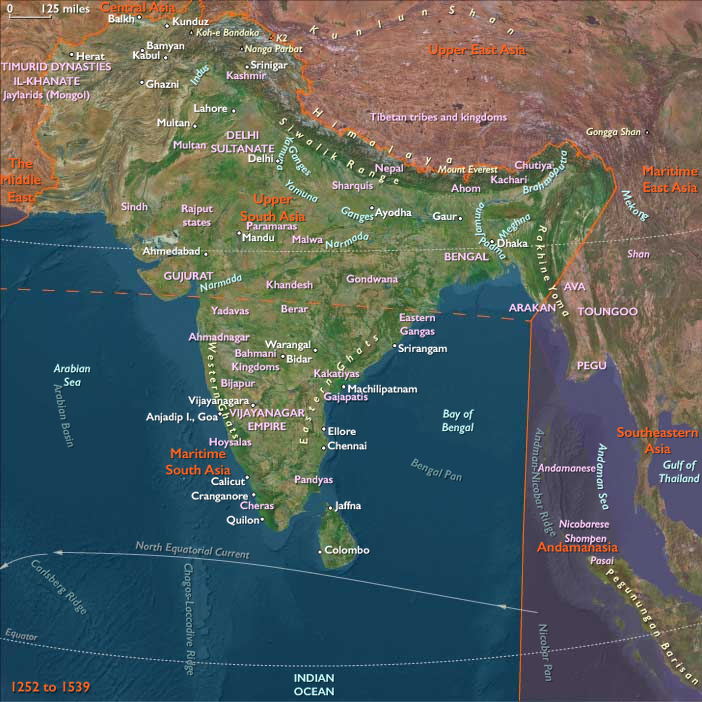
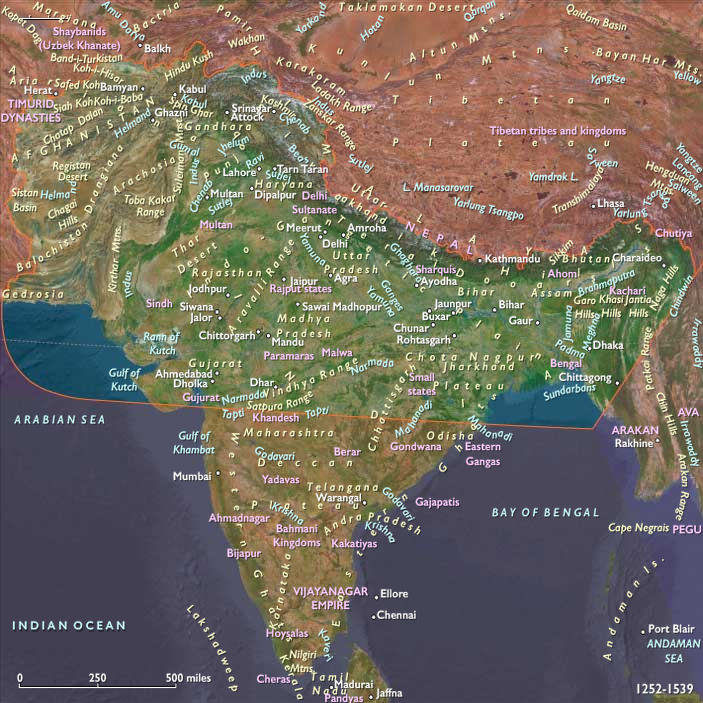
South Asia in this age comprised two interlocking spheres.
Northern South Asia included Afghanistan, Pakistan, northern India, Nepal, Bhutan, Bangladesh, and northwestern Myanmar (the Arakan/Yakhine littoral and Chindwin valley)—a corridor from the Hindu Kush and Khyber gateways across the Indus and Ganges–Yamuna basins to the Brahmaputra delta and the Arakan coast.
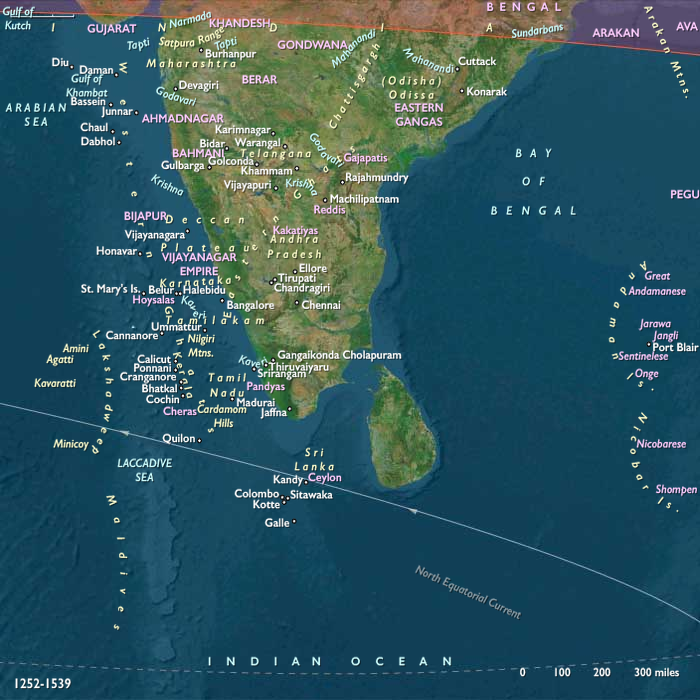
Southern South Asia encompassed southern India, Sri Lanka, the Maldives, Lakshadweep, and the Chagos Archipelago—from the Deccan plateau and the Krishna–Tungabhadra–Kaveri valleys to the Coromandel and Malabar shores and the coral atolls of the central Indian Ocean.
Monsoon-fed plains, terraced Himalayan hills, pepper and cinnamon coasts, and atoll seas together formed one of the early modern world’s most diverse ecological mosaics.
Climate & Environmental Shifts
The Little Ice Age heightened variability:
-
Western disturbances brought deeper winter snows to the Hindu Kush and pulses of rain to the Indus basin.
-
The summer monsoon oscillated sharply, producing Ganges–Brahmaputra flood years followed by shortfalls that stressed rice and wheat belts.
-
Himalayan glaciers advanced in pulses, modulating river regimes; Tarai malarial wetlands waxed and waned.
-
In the south, the Southwest Monsoon fed Malabar’s pepper gardens, the Northeast Monsoon irrigated Coromandel fields; droughts struck the Deccan and Sri Lanka’s dry zone; atolls faced erratic winds, tuna swings, and cyclones.
Subsistence & Settlement
-
Indus–Gangetic core: Wheat, barley, and pulses dominated the west; rice, sugarcane, and jute anchored the east. Sultanate irrigation (canals, nadi diversions) complemented long-lived village tanks in the doabs.
-
Afghanistan & northwest uplands: Orchard–grain valleys (wheat, vines, pomegranates) paired with transhumant herds and caravan towns on the Kabul–Peshawar route.
-
Nepal & Bhutan: Terrace rice in middle hills; millet, buckwheat, and barley higher up; yak–sheep transhumance; salt–grain exchange over the passes.
-
Bengal delta: Intensive wet-rice, fishponds, and palm groves supported dense levee settlements.
-
Arakan littoral & Chindwin valley: Rice coasts and shifting cultivation under the rising kingdom of Mrauk U(founded 1430), a mediator between Bengal and the Bay of Bengal.
-
Deccan & peninsular India: Under Vijayanagara, irrigated rice, millets, and pulses flourished; coastal spice gardens thrived.
-
Sri Lanka: Kotte in the southwest and Jaffna in the north organized rice, coconut, and cinnamon.
-
Maldives & Lakshadweep: Coconuts, tuna, and imported rice sustained atolls; dried tuna (mas huni) and cowries circulated widely. Chagos remained uninhabited, yet entered pilots’ lore.
Technology & Material Culture
-
Hydraulics & fields: Sultanate canals, village tanks, Persian wheels; terrace walls in the Himalaya and Sri Lanka’s reservoirs stabilized yields.
-
Courtly landscapes: Fortified citadels, ribbed domes, and chahar-bāgh gardens inscribed Persianate aesthetics across the plains; in the south, stone temples, soaring gopuram gateways, bronzes, and manuscript ateliers flourished under Vijayanagara.
-
Textiles & metalwork: Bengal’s cottons and fine metal casting; pepper trellises on Malabar; coral-stone mosques in the Maldives; shipyards from Calicut to Cochin.
-
Scripts & paper: Paper mills and scriptoria multiplied Persian and vernacular manuscripts; temple workshops copied śāstra and puranic lore; island chronicles (tarikh) recorded dynasties.
Movement & Interaction Corridors
-
Khyber & Bolan passes: Funneled Central Asian contingents—Timur’s catastrophic raid (1398) and, later, Bābur’s Timurid thrusts into the Punjab.
-
Trunk roads & waterways: Grand-Trunk–style arteries linked Lahore–Delhi–Agra–Varanasi to Bengal river ports; caravanserais and market towns proliferated.
-
Himalayan routes: Salt, wool, and metalware moved between Tibet, Nepal, Bhutan, and the plains; monastic and royal courts managed passes.
-
Indian Ocean circuits: Calicut, Cochin, and Colombo served Arab, Gujarati, and Chinese merchants; horses, textiles, and silver moved in, pepper, cardamom, cinnamon, pearls, and elephants out.
-
Atoll chains: Maldives supplied cowries and dried fish; Lakshadweep bridged Kerala to the central ocean; Chagos marked reefs on charts.
-
Portuguese entry: Vasco da Gama at Calicut (1498); Goa seized (1510); forts at Cochin, Colombo, and Malacca (1511) reoriented sea-lanes.
Cultural & Symbolic Expressions
-
Persianate–Indic synthesis: Under the Delhi Sultanate and successor houses (Jaunpur, Malwa, Gujarat), mosque complexes, madrasas, and Sufi hospices flourished; qawwali, Persian poetry, and vernacular bhaktispread in parallel; shared shrine circuits and urs feasts mediated urban and rural worlds.
-
Himalayan courts: Malla polities in Nepal patronized thangka painting, scholastic lineages, and festival calendars; Bhutanese monastic states fused ritual and rule.
-
Coastal kingdoms: Vijayanagara courts sponsored temple dance (Bharatanatyam), court poetry, and merchant guilds; Kotte and Jaffna balanced Buddhist and Hindu forms.
-
Atolls: Islamic devotion structured Maldives and Lakshadweep—coral mosques, Quran schools, and royal tarikh—adapted to maritime lifeways.
Environmental Adaptation & Resilience
-
Field rotations: Wheat–pulse and paddy–legume cycles sustained soil; flood-recession rice and raised beds in Bengal buffered deluge and drought.
-
Terraces & forests: Stone walls and shelter belts stabilized Himalayan slopes; transhumance staggered herds by elevation and season.
-
Tank systems: Check-gates and storage in the Deccan and Sri Lanka mitigated failure years.
-
Atoll strategies: Diversified coconut–tuna economies, cisterns, and inter-island exchange underwrote fragile ecologies.
-
Institutional relief: Waqf/devadāna lands provisioned monasteries, mosques, and temples that dispensed grain; village banks and merchant credit smoothed shocks.
Technology & Power Shifts (Conflict Dynamics)
-
Sultanate fracture & Timurid shock: Timur’s sack of Delhi (1398) shattered central authority; regional houses rose as the Delhi court recovered fitfully.
-
Timurid–Mughal advent: Bābur seized Kabul (1504), then Panipat (1526), founding the Mughal polity; consolidation followed at Khanwa (1527) and Chanderi (1528), as Rajput houses bargained war and marriage.
-
Arakanese hinge: Mrauk U (from 1430) linked Bengal to Myanmar’s coasts, sheltering Muslim refugees and traders and projecting power across the Kaladan and Chindwin valleys.
-
Vijayanagara zenith: Under rulers like Krishnadevaraya (r. 1509–1529), the empire contested Bahmani successors, fielding fortified cities and massed armies.
-
Portuguese shock: Goa (1510) became the Estado da Índia headquarters; forts at Cochin, Colombo, and Malacca inserted cannon into monsoon politics; raids touched the Maldives and mapped Chagos.
Transition (to 1539 CE)
By 1539, South Asia balanced old orders and new horizons.
In the north, Timurid–Mughal beginnings met sultanate polities in the plains, Malla courts in the Himalaya, and Mrauk U on the Bengal–Arakan hinge.
In the south, Vijayanagara shone in temple and tank, even as Portugal’s forts and fleets rewired Indian Ocean trade.
Across deltas, passes, and atolls, resilience rested on irrigation, redistribution, and diaspora networks—an ecologically diverse monsoon world standing at the threshold of gunpowder empire and global convergence.
People
- Babur
- Bahlul Lodi
- Gurū Nānak
- Humayun
- Ibrahim Lodi
- Jami
- Kabir
- Kamāl ud-Dīn Behzād
- Sher Shah Suri
- Sikander Lodi
Groups
- Tajik people
- Kirat people
- Iranian peoples
- Hinduism
- Pashtun people (Pushtuns, Pakhtuns, or Pathans)
- Jainism
- Kashmir, Kingdom of
- Buddhism
- Buddhism, Tibetan
- Khas peoples
- India, Classical
- Buddhism, Mahayana
- Tokharistan (Kushan Bactria)
- Gandhāra
- Bon
- Bumthang, Kingdom of
- Islam
- Muslims, Sunni
- Muslims, Shi'a
- Ghilzai (Pashtun tribal confederacy)
- Mongols
- Hazara people
- Malla (Nepal)
- Delhi, Sultanate of (Tughluq Dynasty)
- Vijayanagara, Kingdom of
- Bengal, Sultanate of
- Timurid Empire
- Jaunpur Sultanate
- Timurid Emirates
- Delhi, Sultanate of (Sayyid Dynasty)
- Kantipur
- Bhaktapur, Kingdom of
- Lalitpur, also known as Patan, Kingdom of
- Delhi, Sultanate of (Lodi, or Afghan, Dynasty)
- Vijayanagara, (Saluva) Kingdom of
- Vijayanagara, (Tuluva) Kingdom of
- Mughal Empire (Agra)
Topics
Commodoties
Subjects
- Commerce
- Writing
- Architecture
- Sculpture
- Conflict
- Faith
- Government
- Custom and Law
- Medicine
- Mathematics
- Astronomy
- Philosophy and logic
Regions
Subregions
Years: 1396 - 1539
People
- Babur
- Bahlul Lodi
- Gurū Nānak
- Humayun
- Ibrahim Lodi
- Jami
- Kabir
- Kamāl ud-Dīn Behzād
- Sher Shah Suri
- Sikander Lodi
Groups
- Tajik people
- Kirat people
- Iranian peoples
- Hinduism
- Pashtun people (Pushtuns, Pakhtuns, or Pathans)
- Jainism
- Kashmir, Kingdom of
- Buddhism
- Buddhism, Tibetan
- Khas peoples
- India, Classical
- Buddhism, Mahayana
- Tokharistan (Kushan Bactria)
- Gandhāra
- Bon
- Bumthang, Kingdom of
- Islam
- Muslims, Sunni
- Muslims, Shi'a
- Ghilzai (Pashtun tribal confederacy)
- Mongols
- Hazara people
- Malla (Nepal)
- Delhi, Sultanate of (Tughluq Dynasty)
- Vijayanagara, Kingdom of
- Bengal, Sultanate of
- Timurid Empire
- Jaunpur Sultanate
- Timurid Emirates
- Delhi, Sultanate of (Sayyid Dynasty)
- Kantipur
- Bhaktapur, Kingdom of
- Lalitpur, also known as Patan, Kingdom of
- Delhi, Sultanate of (Lodi, or Afghan, Dynasty)
- Vijayanagara, (Saluva) Kingdom of
- Vijayanagara, (Tuluva) Kingdom of
- Mughal Empire (Agra)
Topics
Commodoties
Subjects
- Commerce
- Writing
- Architecture
- Sculpture
- Conflict
- Faith
- Government
- Custom and Law
- Medicine
- Mathematics
- Astronomy
- Philosophy and logic
Regions
Subregions