
Northern South Atlantic (28557 – 7822 BCE): …
Years: 28577BCE - 7822BCE
Northern South Atlantic (28557 – 7822 BCE): Gyre Heart, Volcanic Isles, and Oligotrophic Blue
Geographic and Oceanographic Frame
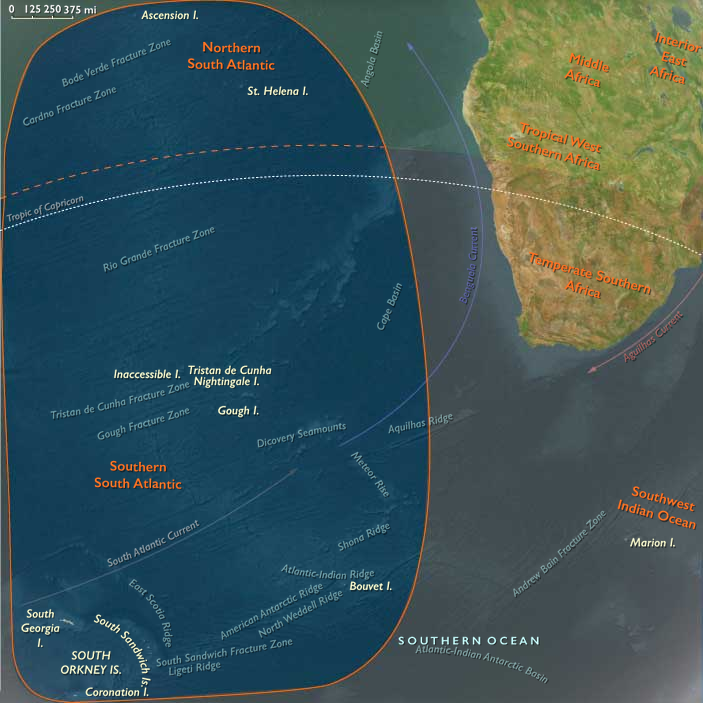
Northern South Atlantic here means the South Atlantic basin from the Equator to the mid-subtropics, centered on the South Equatorial Current and the subtropical gyre core. It includes the isolated volcanic and reef systems of Ascension and St Helena (on the Mid-Atlantic Ridge) and, on the western flank, Fernando de Noronha, Rocas Atoll, São Pedro & São Paulo, and Trindade–Martim Vaz off Brazil.
(Note: the Tristan–Gough group lies farther south in the Southern South Atlantic.)
Climate Pulses and Sea-Level Change
-
Last Glacial Maximum (c. 26,500 – 19,000 BCE): Global sea level ~120 m lower expanded rocky shore platforms around the islands; cooler SSTs and stronger trade winds intensified Benguela upwelling along southwest Africa and sharpened nutrient fronts. Coral accretion slowed on warm-water reefs (Noronha, Rocas), while pelagic productivity shifted toward upwelling margins and island wake effects.
-
Bølling–Allerød (c. 14,700 – 12,900 BCE): Rapid warming/moistening boosted SSTs; the SE trades relaxed slightly, gyre stratification increased, and reef growth rebounded in the west. Seasonal plankton blooms along current boundaries enriched food webs for fish, turtles, and seabirds.
-
Younger Dryas (c. 12,900 – 11,700 BCE): Modest cooling nudged productivity back toward wind-driven zones and island wake upwelling; reef growth slowed but persisted in sheltered lagoons.
-
Early Holocene (after c. 11,700 BCE): Rising seas drowned LGM terraces, establishing modern shorelines; warm, stable SSTs favored rapid reef expansion (especially at Rocas, the South Atlantic’s classic atoll) and broadened turtle nesting beaches on newly formed sand cays.
Islands, Reefs, and Ecologies
-
Mid-ocean volcanoes (Ascension, St Helena): Basaltic cones with young lava fields, cinder ridges, and scant fresh water; lee-side eddies created island mass effects that concentrated plankton and small pelagics. Harsh, arid climates on land; cliffs and ledges hosted immense booby, frigatebird, and tern rookeries.
-
Western ridge and seamount arc (Noronha, Rocas, São Pedro & São Paulo, Trindade–Martim Vaz): Mix of volcanic islands and reef platforms. Rocas—a low-lying ring of coral—supported lagoons rich in juveniles of reef fish and invertebrates. Noronha and Trindade had rocky shores and pocket reefs, with nutrient pulses from internal waves and current shear.
-
Pelagic highways: Humpback and other baleen whales transited seasonally; tuna, billfish, and sharkspatrolled thermal fronts. Green and hawksbill turtles used multiple islands as nesting sites.
Human Presence
-
None. Distances, weak archipelagic stepping-stones, and open-ocean conditions placed this basin far beyond late Pleistocene seafaring capacity. Ecosystems evolved without terrestrial predators or human fire.
Environmental Dynamics
-
Gyre stratification vs. upwelling: The gyre core remained oligotrophic (blue water); biological hotspots formed where currents hit islands/seamounts, at fronts, and along Benguela margins.
-
Volcanism and erosion: Intermittent eruptions (especially on the younger edifices) refreshed soils and altered coastlines; wave action reworked LGM benches into early-Holocene beach ridges.
-
Seabird nutrient pumps: Massive colonies moved marine nutrients ashore, fertilizing sparse island flora and nearshore waters via guano runoff.
Symbolic and Conceptual Role
For contemporaneous peoples of Africa and South America, this was an unseen blue wilderness—a wind-belt and current system felt only indirectly in coastal weather and fish migrations, not mapped in any oral geography.
Transition Toward the Holocene
By 7822 BCE, warm, stable seas and higher stands had established today’s island outlines, reef flats were broad and productive, and seabird/turtle rookeries flourished on predator-free shores. The Northern South Atlantic had become a mosaic of pelagic deserts and island-fed oases—still entirely untouched by human hands.
Topics
Subjects
Regions
Subregions
Years: 28577BCE - 7822BCE
Topics
Subjects
Regions
Subregions