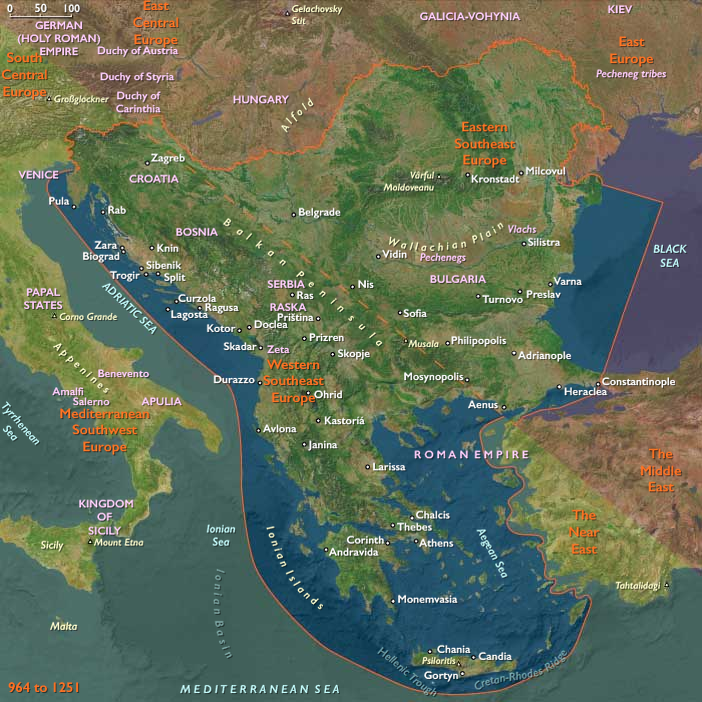
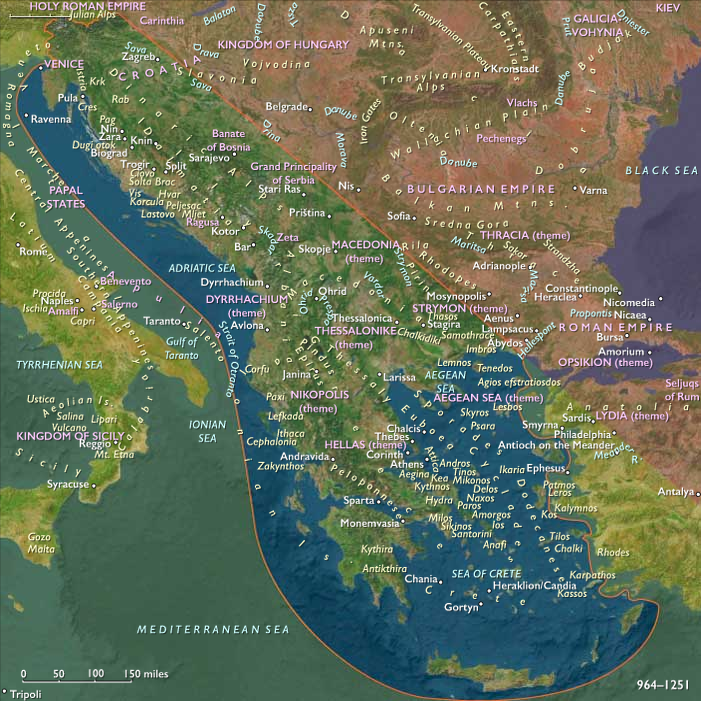
…northern Greece, and northern Bulgaria.
Years: 981 - 981
…northern Greece, and northern Bulgaria.
Locations
People
Groups
- Greeks, Medieval (Byzantines)
- Bulgarians (South Slavs)
- Serbs (South Slavs)
- Roman Empire, Eastern: Macedonian dynasty
- Bulgarian Empire (First)
- Albanians
Topics
Commodoties
Subjects
Regions
Subregions
Related Events
Filter results
Showing 10 events out of 28 total
Stephen V inherits the whole Kingdom of Hungary after his father's death on May 3, 1270, although the deceased senior king had entrusted his daughter, Anna, and his followers to King Ottokar II of Bohemia in his last will, and they had escaped to Prague before Stephen arrived to Esztergom.
Before his (second) coronation, Stephen grants the County of Esztergom to the Archbishop.
To secure foreign support, Stephen forms a double matrimonial alliance with the Angevins, chief partisans of the pope.
The first of these is the marriage, in 1270, of his twelve-year-old daughter Mary to the future King Charles II of Naples.
The second alliance is the marriage of Stephen's infant son, Ladislaus, to Charles II's sister Elisabeth.
Stephen has a meeting in August 1270 with his brother-in-law, Prince Boleslaw V of Poland, in Kraków where they conclude an alliance against the King of Bohemia.
Stephen also has a meeting with Ottokar on October 16 on an island of the Danube near Pozsony, where the two rulers conclude a two-year truce.
War again breaks out between Hungary and Bohemia following smaller skirmishes on the border.
Ottokar II leads his armies against Hungary; Stephen is defeated in two smaller battles, but finally wins a decisive victory on May 21, 1271 over Ottokar’s Czech and Austrian troops.
In the subsequent Peace of Pressburg, the King of Bohemia hands back the fortresses occupied during his campaign, while Stephen renounces his claim to the Hungarian royal treasury that his sister, Anna had taken to Prague after their father's death.
Stephen leaves in the summer of 1272 for Dalmatia, where he plans to meet King Charles I of Sicily, when he is informed that Joachim Gut-Keled had kidnapped his infant son, Ladislaus, and hidden in Koprivnica.
Stephen is planning to raise an army to rescue his infant son when he dies suddenly on August 6.
Charles has introduced feudalism to the Italian south at a time when it is weakening elsewhere.
His oppressive regime is highly unpopular, particularly in Sicily.
A spontaneous outbreak against Angevin rule, possibly fanned by agents provocateurs in the pay of Aragon and Constantinople, begins in Palermo at the time of vespers (evening worship) on Easter Monday, 1282, when some Sicilians attending a church service assault and kill several French soldiers.
who had insulted them The revolt, spreading across the island, results in the massacre, during the night of March 30-31, of about two thousand French inhabitants, almost the entire French population of Sicily.
Roger de Loria, a Sicilian admiral in Aragonese service, is the son of Richard of Lauria, Great Justiciar of the Kingdom of Sicily, and Donna Bella, a nurse of Constance of Hohenstaufen.
His father had served under King Manfred of Sicily; when the last member of that family, Conradin of Swabia, was beheaded at Naples in 1268, he had taken refuge with other Ghibelline exiles at Barcelona, part of the Kingdom of Aragón, with his mother.
Peter III of Aragon, who had married Constance of Hohenstaufen, later made him knight together with Corrado Lancia, who is to be a comrade of Roger in many of his enterprises.
In 1282, Roger had been named commander of the Aragonese fleet, a charge he will retain under Peter's successors James II and Frederick III.
Roger of Lauria had commanded the Aragonese fleet during the campaign to capture Sicily from the Angevins after the Sicilian Vespers revolt in 1282, which made the Aragonese rulers of Sicily.
Charles of Salerno, in the absence of his father Charles I of Naples, had sent the Provençal fleet to relieve the besieged garrison of Malta, which is trapped in the Castello del Mare (the "Castle of the Sea", now known as Fort St. Angelo) in Grand Harbour after the inhabitants of Malta had revolted.
Roger, learning of this, sends his own fleet to support the Maltese.
Arriving at night on July 7-8, 1283,he makes contact with a besieger and sends a sentry boat into the harbor.
It is reported that the Angevin galleys are beached under the castle walls.
Roger moves his galleys into line abreast at the entrance to the harbor, silencing the guard boats in the process, and connects his ships together.
At about dawn, he orders a trumpet challenge to be sounded.
His reason for doing this is not clear.
Perhaps he wanted to show the bravery and boldness of his crews, or to prevent anyone from saying he couldn't have won if the enemy hadn't been asleep, but since he later attacked a sleeping enemy, it would seem that he did it to draw the Angevins out to his prepared position.
It would have been difficult for him to attack in the confines of the harbor, and he would in any event have lost the element of surprise.
Also, beached galleys are almost impossible to defeat in close combat, as they can be continually reinforced from shore.
The Angevin crews rush to launch their galleys, and move out in a disorganized manner.
Roger first deploys his Catalan archers, then closes for hand-to-hand combat.
Angevin commander William Cornut is killed by Roger in single combat when he boarded Roger's flagship, but his co-commander Bartholomew Bonvin breaks through the line with some galleys and escapes.
About ten galleys are captured.

Charles' Genoese allies have collected several large fleets of galleys, and Lauria determines to attack Charles' galleys, which are at Naples, before these can join them and hunt down the Aragonese fleet.
He uses the cover of darkness to arrive off Naples, where he makes several raids ashore to try to tempt Charles of Salerno out where he could be fought.
On the night of June 4, Lauria captures two Provençal galleys sent ahead by Charles' ally and father Charles I of Naples, who is heading south from Genoa.
Charles has definite orders to stay in port and wait for his allies, but his impetuousness overcomes his initial reluctance and after Lauria's galleys approach closely, the Neapolitans come out in single file and chase them in a disorganized manner southward.
Lauria feigns retreat and keeps ahead of them until he draws close to ten or so galleys he had left near Castellammare, then turns and forms a crescent formation, with the galleys that had joined at the rear, and attacks Charles' fleet from the sides, where galleys are the most vulnerable.
Charles' fifteen to eighteen royal galleys flee back to Naples, leaving the nine to thirteen French-crewed galleys to be captured.
Charles' galley is the last to be captured, and surrenders only when Lauria sends divers overboard in order to sink it.
Charles will be kept prisoner until Edward I of England intervenes in 1288.
Palermo had been the capital of the Kingdom of Naples before the accession of Charles of Anjou to the throne of Naples in 1266.
There was a royal residence in Naples, at the Castel Capuano.
However, when the capital was moved to Naples, Charles had ordered a new castle, not far from the sea, built to house the court.
Works directed by French architects began in 1279 and were completed three years later.
Due to the War of the Sicilian Vespers, the new fortress remains uninhabited until 1285, when Charles, who dies on January 7, is succeeded by his son, Charles of Salerno, as Charles II, though the younger Charles is at this time still incarcerated by the Aragonese.
Castel Nuovo will soon become the nucleus of the historical center of the city, and often be the site of famous events.
Charles of Anjou has left his captive son Charles as his natural successor.
Honorius IV, more peaceably inclined than Martin IV, had not renounced the Church's support of the House of Anjou, nor had he set aside the severe ecclesiastical punishments imposed upon Sicily.
On the other hand, he does not approve of the tyrannical government the Sicilians had been subject to under Charles of Anjou.
This is evident from legislation embodied in his constitution of September 17, 1285 (Constitutio super ordinatione regni Siciliae), in which he states that no government can prosper that is not founded on justice and peace.
He passes forty-five ordinances intended chiefly to protect the people of Sicily against their king and his officials.
Years: 981 - 981
Locations
People
Groups
- Greeks, Medieval (Byzantines)
- Bulgarians (South Slavs)
- Serbs (South Slavs)
- Roman Empire, Eastern: Macedonian dynasty
- Bulgarian Empire (First)
- Albanians