
Northeastern North America (820 – 963 CE): …
Years: 820 - 963
Northeastern North America (820 – 963 CE): Norse Pioneers, Woodland Mosaics, and Maize Frontiers
Geographic and Environmental Context
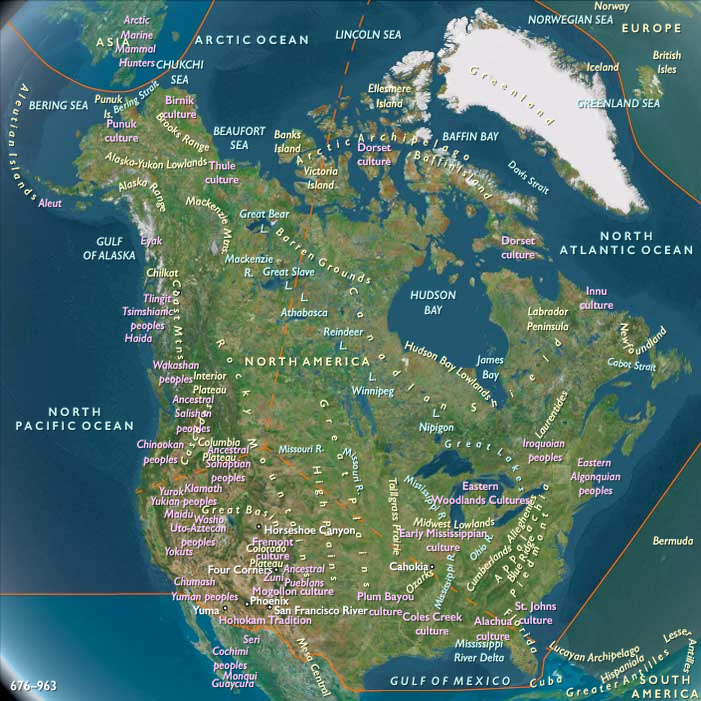
Northeastern North America includes: the Atlantic coast from Jacksonville, Florida to St. John’s, Newfoundland; Greenland; the Canadian Arctic; all Canadian provinces east to the Saskatchewan–Alberta border; and within the U.S., the Old South (Virginia, Carolinas, most of Georgia, northeast Alabama, Tennessee except its southwest), the Appalachian Plateau, the Midwest Lowlands, the Driftless Area, the Tallgrass Prairie, the Big Woods, the Drift Prairie, and the Aspen Parkland.
-
Anchors: the Atlantic seaboard (Charleston, Chesapeake Bay, New York, Boston, Halifax, St. John’s), the Great Lakes (Erie, Ontario, Huron, Michigan, Superior), the Mississippi–Ohio valleys (Cahokia precursor sites, Kentucky–Illinois), the prairie–woodland margins (Iowa, Minnesota, Manitoba), the Canadian Shield and St. Lawrence valley, and Greenland’s coastal fjords.
Climate and Environmental Shifts
-
The Medieval Warm Period lengthened growing seasons, pushing maize agriculture north into the Ohio Valley and toward the Great Lakes.
-
Rich fisheries supported Atlantic and Great Lakes populations; Greenland’s fjords became viable for Norse settlers by the late 10th century.
Societies and Political Developments
-
Woodland cultures: Iroquoian and Algonquian ancestors inhabited the Great Lakes, St. Lawrence, and Atlantic seaboard, blending farming, hunting, and fishing.
-
Old South: Mississippian precursors experimented with maize-centered chiefdoms.
-
Prairie margins: semi-sedentary groups combined bison hunting with riverine farming.
-
Norse Greenland: Erik the Red’s colony (Eastern and Western Settlements) formed late in this age (~985).
-
Arctic: Dorset Paleo-Inuit cultures persisted before Thule migration.
Economy and Trade
-
Maize, beans, squash expanded in the Ohio–Illinois valleys.
-
Copper from Lake Superior, obsidian, shells, and mica circulated via long-distance exchange.
-
Fisheries: cod, herring, and sturgeon in the Atlantic and Great Lakes; seals and walrus in the Arctic.
-
Greenland Norse exported walrus ivory, hides, and furs.
Belief and Symbolism
-
Mound-building (Hopewell–Adena legacies) persisted in the Ohio Valley.
-
Woodland cosmologies emphasized sky beings and earth diver myths.
-
Norse Greenlanders practiced pagan rites, shifting toward Christianity after 1000.
Long-Term Significance
By 963, Northeastern North America was a patchwork of mound-builders, Woodland farmers, and Norse pioneers, with maize advancing, Greenland colonized, and the Arctic awaiting Thule migrations.

Northeastern North America (with civilization) ©2024-25 Electric Prism, Inc. All rights reserved.
Groups
- Mound Builders
- Woodland culture
- Dorset culture
- Mississippian culture
- Norse
- Iroquois (Haudenosaunee, also known as the League of Peace and Power, Five Nations, or Six Nations)
- Algonquin, or Algonkin, people (Amerind tribe)
- Inuit
Topics
Commodoties
- Rocks, sand, and gravel
- Fish and game
- Weapons
- Hides and feathers
- Gem materials
- Colorants
- Oils, gums, resins, and waxes
- Grains and produce
- Ceramics
- Strategic metals
Subjects
Regions
Subregions

Years: 820 - 963
Northeastern North America (with civilization) ©2024-25 Electric Prism, Inc. All rights reserved.
Groups
- Mound Builders
- Woodland culture
- Dorset culture
- Mississippian culture
- Norse
- Iroquois (Haudenosaunee, also known as the League of Peace and Power, Five Nations, or Six Nations)
- Algonquin, or Algonkin, people (Amerind tribe)
- Inuit
Topics
Commodoties
- Rocks, sand, and gravel
- Fish and game
- Weapons
- Hides and feathers
- Gem materials
- Colorants
- Oils, gums, resins, and waxes
- Grains and produce
- Ceramics
- Strategic metals
Subjects
Regions
Subregions