
Northeastern North America (1876 to 1887 …
Years: 1876 - 1887
Northeastern North America
(1876 to 1887 CE): Indigenous Relocation, Industrial Consolidation, Infrastructure Standardization, and Political Evolution
Between 1876 and 1887, Northeastern North America underwent significant transitions in indigenous relations, infrastructure development, industrial growth, and political changes. This era saw the continued reshaping of regional economies, further integration through technological advancements, and notable shifts in governance.
Indigenous Affairs and Relocations
In 1876, Fort Belknap was discontinued, prompting the Gros Ventre and Assiniboine peoples receiving annuities there to relocate to Fort Peck and Wolf Point agencies. While the Assiniboine relocated without objection, the Gros Ventre refused due to tensions with the Sioux, forfeiting their annuities rather than move. The Fort Belknap Agency was reinstated in 1878, allowing the Gros Ventre and remaining Assiniboine to resume receiving supplies at the site.
Industrial Growth and Standardization
Bluestone Industry and Infrastructure
Bluestone continued as a critical construction material, shaping urban architecture and infrastructure. An eighteen-mile road built from bluestone "tracks" supported heavy wagon transport from quarries in villages later submerged by the Ashokan Reservoir, passing through Kingston down to Wilbur on Rondout Creek. Shipments from these areas, notably by entrepreneur Thomas Cornell's barges and tugboats, supplied urban areas like New York City extensively.
Kingston’s sidewalks and curbstones remained almost entirely bluestone, and notable buildings included Kingston's Old Dutch Church, designed by Minard Lefever, constructed from native bluestone blocks. Bluestone was also prominently used in residential architecture, exemplified by Henry Samson's Italian villa on West Chestnut Street.
Continental Time Zones
In this era, U.S. and Canadian railroads introduced five standard continental time zones, resolving confusion from thousands of local timekeeping systems and significantly aiding in transportation coordination and commerce.
Corporate Expansion
Industrial consolidation accelerated notably, with corporations such as Standard Oil becoming the world’s largest company. Trusts emerged to dominate commodities including oil, whiskey, sugar, and lead, signaling a growing concentration of economic power.
Political Evolution
Political transitions marked this period, beginning with Rutherford B. Hayes assuming the presidency in 1877following a contentious election against Democrat Samuel J. Tilden. Subsequent leaders, including short-tenured President James A. Garfield, assassinated in 1881, and his successor Chester A. Arthur, continued to steer national policy amidst rapid societal and economic changes. The facial hair of these presidents, evolving in style and prominence, reflected broader cultural trends of the period.
Legacy of the Era (1876–1887 CE)
The developments between 1876 and 1887 highlighted continuing indigenous struggles, significant technological advancements, economic centralization, and ongoing political shifts, all of which further defined Northeastern North America’s evolving character and historical trajectory.
People
Groups
- Lakota, aka Teton Sioux (Amerind tribe)
- Gros Ventre or “Atsina” people (Amerind tribe)
- Assiniboine people (Amerind tribe)
- United States of America (US, USA) (Washington DC)
- Standard Oil
- Standard Oil Trust
Topics
Commodoties
Subjects
- Commerce
- Writing
- Painting and Drawing
- Public health
- Conflict
- Faith
- Government
- Custom and Law
- Catastrophe
Regions
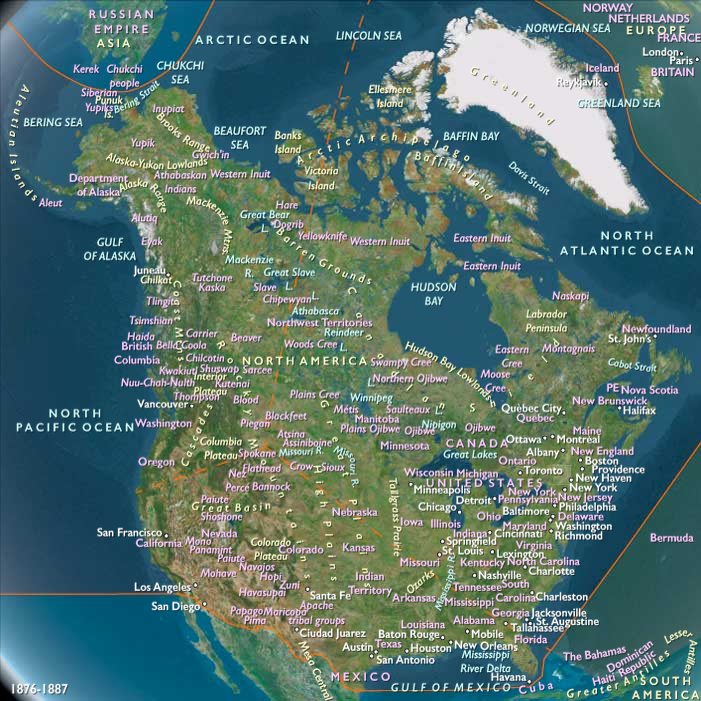
Subregions
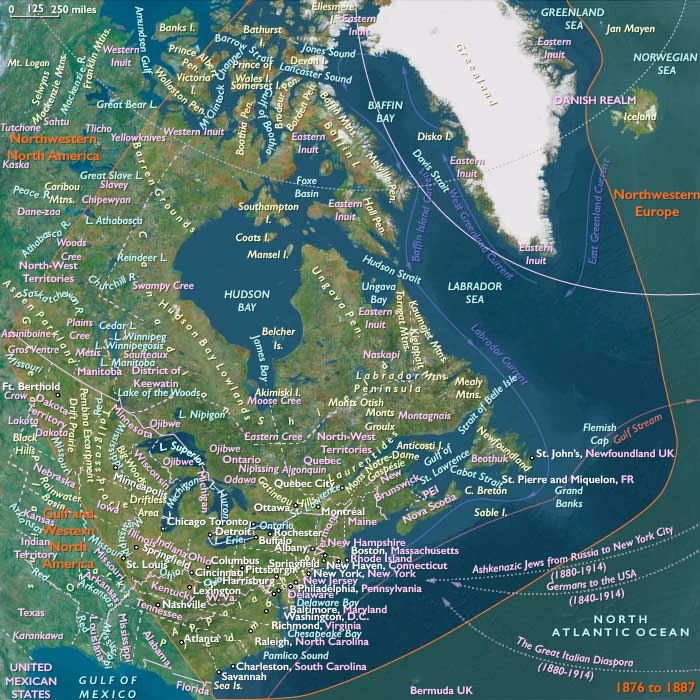
Years: 1876 - 1887
People
Groups
- Lakota, aka Teton Sioux (Amerind tribe)
- Gros Ventre or “Atsina” people (Amerind tribe)
- Assiniboine people (Amerind tribe)
- United States of America (US, USA) (Washington DC)
- Standard Oil
- Standard Oil Trust
Topics
Commodoties
Subjects
- Commerce
- Writing
- Painting and Drawing
- Public health
- Conflict
- Faith
- Government
- Custom and Law
- Catastrophe
Regions
Subregions