
Northeastern North America (1852 to 1863 …
Years: 1852 - 1863
Northeastern North America
(1852 to 1863 CE): Epidemics, Industrial Expansion, Cultural Flourishing, and the American Civil War
From 1852 to 1863, Northeastern North America faced severe public health crises, rapid industrial expansion, significant cultural achievements, and intensifying national tensions culminating in the American Civil War. This era witnessed serious epidemics, urban growth, booming industrial activities, and the peak of artistic movements, all occurring amid escalating debates over slavery, states' rights, and national identity.
Epidemics and Public Health
Cholera and Typhus Epidemics
In 1854, a severe outbreak of cholera struck Chicago, resulting in about thirty-five hundred deaths, around five and a half percent of the city's population. Cholera also devastated New York, exacerbated by crowded conditions due to a major influx of Irish immigrants. Concurrently, a typhus epidemic originating in 1837 continued into the 1840s and 1850s, killing thousands of Irish immigrants in Canada, who had fled the Great Irish Famine aboard overcrowded ships.
Industrial and Economic Expansion
Bluestone Industry Flourishes
The bluestone industry reached new heights, with extensive usage for sidewalks, curbstones, building foundations, and architectural adornments in cities such as New York and Kingston. Shipped from significant distribution points like Rondout and Malden on barges and tugboats owned by entrepreneur Thomas Cornell, bluestone became a defining feature of urban infrastructure. Notably, Kingston’s sidewalks and curbstones were predominantly made from bluestone. Architectural landmarks such as Kingston's Old Dutch Church, designed by Minard Lefever and built between 1850 and 1852, and an Italian villa constructed in 1858 by leather tanning entrepreneur Henry Samson on West Chestnut Street, exemplified the widespread architectural use of this distinctive stone.
Ice Harvesting and Brick Manufacturing
Ice harvesting along the Hudson River expanded, providing year-round ice preserved in straw-insulated warehouses for critical refrigeration in communities like Rondout, Kingston, and Wilbur. Simultaneously, large-scale brick manufacturing factories near these shipping hubs further strengthened local economies.
Indigenous Trade and Relations
Arapaho Trade Networks
The Arapaho actively traded with farming villages of the Arikara, Mandan, and Hidatsa along the upper Missouri River, exchanging meat and hides for corn, squash, and beans. Known as the "Colored Stone Village People" by the Arikara, possibly due to gemstones from the Southwest among traded items, and as E-tah-leh or Ita-Iddi ("bison-path people") by the Hidatsa, the Arapaho played a critical role in regional indigenous economies and relations.
Artistic and Cultural Peak
Hudson River School
The Hudson River School of painting reached its artistic zenith during this period, profoundly influencing American culture and aesthetics. Led by artists such as John Frederick Kensett, George Inness, Asher B. Durand, Thomas Doughty, Jasper Cropsey, Sanford Robinson Gifford, and Frederick Edwin Church, the school was deeply inspired by Romanticism. Paintings from this period captured sublime landscapes of the Hudson River Valley, Catskill Mountains, Adirondack Mountains, and White Mountains of New Hampshire, emphasizing themes of exploration, settlement, and harmonious coexistence with nature.
Rising Tensions and the American Civil War
Political and Social Struggles
Tensions over slavery intensified, driven by abolitionist activism and political debates over states' rights. Radical abolitionists like William Lloyd Garrison, publisher of The Liberator, and former slave Frederick Douglass, who published the influential newspaper North Star, heightened public awareness and resistance against slavery. These debates significantly polarized American society.
Outbreak of the Civil War
By 1861, conflicts between Northern free states and Southern slave states erupted into the American Civil War, fundamentally altering the nation. The Northeast mobilized extensive resources, both industrial and human, contributing significantly to Union efforts. The war demanded major shifts in manufacturing, infrastructure, and transportation, laying foundations for future industrialization and urbanization.
Legacy of the Era (1852–1863 CE)
From 1852 to 1863, Northeastern North America navigated an era defined by industrial growth, severe public health crises, cultural expression, and the deep national trauma of the Civil War. These events profoundly shaped the region's economy, culture, and social structure, with legacies that would influence American identity for generations.
People
- Abraham Lincoln
- Asher Brown Durand
- Franklin Pierce
- Frederic Edwin Church
- Frederick Douglass
- George Inness
- Henry David Thoreau
- J. M. W. Turner
- James K. Polk
- Jasper Francis Cropsey
- John Frederick Kensettt
- Paul Weber
- Ralph Waldo Emerson
- Sanford Robinson Gifford
- Thomas Doughty
- William Lloyd Garrison
Groups
- Hidatsa people (Amerind tribe)
- Arapaho people (Amerind tribe)
- Arikara people (Amerind tribe)
- Mandan (Amerind tribe)
- New Hampshire, State of (U.S.A.)
- New York State (U.S.A.)
- United States of America (US, USA) (Washington DC)
- Illinois, State of (U.S.A.)
- Canada, Province of
- Canada, Province of
- Canada, Province of
- Canada, Province of
Topics
- Middle Subatlantic Period
- Little Ice Age (LIA)
- Highland Clearances
- Great Awakening, Second
- Party System, Second (United States)
- Literature: 1828 to 1972
- Little Ice Age, Warm Phase IV
- Western Art: Romanticism
- cholera pandemic, 1846-1860
- American Civil War (War between the States, War of the Rebellion, War of Secession, War for Southern Independence)
- cholera pandemic, 1863–1875
Commodoties
Subjects
- Commerce
- Writing
- Painting and Drawing
- Public health
- Conflict
- Faith
- Government
- Custom and Law
- Catastrophe
Regions
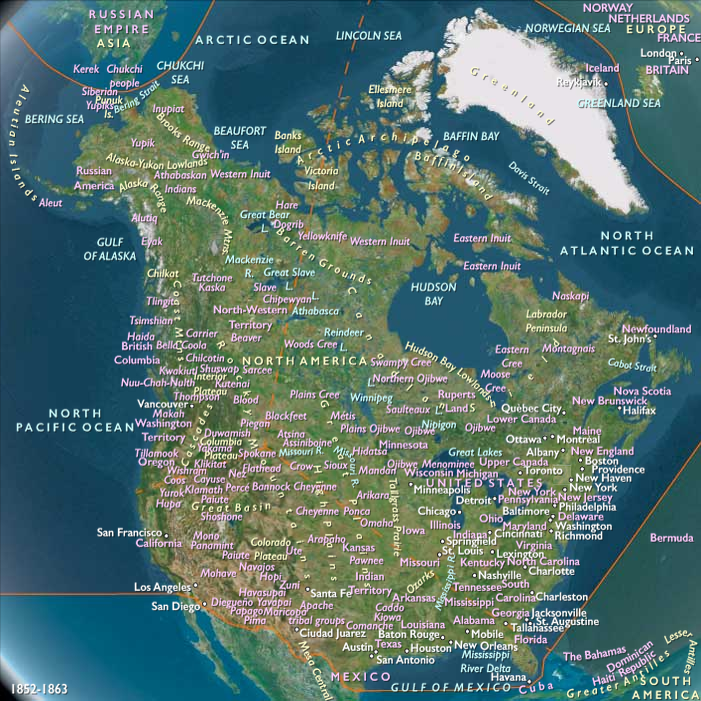
Subregions
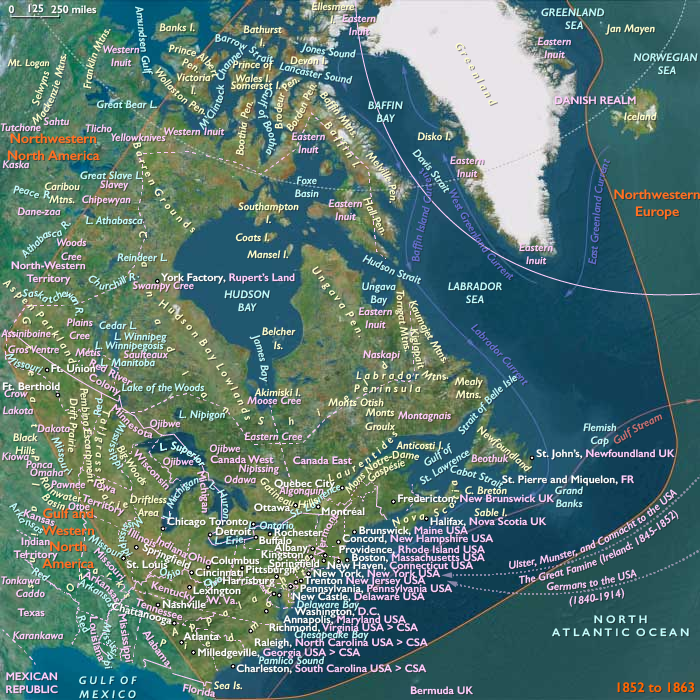
Years: 1852 - 1863
People
- Abraham Lincoln
- Asher Brown Durand
- Franklin Pierce
- Frederic Edwin Church
- Frederick Douglass
- George Inness
- Henry David Thoreau
- J. M. W. Turner
- James K. Polk
- Jasper Francis Cropsey
- John Frederick Kensettt
- Paul Weber
- Ralph Waldo Emerson
- Sanford Robinson Gifford
- Thomas Doughty
- William Lloyd Garrison
Groups
- Hidatsa people (Amerind tribe)
- Arapaho people (Amerind tribe)
- Arikara people (Amerind tribe)
- Mandan (Amerind tribe)
- New Hampshire, State of (U.S.A.)
- New York State (U.S.A.)
- United States of America (US, USA) (Washington DC)
- Illinois, State of (U.S.A.)
- Canada, Province of
- Canada, Province of
- Canada, Province of
- Canada, Province of
Topics
- Middle Subatlantic Period
- Little Ice Age (LIA)
- Highland Clearances
- Great Awakening, Second
- Party System, Second (United States)
- Literature: 1828 to 1972
- Little Ice Age, Warm Phase IV
- Western Art: Romanticism
- cholera pandemic, 1846-1860
- American Civil War (War between the States, War of the Rebellion, War of Secession, War for Southern Independence)
- cholera pandemic, 1863–1875
Commodoties
Subjects
- Commerce
- Writing
- Painting and Drawing
- Public health
- Conflict
- Faith
- Government
- Custom and Law
- Catastrophe
Regions
Subregions