
Northeastern North America (1840 to 1851 …
Years: 1840 - 1851
Northeastern North America
(1840 to 1851 CE): Epidemics, Industrial Development, and Social Reform
From 1840 to 1851, Northeastern North America experienced severe health crises, significant industrial expansion, transformative immigration patterns, and dynamic social and cultural movements. This era was characterized by devastating epidemics, burgeoning industries, powerful intellectual and artistic movements, and growing anti-slavery activism.
Epidemics and Public Health Crises
Cholera and Typhus Epidemics
In the early 1840s, cholera killed thousands in New York, a major destination for Irish immigrants. In 1843, a typhus epidemic originating from an earlier outbreak in Philadelphia claimed the life of the son of Franklin Pierce, future fourteenth President of the United States, in Concord, New Hampshire. Another severe typhus epidemic, from 1847 to 1848, resulted in more than twenty thousand deaths in Canada, primarily among Irish immigrants fleeing the Great Irish Famine. These immigrants contracted the disease aboard crowded "coffin ships," and health officials, unaware of effective sanitation and disease prevention methods, quarantined victims ineffectively. Additionally, the cholera outbreak of 1849–1850 claimed the life of former U.S. President James K. Polk in Nashville.
Industrial and Economic Growth
Bluestone Industry
The bluestone industry in Ulster County, New York, began with Silas Brainard recognizing the industrial potential of this deep-blue sandstone in the 1840s. By 1850, the local bluestone industry had become well-established, with significant quarries in Sawkill and Hurley, and major shipment points in Wilbur on the Rondout Creek and Malden on the Hudson. Bluestone from Wilbur, also known as Twaalfskill, notably paved the sidewalks of New York City. Before its commercial development, bluestone was utilized by natives and early settlers for tools and practical items such as chicken troughs, chimney caps, and tombstones.
Ice Harvesting and Brick Manufacturing
Ice harvesting continued to thrive along the Hudson River, with ice blocks preserved year-round in warehouses insulated with straw, serving as a rudimentary form of refrigeration for local communities including Rondout, Kingston, and Wilbur. Concurrently, large brick-making factories emerged near these shipping hubs, complementing the growing local economy.
Immigration and Canadian Developments
Irish and Scottish Immigration
Immigration resumed significantly after the War of 1812, with over nine hundred and sixty thousand arrivals from Britain to Canada between 1815 and 1850. These included refugees from the Great Irish Famine and Gaelic-speaking Scots displaced by the Highland Clearances. The influx of these immigrants deeply affected the demographic and cultural landscape of Canada and Northeastern United States.
Canadian Political Union
The Act of Union in 1841 merged Upper and Lower Canada into the Province of Canada, establishing responsible government across British North America by 1849. This union aimed to stabilize political tensions and foster more coherent governance, following earlier rebellions and demands for reform.
Social Reform and Abolitionism
Abolitionist Movement
The abolitionist movement intensified during this period, particularly under influential figures such as William Lloyd Garrison, who published the radical anti-slavery newspaper The Liberator, and Frederick Douglass, who began writing for Garrison’s newspaper around 1840 before founding his own abolitionist paper, North Star, in 1847. While radicals like Garrison considered slavery a sin demanding immediate eradication, moderate abolitionists, including future president Abraham Lincoln, regarded slavery as a regrettable social evil rather than a religious transgression.
Transcendentalist Movement
The Transcendentalist movement, led by Ralph Waldo Emerson, emphasized personal freedom, individualism, and a belief in the inherent goodness of people. Influenced by Romantic ideals, Transcendentalists sought to reconcile individual spirituality with empirical scientific understanding, profoundly shaping American thought and culture.
Artistic and Cultural Developments
Hudson River School
The Hudson River School of painting flourished, reflecting themes of discovery, exploration, and settlement, and depicting the American landscape as a harmonious pastoral setting where humans and nature coexist peacefully. These artists, inspired by European masters such as Claude Lorrain, John Constable, and J.M.W. Turner, portrayed nature as a divine manifestation, capturing both the idyllic agricultural landscapes and rapidly disappearing wilderness. Their work complemented contemporary literary voices like Henry David Thoreau and Ralph Waldo Emerson.
Artists associated with the Hudson River School, such as members trained under the Düsseldorf school of painting and German painter Paul Weber, often composed their scenes from multiple observations made during arduous travels, creating realistic yet idealized landscapes.
Legacy of the Era (1840–1851 CE)
From 1840 to 1851, Northeastern North America navigated a transformative period defined by devastating epidemics, significant industrial and economic developments, dynamic immigration, robust abolitionist and reform movements, and profound artistic and intellectual achievements. These developments reshaped the region's cultural and social identity, set the stage for intensified sectional tensions, and further entrenched industrialization as a defining feature of American society.
People
- Abraham Lincoln
- Franklin Pierce
- Frederick Douglass
- Henry David Thoreau
- J. M. W. Turner
- James K. Polk
- Paul Weber
- Ralph Waldo Emerson
Groups
- Irish people
- Scottish people
- Scotland
- Pennsylvania, Commonwealth of (U.S.A.)
- New Hampshire, State of (U.S.A.)
- New York State (U.S.A.)
- Canada, Lower, (British province)
- Canada, Upper, (British province)
- Tennessee, State of (U.S.A.)
- United States of America (US, USA) (Washington DC)
- Britain (United Kingdom of Great Britain and Ireland)
- Canada, Province of
- Canada, Province of
- Canada, Province of
Topics
- Middle Subatlantic Period
- Little Ice Age (LIA)
- Highland Clearances
- Great Awakening, Second
- Party System, Second (United States)
- Literature: 1828 to 1972
- Little Ice Age, Warm Phase IV
- Western Art: Romanticism
- Great Irish Famine of 1845-49
- cholera pandemic, 1846-1860
Commodoties
Subjects
- Commerce
- Writing
- Painting and Drawing
- Public health
- Conflict
- Faith
- Government
- Custom and Law
- Catastrophe
- Finance
Regions
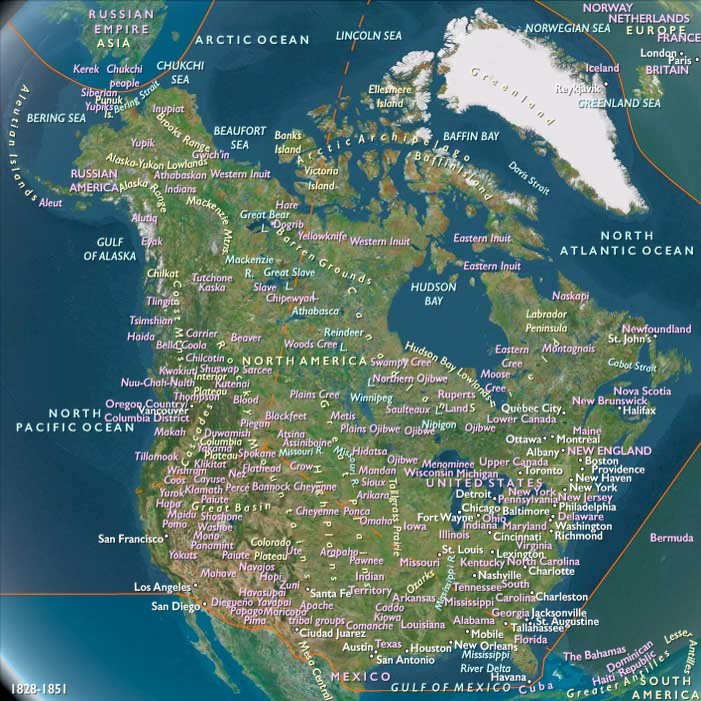
Subregions
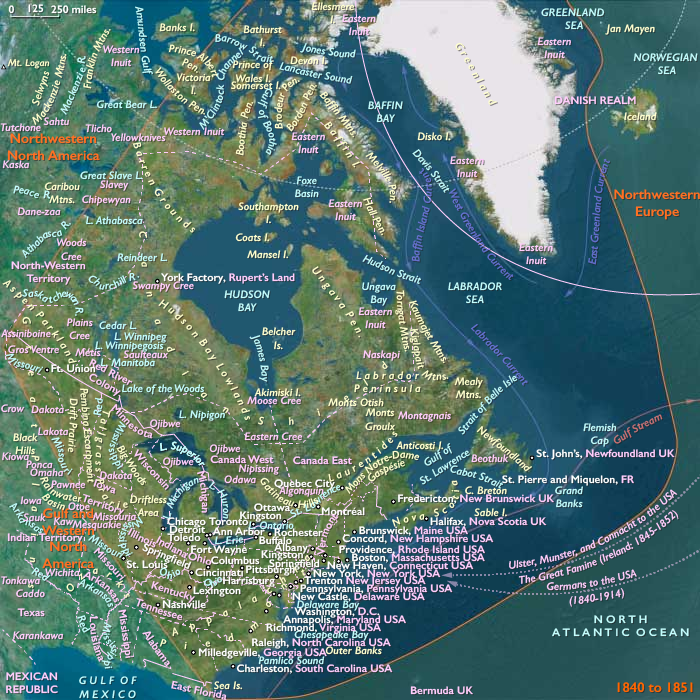
Years: 1840 - 1851
People
- Abraham Lincoln
- Franklin Pierce
- Frederick Douglass
- Henry David Thoreau
- J. M. W. Turner
- James K. Polk
- Paul Weber
- Ralph Waldo Emerson
Groups
- Irish people
- Scottish people
- Scotland
- Pennsylvania, Commonwealth of (U.S.A.)
- New Hampshire, State of (U.S.A.)
- New York State (U.S.A.)
- Canada, Lower, (British province)
- Canada, Upper, (British province)
- Tennessee, State of (U.S.A.)
- United States of America (US, USA) (Washington DC)
- Britain (United Kingdom of Great Britain and Ireland)
- Canada, Province of
- Canada, Province of
- Canada, Province of
Topics
- Middle Subatlantic Period
- Little Ice Age (LIA)
- Highland Clearances
- Great Awakening, Second
- Party System, Second (United States)
- Literature: 1828 to 1972
- Little Ice Age, Warm Phase IV
- Western Art: Romanticism
- Great Irish Famine of 1845-49
- cholera pandemic, 1846-1860
Commodoties
Subjects
- Commerce
- Writing
- Painting and Drawing
- Public health
- Conflict
- Faith
- Government
- Custom and Law
- Catastrophe
- Finance
Regions
Subregions