
Northeastern North America (1804 to 1815 …
Years: 1804 - 1815
Northeastern North America
(1804 to 1815 CE): Exploration, Conflict, and Emerging National Identity
The years 1804 to 1815 in Northeastern North America marked an era of pivotal exploration, territorial expansion, intense conflicts, and significant developments shaping American national identity. During this period, Americans eagerly pursued westward expansion, leading to prolonged conflicts known as the American Indian Wars, while the Louisiana Purchase of 1803 nearly doubled the nation's size. Intensified slavery, frontier settlement, and evolving political landscapes also characterized this era, culminating in the War of 1812, a conflict that strengthened American nationalism despite its ambiguous conclusion.
Landmark Western Exploration
Lewis and Clark Expedition (1804–1806)
Following the Louisiana Purchase (1803), championed by the third U.S. president, Thomas Jefferson, the historic expedition led by Meriwether Lewis and William Clark, known as the Corps of Discovery, explored territories west of the Mississippi River. Their journey to the Pacific Ocean and back significantly expanded geographic and scientific understanding of the continent.
Zebulon Pike’s Explorations (1805–1807)
Explorer Zebulon Pike simultaneously conducted extensive explorations, mapping the Upper Mississippi River region and the southern parts of the newly acquired Louisiana Territory, enhancing U.S. knowledge of its expanding frontier.
Frontier Settlement and Westward Expansion
The Louisiana Purchase encouraged a vast wave of American settlers to push westward beyond the Appalachians. The frontier reached the Mississippi River by 1800, and new states such as Ohio (1803) were rapidly admitted into the Union. Settlements expanded into the Ohio Country, the Indiana Territory, and the lands of the lower Mississippi valley, particularly around St. Louis, which, after 1803, became a major gateway to the West. Americans enthusiastically pursued opportunities in new territories, sparking tensions and conflict with indigenous peoples.
In South Carolina, the antebellum economy flourished, particularly through cotton cultivation after Eli Whitney's invention of the cotton gin in 1793. Though nominally democratic, South Carolina remained tightly controlled by a powerful planter elite, with strict property and slaveholding requirements limiting political participation to wealthy landowners.
War of 1812 and Its Impacts
Causes and Conflicts
The U.S. declared war against Great Britain in 1812, motivated by grievances such as impressment of American sailors, trade restrictions, and Britain's support for Native American resistance. Prominent Federalist leaders, including Boston-based politician Harrison Gray Otis, strongly opposed the war, advocating states' rights at the Hartford Convention (1814).
Combat and Indigenous Alliances
Intense battles occurred along the Canadian-American frontier. Native leaders like Tecumseh allied with Britain, resisting American westward expansion until Tecumseh's defeat and death at the Battle of the Thames (1813). The war saw notable events such as the British burning of Washington D.C. (1814) and the failed British assault on Baltimore, immortalized by Francis Scott Key's poem "The Star-Spangled Banner."
Conclusion and National Identity
Ending in stalemate with the Treaty of Ghent (1814), the war nonetheless bolstered U.S. nationalism and confirmed the nation's resilience. The final American victory at the Battle of New Orleans (January 1815) elevated Andrew Jackson as a national hero.
Social, Economic, and Cultural Developments
Expansion of Slavery and Southern Economy
Despite the ideals of liberty proclaimed in the American Revolution, slavery expanded dramatically in the Deep South. Following the failed Gabriel’s Rebellion (1800) in Virginia, Southern planters imposed even harsher controls on enslaved people. By 1810, South Carolina had a large enslaved population—nearly half of its residents—essential for its thriving cotton economy. Powerful merchant families, such as the Boston-based Cabots and Perkins, continued amassing wealth through shipping and involvement in slave-related trade, exemplifying the complex intersections of commerce, slavery, and politics.
Religious Revival and Frontier Culture
The Second Great Awakening profoundly influenced frontier society, encouraging evangelical Protestant revivals, camp meetings, and increased participation in denominations like Baptists and Methodists. Large camp meetings, including the famous gathering at Cane Ridge, Kentucky (1801), energized religious life and social reform movements.
Jeffersonian Democracy and Early Political Developments
Thomas Jefferson, a leading advocate for individual liberty and separation of church and state, profoundly shaped U.S. politics in the early 1800s. Serving as president from 1801 to 1809, he oversaw the Louisiana Purchase, which significantly expanded the nation's territory. Despite advocating democratic ideals, Jefferson himself exemplified contradictions: he was an eloquent champion of freedom who remained economically reliant on enslaved labor at his plantation home, Monticello, and was likely father to several children with Sally Hemings, an enslaved African-American woman.
Jefferson and his successor, James Madison (1809–1817)—both clean-shaven like their predecessors, Washington and Adams—oversaw the complex diplomatic tensions and conflicts culminating in the War of 1812.
Domestic Turmoil and Conspiracy
During this era, internal U.S. affairs were unsettled. The Spanish withdrawal of the American “right of deposit” at New Orleans (1802) escalated tensions, fueling discussions of war. The controversial third vice-president, Aaron Burr, became embroiled in scandal, allegedly conspiring in 1805–1807 to foment secession in the western territories alongside General James Wilkinson. Although his conspiracy remains debated among historians, it highlighted the fragility of national unity during this period.
International Commerce and Opium Trade
Prominent American merchant families such as the Cabots of Boston continued to build fortunes through shipping, privateering, and participation in the Triangular Trade involving enslaved Africans. Samuel Cabot Jr., through marriage to Eliza Perkins, daughter of merchant king Colonel Thomas Perkins, expanded family wealth by engaging in controversial opium trade with China via British smugglers, highlighting the far-reaching commercial interests of prominent American families during this period.
Additionally, major institutions like Brown University began confronting the economic legacy of slavery, addressing their involvement in slave trading as well as their complex roles in the nation’s commercial and academic development.
Native American Realignment and the American Indian Wars
American eagerness for westward expansion led to escalating violence and displacement of indigenous peoples. During the War of 1812, some Native tribes allied with the British as a strategy against American expansion. However, the defeat of Native coalitions severely weakened resistance, enabling accelerated settler encroachment on indigenous territories. Tribes like the Mandan, Assiniboine, and Crow faced ongoing conflicts, devastating epidemics, and the pressures of expanding American settlements.
Legacy of the Era (1804–1815 CE)
From 1804 to 1815, Northeastern North America witnessed transformative developments shaping national identities, geopolitical alignments, and social structures. The era was defined by dramatic territorial growth through the Louisiana Purchase, intense frontier conflict, expanded slavery, profound religious awakenings, and political controversies. While the War of 1812 tested American resilience, it ultimately strengthened the nation's identity. Simultaneously, the persistence and expansion of slavery deepened social divisions that would have profound consequences for decades to follow.
People
- Aaron Burr
- Andrew Jackson
- Anthony Wayne
- Arthur St. Clair
- Daniel Boone
- Eli Whitney
- Francis Scott Key
- Harrison Gray Otis
- James Madison
- James Wilkinson
- Meriwether Lewis
- Tecumseh
- Tenskwatawa
- Thomas Handasyd Perkins
- Thomas Jefferson
- William Clark
- Zebulon Pike
Groups
- Assiniboine people (Amerind tribe)
- Mandan (Amerind tribe)
- Crow people, aka Absaroka or Apsáalooke (Amerind tribe)
- Protestantism
- France, (Bourbon) Kingdom of
- Ohio Country
- Baptists
- Illinois Country
- Spain, Bourbon Kingdom of
- Britain, Kingdom of Great
- Nova Scotia (British Colony)
- Hudson's Bay Company (HBC)
- Methodists
- Pennsylvania, Commonwealth of (U.S.A.)
- Virginia, Commonwealth of (U.S.A.)
- North Carolina, State of (U.S.A.)
- North West Company
- Massachusetts, Commonwealth of (U.S.A.)
- New Brunswick, British colony of
- Northwest Territory (U.S.A.)
- South Carolina, State of (U.S.A.)
- Canada, Upper, (British province)
- Canada, Lower, (British province)
- Kentucky, Commonwealth of (U.S.A.)
- Tennessee, State of (U.S.A.)
- Mississippi, Territory of (U.S.A.)
- United States of America (US, USA) (Washington DC)
- Indiana, Territory of (U.S.A.)
- Louisiana (French colony)
- Louisiana, District of (U.S.A.)
- Ohio, State of (U.S.A.)
- Orleans, Territory of (U.S.A.)
- Louisiana, Territory of (U.S.A.)
- Illinois, Territory of (U.S.A.)
- Missouri, Territory of (U.S.A.)
- Louisiana, State of (U.S.A.)
Topics
- Middle Subatlantic Period
- Little Ice Age (LIA)
- North American Fur Trade
- Great Awakening, Second
- Burr conspiracy
- Tecumseh's War
- 1812, War of
- Thames, Battle of the
- New Orleans, Battle of
Commodoties
Subjects
- Commerce
- Public health
- Conflict
- Mayhem
- Faith
- Government
- Scholarship
- Custom and Law
- Catastrophe
- Human Migration
Regions
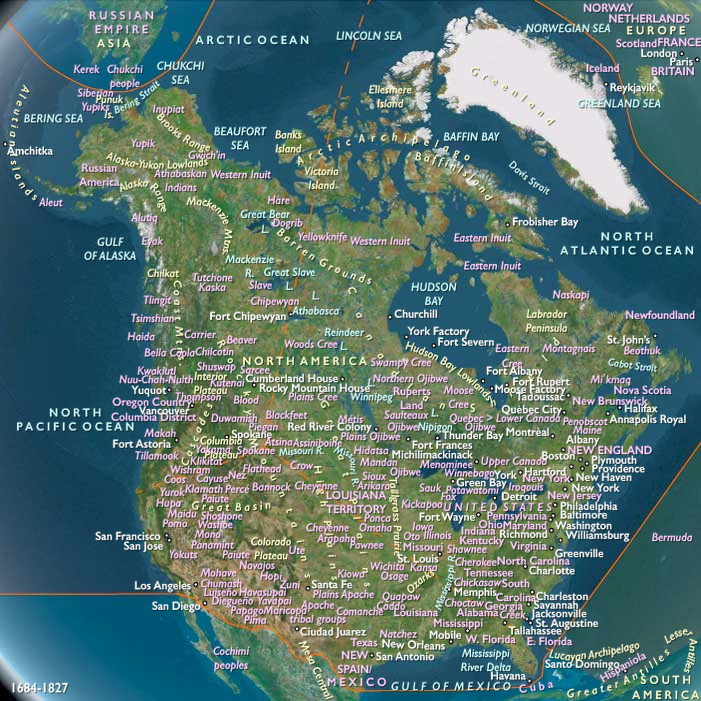
Subregions
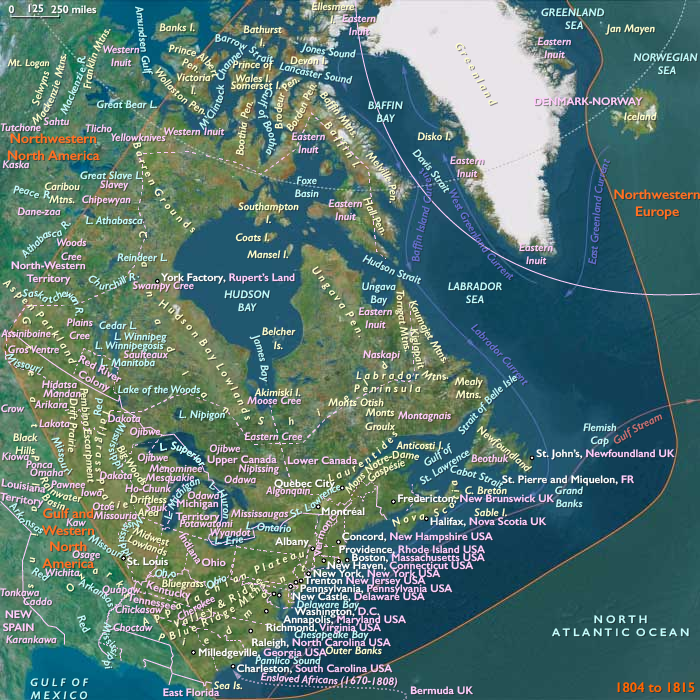
Related Events
Showing 10 events out of 13 total
Years: 1804 - 1815
People
- Aaron Burr
- Andrew Jackson
- Anthony Wayne
- Arthur St. Clair
- Daniel Boone
- Eli Whitney
- Francis Scott Key
- Harrison Gray Otis
- James Madison
- James Wilkinson
- Meriwether Lewis
- Tecumseh
- Tenskwatawa
- Thomas Handasyd Perkins
- Thomas Jefferson
- William Clark
- Zebulon Pike
Groups
- Assiniboine people (Amerind tribe)
- Mandan (Amerind tribe)
- Crow people, aka Absaroka or Apsáalooke (Amerind tribe)
- Protestantism
- France, (Bourbon) Kingdom of
- Ohio Country
- Baptists
- Illinois Country
- Spain, Bourbon Kingdom of
- Britain, Kingdom of Great
- Nova Scotia (British Colony)
- Hudson's Bay Company (HBC)
- Methodists
- Pennsylvania, Commonwealth of (U.S.A.)
- Virginia, Commonwealth of (U.S.A.)
- North Carolina, State of (U.S.A.)
- North West Company
- Massachusetts, Commonwealth of (U.S.A.)
- New Brunswick, British colony of
- Northwest Territory (U.S.A.)
- South Carolina, State of (U.S.A.)
- Canada, Upper, (British province)
- Canada, Lower, (British province)
- Kentucky, Commonwealth of (U.S.A.)
- Tennessee, State of (U.S.A.)
- Mississippi, Territory of (U.S.A.)
- United States of America (US, USA) (Washington DC)
- Indiana, Territory of (U.S.A.)
- Louisiana (French colony)
- Louisiana, District of (U.S.A.)
- Ohio, State of (U.S.A.)
- Orleans, Territory of (U.S.A.)
- Louisiana, Territory of (U.S.A.)
- Illinois, Territory of (U.S.A.)
- Missouri, Territory of (U.S.A.)
- Louisiana, State of (U.S.A.)
Topics
- Middle Subatlantic Period
- Little Ice Age (LIA)
- North American Fur Trade
- Great Awakening, Second
- Burr conspiracy
- Tecumseh's War
- 1812, War of
- Thames, Battle of the
- New Orleans, Battle of
Commodoties
Subjects
- Commerce
- Public health
- Conflict
- Mayhem
- Faith
- Government
- Scholarship
- Custom and Law
- Catastrophe
- Human Migration
Regions
Subregions