
Northeastern North America (1780 to 1791 …
Years: 1780 - 1791
Northeastern North America
(1780 to 1791 CE): Decisive Struggles, Frontier Expansion, and Indigenous Repercussions
The era 1780 to 1791 in Northeastern North America witnessed the decisive conclusion of the American Revolutionary War, the formation of the United States under a new Constitution, critical territorial reorganization in British Canada, and profound impacts on indigenous nations throughout the region. This period was marked by shifting frontiers, postwar migrations, severe epidemic outbreaks, and significant social, economic, and political restructuring.
Final Years of the Revolutionary War
Southern Campaigns and British Defeat
From 1780, the conflict in the southern colonies intensified, especially in South Carolina, where warfare devastated the region. British forces captured Charleston (May 1780), securing their largest victory of the war. However, guerrilla leaders like Francis Marion ("Swamp Fox"), Thomas Sumter, and Andrew Pickens conducted relentless raids against British and Loyalist forces. The decisive American victories at Kings Mountain (1780) and Cowpens (1781) turned the tide, culminating in British General Cornwallis’s surrender at Yorktown (October 1781).
Treaty of Paris (1783) and Territorial Reconfigurations
Recognition of American Independence
The Treaty of Paris (1783) formally recognized the independence of the United States, ceding all British claims east of the Mississippi River (except Florida, returned to Spain). This significantly reshaped the geopolitical landscape.
Indigenous Exclusion and Continuing Tensions
Indigenous nations were excluded from the treaty, leaving territorial claims unresolved. Tribes allied with Britain—such as parts of the Iroquois Confederacy and the Cherokee—suffered severe repercussions, including major land losses.
Westward Expansion and Frontier Hardships
Movement West of the Appalachians
As soon as the war ended in 1781, a significant westward migration originated in Pennsylvania, Virginia, and North Carolina, rapidly extending beyond the Appalachian Mountains. Early settlers initially relied on hunting abundant deer, turkeys, and other game for survival. Gradually, livestock—hogs, sheep, cattle, and horses—became commonplace. Primitive lean-to shelters gave way to one-room log cabins, animal-skin clothing was replaced by homespun garments, and rudimentary farming communities took shape.
The restless pioneer ethos prompted continual westward movement, as settlers periodically uprooted themselves to establish new settlements fifty or a hundred miles further into the wilderness.
The Wilderness Road and Kentucky Settlements
The Wilderness Road, pioneered by Daniel Boone, became a primary corridor for settlers moving into Kentucky. Despite its steepness and rough conditions, traversable only by foot or horseback, thousands poured into Kentucky after 1783. Violent indigenous resistance was frequent; in 1784 alone, Native American warriors killed over one hundred travelers along the route. Among them was the grandfather of future president Abraham Lincoln, who was killed and scalped near Louisville in 1784.
In 1788, settlers founded Marietta, Ohio, the first permanent American settlement in the Northwest Territory, heralding further settlement west of the Appalachians.
Devastating Epidemics Among Plains Tribes
The Smallpox Epidemic of 1781
A devastating smallpox epidemic, originating in Mexico City (1779–1780), slowly traveled northward along indigenous trade routes, reaching the Northern Plains in 1781. Nations such as the Comanche, Shoshone, Mandan, and Hidatsa were severely affected.
The Mandan suffered catastrophic losses; their thirteen clans were reduced to only seven, losing three clan lineages altogether. Subsequently, survivors moved north approximately twenty-five miles and consolidated into two villages on opposite banks of the Missouri River, where remnants of the similarly devastated Hidatsa joined them for mutual defense. Raids by the Lakota Sioux and Crow warriors during and after the epidemic exacerbated their vulnerability.
Indigenous Resistance in the Northwest Territory
Following American independence, increased settlement in the Ohio Country (the newly designated Northwest Territory) triggered violent resistance by indigenous coalitions, including the Miami Confederacy and Shawnee, under leaders such as Little Turtle and Blue Jacket. They inflicted severe defeats upon American forces, culminating in St. Clair’s Defeat (1791), highlighting ongoing indigenous opposition to American expansion.
Shays' Rebellion and Constitutional Reform
Economic Instability and Shays' Rebellion (1786–1787)
Post-revolutionary economic prosperity quickly devolved into severe depression, characterized by widespread debt, delinquent taxes, and foreclosures. In Massachusetts, economic desperation erupted into violent protests known as Shays’ Rebellion, led by farmers against oppressive courts and debt imprisonment. The rebellion exposed critical weaknesses in the Articles of Confederation, notably the federal government's inability to regulate commerce or enforce taxation, galvanizing calls for governmental reform.
U.S. Constitution (1787–1791)
The Philadelphia Convention (1787) drafted the U.S. Constitution to address these governance issues, establishing a robust federal government divided into three branches. Ratified in 1788, the new government took effect with George Washington’s inauguration in 1789, followed by the adoption of the Bill of Rights (1791).
British Canada and Loyalist Migrations
Tens of thousands of Loyalists fleeing revolutionary persecution reshaped British-controlled Canada, prompting Britain to create New Brunswick from Nova Scotia (1784) and split Quebec into English-speaking Upper Canada and French-speaking Lower Canada in 1791, granting each an elected legislative assembly.
Northern Indigenous Societies and Economic Networks
Mandan and Plains Economies
The Mandan continued to prosper economically despite severe population losses. As key intermediaries in the fur and horse trade along the Upper Missouri River, they skillfully navigated commerce with competing European and American traders, solidifying their central role in regional trade networks despite ongoing threats from more militarized Plains nations.
Greenland Settlements and Epidemics
In Greenland’s Egedesminde Colony (Aasiaat), founded by missionary Niels Egede, European whalers inadvertently introduced smallpox epidemics during the 1770s and 1780s, significantly reducing indigenous populations and dramatically reshaping local demographics.
Cultural and Ideological Shifts
The Great Awakening’s Legacy
The evangelical fervor of the Great Awakening continued influencing cultural and political ideologies, fueling revolutionary notions of liberty, religious freedom, and individual rights, laying ideological foundations for American republicanism.
Education and Intellectual Expansion
The immediate postwar period saw increased emphasis on education, with institutions such as Transylvania University (established in 1780 in Kentucky), becoming centers of intellectual discourse in the expanding frontier society.
Legacy of the Era (1780–1791 CE)
Between 1780 and 1791, Northeastern North America experienced transformative shifts. The conclusion of the Revolutionary War and subsequent territorial expansion significantly altered regional geopolitics. Westward migrations profoundly reshaped the frontier, encountering violent resistance from indigenous nations and severe hardships, including devastating epidemics like the smallpox outbreak of 1781.
Internal tensions like Shays’ Rebellion exposed critical weaknesses in national governance, prompting constitutional reform. Simultaneously, Loyalist migrations restructured British Canadian territories. These complex interactions among settlers, indigenous nations, and emergent national governments created foundational dynamics influencing the region’s future trajectory.
People
- Andrew Pickens
- Arthur St. Clair
- Blue Jacket
- Charles Cornwallis, 1st Marquess Cornwallis
- Daniel Shays
- Francis Marion
- George Washington
- Little Turtle
- Niels Egede
- Thomas Sumter
Groups
- Iroquois (Haudenosaunee, also known as the League of Peace and Power, Five Nations, or Six Nations)
- Austria, Archduchy of
- Mohawk people (Amerind tribe)
- Cherokee, or Tsalagi (Amerind tribe)
- Miami (Amerind tribe)
- Crow people, aka Absaroka or Apsáalooke (Amerind tribe)
- Shoshone, Shoshoni, or Snakes (Amerind tribe)
- Hidatsa people (Amerind tribe)
- Mandan (Amerind tribe)
- Lakota, aka Teton Sioux (Amerind tribe)
- Oneida people (Amerind tribe)
- Onondaga people (Amerind tribe)
- Cayuga people(Amerind tribe)
- Seneca (Amerind tribe)
- Protestantism
- New France (French Colony)
- Shawnees, or Shawanos (Amerind tribe)
- France, (Bourbon) Kingdom of
- Ohio Country
- Comanche (Amerind tribe)
- Massachusetts, Province of (English Crown Colony)
- Spain, Bourbon Kingdom of
- Britain, Kingdom of Great
- Nova Scotia (British Colony)
- South Carolina, Province of (British Colony)
- West Florida
- East Florida
- Pennsylvania, Commonwealth of (U.S.A.)
- Virginia, Commonwealth of (U.S.A.)
- North Carolina, State of (U.S.A.)
- United States of America (US, USA) (Philadelphia PA)
- Massachusetts, Commonwealth of (U.S.A.)
- United States of Americs (US, USA) (Annapolis MD)
- New Brunswick, British colony of
- United States of America (US, USA) (New York NY)
- United States of America (US, USA) (Philadelphia PA)
- Canada, Upper, (British province)
- Canada, Lower, (British province)
Topics
- Middle Subatlantic Period
- Little Ice Age (LIA)
- Colonization of the Americas, Spanish
- North American Fur Trade
- Colonization of the Americas, English
- Little Ice Age, Warm Phase III
- American Revolution
- American Revolutionary War, Southern theater of the
- American Revolutionary War, or American War of Independence
- Kings Mountain, Battle of
- Cowpens, Battle of
- Shays' Rebellion
- St. Clair's Defeat
Commodoties
Subjects
- Commerce
- Public health
- Conflict
- Faith
- Government
- Scholarship
- Custom and Law
- Catastrophe
- Human Migration
Regions
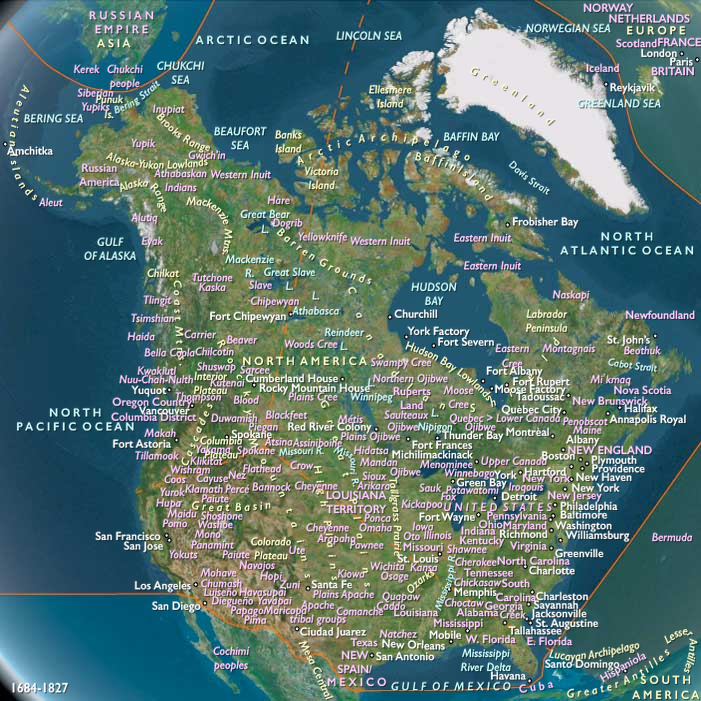
Subregions
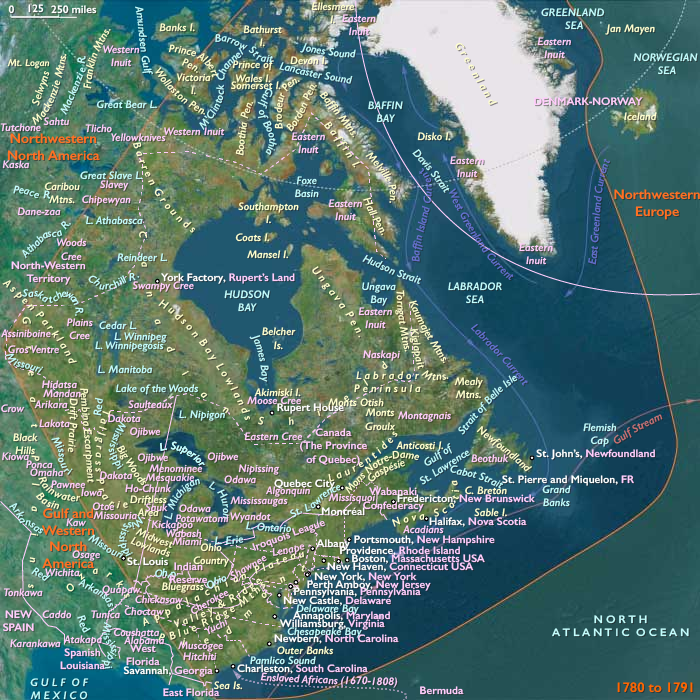
Years: 1780 - 1791
People
- Andrew Pickens
- Arthur St. Clair
- Blue Jacket
- Charles Cornwallis, 1st Marquess Cornwallis
- Daniel Shays
- Francis Marion
- George Washington
- Little Turtle
- Niels Egede
- Thomas Sumter
Groups
- Iroquois (Haudenosaunee, also known as the League of Peace and Power, Five Nations, or Six Nations)
- Austria, Archduchy of
- Mohawk people (Amerind tribe)
- Cherokee, or Tsalagi (Amerind tribe)
- Miami (Amerind tribe)
- Crow people, aka Absaroka or Apsáalooke (Amerind tribe)
- Shoshone, Shoshoni, or Snakes (Amerind tribe)
- Hidatsa people (Amerind tribe)
- Mandan (Amerind tribe)
- Lakota, aka Teton Sioux (Amerind tribe)
- Oneida people (Amerind tribe)
- Onondaga people (Amerind tribe)
- Cayuga people(Amerind tribe)
- Seneca (Amerind tribe)
- Protestantism
- New France (French Colony)
- Shawnees, or Shawanos (Amerind tribe)
- France, (Bourbon) Kingdom of
- Ohio Country
- Comanche (Amerind tribe)
- Massachusetts, Province of (English Crown Colony)
- Spain, Bourbon Kingdom of
- Britain, Kingdom of Great
- Nova Scotia (British Colony)
- South Carolina, Province of (British Colony)
- West Florida
- East Florida
- Pennsylvania, Commonwealth of (U.S.A.)
- Virginia, Commonwealth of (U.S.A.)
- North Carolina, State of (U.S.A.)
- United States of America (US, USA) (Philadelphia PA)
- Massachusetts, Commonwealth of (U.S.A.)
- United States of Americs (US, USA) (Annapolis MD)
- New Brunswick, British colony of
- United States of America (US, USA) (New York NY)
- United States of America (US, USA) (Philadelphia PA)
- Canada, Upper, (British province)
- Canada, Lower, (British province)
Topics
- Middle Subatlantic Period
- Little Ice Age (LIA)
- Colonization of the Americas, Spanish
- North American Fur Trade
- Colonization of the Americas, English
- Little Ice Age, Warm Phase III
- American Revolution
- American Revolutionary War, Southern theater of the
- American Revolutionary War, or American War of Independence
- Kings Mountain, Battle of
- Cowpens, Battle of
- Shays' Rebellion
- St. Clair's Defeat
Commodoties
Subjects
- Commerce
- Public health
- Conflict
- Faith
- Government
- Scholarship
- Custom and Law
- Catastrophe
- Human Migration
Regions
Subregions