
Northeastern North America (1768 to 1779 …
Years: 1768 - 1779
Northeastern North America
(1768 to 1779 CE): Revolutionary Turmoil, Frontier Expansion, and Indigenous Realignments
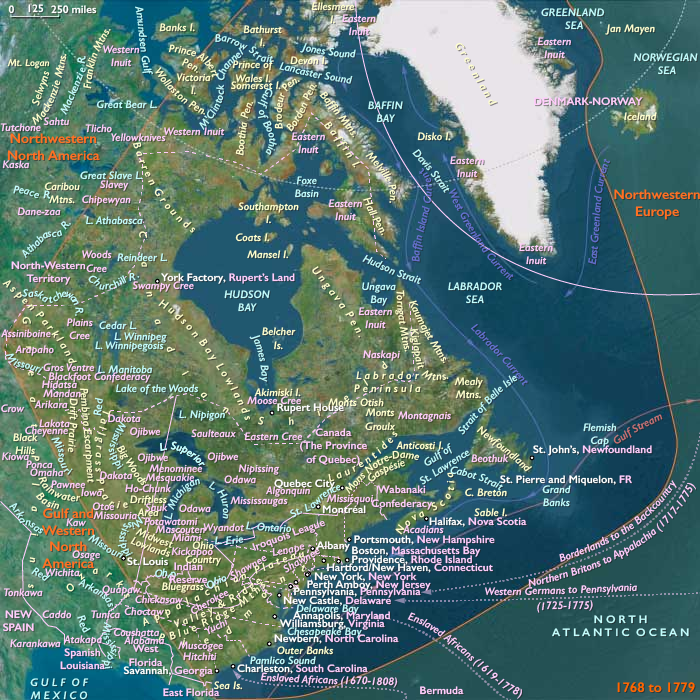
The years 1768 to 1779 in Northeastern North America marked a time of profound revolutionary upheaval, rapid frontier expansion, complex indigenous interactions, and significant social change. Frontier settlements expanded despite prohibitions, indigenous alliances shifted, and regional economies were restructured by warfare and trade. This era fundamentally reshaped the political, social, and cultural dynamics of the region.
Frontier Expansion and Conflicts
Treaty of Fort Stanwix (1768) and Kentucky Settlements
In 1768, the Treaty of Fort Stanwix—negotiated between British colonial authorities and the Iroquois Confederacy—aimed to ease frontier tensions by shifting the boundary line established in 1763. However, the treaty opened extensive territory south of the Ohio River, including modern-day Kentucky, to American colonial settlement, exacerbating intertribal conflict and sparking resistance from displaced native nations.
In 1775, renowned frontiersman Daniel Boone blazed a trail through the Cumberland Gap on behalf of the Transylvania Company, establishing Boonesborough in central Kentucky. His route was soon extended to reach the Falls of the Ohio (modern-day Louisville), accelerating the settlement and territorial ambitions of frontier colonists.
The Watauga Settlements and Cherokee Conflicts (1770–1777)
European settlers began moving into the Watauga, Nolichucky, and Holston River valleys (modern-day Tennessee) during the late 1760s and early 1770s. Initially believing these lands had been ceded by the Cherokee in the 1770 Treaty of Lochaber, settlers soon learned through Colonel John Donelson’s survey that these lands remained Cherokee territory, making their settlement illegal under British law.
In 1772, settlers negotiated a ten-year lease with the Cherokee, forming the independent Watauga Association to govern themselves. These actions were strongly opposed by Cherokee factions, notably led by the influential chief Dragging Canoe.
When war erupted in 1775, Watauga settlers formed the Washington District, pledging allegiance to the American revolutionary cause. Following petitions, North Carolina annexed the territory as Washington County in November 1777. Cherokee attempts to forcibly reclaim the region culminated in their defeat in 1776, leading to the Treaty of Long Island (1777), ceding the Watauga and Nolichucky valleys to the Americans.
Revolutionary War and Southern Devastation
South Carolina and Civil Conflict
South Carolina emerged as a central theater during the American Revolutionary War (1775–1783), with about one-third of the war’s combat actions taking place within its borders—more than in any other colony. The state suffered intensely from British invasions and violent internal conflict between Patriot partisans and Loyalist factions, particularly devastating the backcountry. Approximately 25,000 enslaved persons (around thirty percent of South Carolina's enslaved population) fled, migrated, or perished due to wartime upheaval.
The destruction and displacement in South Carolina profoundly altered the region's demographic, economic, and social structure, reshaping its political identity and intensifying its reliance on slavery in subsequent decades.
Indigenous Alliances and Frontier Warfare
Iroquois and Ohio Valley Conflicts
The American Revolution profoundly disrupted indigenous alliances. The previously unified Iroquois Confederacy split over revolutionary allegiances. Tribes like the Mohawk, Cayuga, Seneca, and Onondaga generally allied with the British, while the Oneida and Tuscarora largely supported the Americans. This schism escalated warfare on the New York frontier, culminating in punitive campaigns against Iroquois settlements, notably the Sullivan Expedition (1779), which severely impacted Iroquois communities.
Mandan Trade Networks and Equine Culture
On the northern Great Plains, the Mandan significantly enhanced their economic and territorial influence during this era, capitalizing on extensive trade networks involving furs, horses, firearms, and buffalo products. Having acquired horses in the mid-eighteenth century from southern Apache intermediaries, the Mandan used horses to expand their hunting territories and enhance their role as trade intermediaries. Mandan villages served as hubs connecting European traders from British, French, and Spanish backgrounds. After France ceded territory west of the Mississippi to Spain (1763), Spanish officials in St. Louis actively pursued stronger trade relations with the Mandan (whom they called Mandanas), hoping to curb British and American influence. Nevertheless, the Mandan continued open trade with all European competitors, refusing exclusive alliances and maximizing their commercial advantages.
In parallel, French traders based in St. Louis—particularly the influential Chouteau brothers—established direct trade routes to Santa Fé, further integrating the Great Plains into an expansive transcontinental economic network.
Northern Settlements and Indigenous Populations
Greenland and Egedesminde Colony
In Greenland’s Aasiaat Archipelago, indigenous populations dating back millennia had traditionally subsisted through seasonal migrations, hunting seals, reindeer, halibut, narwhals, and beluga whales. The establishment of Egedesminde Colony in 1759 by Norwegian missionary Niels Egede, son of Hans Egede, initiated a small-scale European settlement initially located north of Nordre Strømfjord. In 1763, the settlement was relocated to its current position.
By the 1770s, European settlers, primarily whalers, inadvertently introduced smallpox. The ensuing epidemic ravaged Greenland's indigenous population around Egedesminde, dramatically impacting local demographics and destabilizing traditional lifeways.
Ideological Developments and Cultural Transformations
Influence of the Great Awakening
The evangelical fervor of the Great Awakening (1730s–1740s), which had continued influencing the colonies into this era, shaped revolutionary ideology by emphasizing individual liberty, religious independence, and democratic principles. Ministers across the colonies openly supported the revolutionary cause, reinforcing political commitments through religious conviction.
Legacy of the Era (1768–1779 CE)
The years 1768–1779 significantly reshaped Northeastern North America. Frontier expansion, such as Boone’s Kentucky settlements and the Watauga communities in Tennessee, challenged British prohibitions, escalating tensions. South Carolina’s intense civil conflict and widespread displacement of enslaved populations demonstrated the deep social disruptions caused by war. Indigenous nations—including the Iroquois and Cherokee—experienced internal divisions and external pressures, resulting in substantial territorial and cultural losses. At the same time, the Mandan and other Plains tribes successfully capitalized on expanding trade networks, reshaping regional economic dynamics.
Together, these developments irrevocably altered regional political structures, demography, indigenous relationships, and colonial ambitions, laying foundational elements for the subsequent emergence of an independent United States and reshaping indigenous North America in lasting ways.
People
- Daniel Boone
- Dragging Canoe
- George Washington
- John Donelson
- John Sullivan
- Niels Egede
- Pontiac (Ottawa leader)
- William Pitt
Groups
- Iroquois (Haudenosaunee, also known as the League of Peace and Power, Five Nations, or Six Nations)
- Austria, Archduchy of
- Mohawk people (Amerind tribe)
- Seneca (Amerind tribe)
- Cherokee, or Tsalagi (Amerind tribe)
- Cayuga people(Amerind tribe)
- Onondaga people (Amerind tribe)
- Oneida people (Amerind tribe)
- Mandan (Amerind tribe)
- Shoshone, Shoshoni, or Snakes (Amerind tribe)
- Protestantism
- New France (French Colony)
- France, (Bourbon) Kingdom of
- Ohio Country
- Spain, Bourbon Kingdom of
- Britain, Kingdom of Great
- South Carolina, Province of (British Colony)
- West Florida
- East Florida
Topics
- Middle Subatlantic Period
- Little Ice Age (LIA)
- Colonization of the Americas, Spanish
- North American Fur Trade
- Colonization of the Americas, English
- Little Ice Age, Warm Phase III
- American Revolution
- American Revolutionary War, or American War of Independence
- American Revolutionary War, Southern theater of the
- Sullivan Expedition
Commodoties
Subjects
Regions
Subregions
Years: 1768 - 1779
People
- Daniel Boone
- Dragging Canoe
- George Washington
- John Donelson
- John Sullivan
- Niels Egede
- Pontiac (Ottawa leader)
- William Pitt
Groups
- Iroquois (Haudenosaunee, also known as the League of Peace and Power, Five Nations, or Six Nations)
- Austria, Archduchy of
- Mohawk people (Amerind tribe)
- Seneca (Amerind tribe)
- Cherokee, or Tsalagi (Amerind tribe)
- Cayuga people(Amerind tribe)
- Onondaga people (Amerind tribe)
- Oneida people (Amerind tribe)
- Mandan (Amerind tribe)
- Shoshone, Shoshoni, or Snakes (Amerind tribe)
- Protestantism
- New France (French Colony)
- France, (Bourbon) Kingdom of
- Ohio Country
- Spain, Bourbon Kingdom of
- Britain, Kingdom of Great
- South Carolina, Province of (British Colony)
- West Florida
- East Florida
Topics
- Middle Subatlantic Period
- Little Ice Age (LIA)
- Colonization of the Americas, Spanish
- North American Fur Trade
- Colonization of the Americas, English
- Little Ice Age, Warm Phase III
- American Revolution
- American Revolutionary War, or American War of Independence
- American Revolutionary War, Southern theater of the
- Sullivan Expedition
Commodoties
Subjects
Regions
Subregions