
Northeastern North America (1648 to 1659 …
Years: 1648 - 1659
Northeastern North America
(1648 to 1659 CE): Haudenosaunee Conquest, Huron Collapse, and Transformation of Indigenous Alliances
Between 1648 and 1659 CE, Northeastern North America underwent profound geopolitical transformation marked by aggressive Haudenosaunee (Iroquois) expansion, catastrophic defeat of the Huron Confederacy, relentless epidemics, and intensified colonial competition. Haudenosaunee military campaigns devastated neighboring indigenous nations, dramatically reshaping regional power dynamics, severely disrupting the French colonial fur trade, and intensifying intertribal and colonial-indigenous conflicts.
Haudenosaunee Conquests and Huron Collapse
Devastation of Huronia (1649)
In 1649, the Haudenosaunee launched a devastating, decisive attack deep into the heart of Huronia. Several key Huron villages—including major settlements such as St. Ignace and St. Louis—were violently destroyed, and hundreds, possibly thousands, were killed. Among the casualties were Jesuit missionaries Jean Brébeuf, Charles Garnier, and Gabriel Lallemant, later revered as Catholic martyrs.
Following this catastrophic assault, the Huron population—already severely diminished by European epidemics—collapsed from approximately 15,000 to just 500 survivors. The remnants dispersed, seeking refuge on islands in the Great Lakes and among neighboring nations. Their dispersal created a power vacuum in the fur trade subsequently filled by the Ottawa and other Algonquin-speaking tribes allied with the French.
Haudenosaunee Raiding Tactics
Iroquois warfare was notably fierce and efficient. Raids on isolated European and indigenous settlements typically involved swift, silent movement through dense forests, followed by surprise assaults wielding tomahawks and scalping knives. Settlements were often utterly destroyed, inhabitants massacred, and prisoners—especially women and children—carried back to Haudenosaunee villages. Male prisoners frequently faced ritualized execution by prolonged torture; female and younger prisoners were often adopted into Haudenosaunee communities.
Haudenosaunee Expansion Beyond Huronia
Destruction of the Neutral Confederacy (1650–1651)
Following the fall of the Hurons, Haudenosaunee war parties, led primarily by the Seneca nation, attacked and destroyed the powerful Neutral Confederacy in southern Ontario around 1650–1651. Numerically comparable to the Haudenosaunee but lacking European firearms, the Neutrals were quickly overwhelmed, losing their territory and political autonomy.
Conquest of the Erie Nation (1656)
In 1656, the Haudenosaunee annihilated another substantial confederacy, the Erie (Nation of the Cat), an Iroquoian-speaking people living along the shores of Lake Erie. Defeating the Erie significantly expanded Haudenosaunee territory westward, further consolidating their power over the eastern Great Lakes region.
Expansion into the Ohio and Illinois Countries
The Haudenosaunee also aggressively expanded southwestward. They displaced the Algonquin-speaking Shawnee from the Ohio Valley, asserting dominance over this strategic region, and extended control westward through the Illinois Country as far as the Mississippi River. By 1650, Haudenosaunee territories extended from the southern reaches of the English Virginia Colony northward to the St. Lawrence River.
Haudenosaunee Conflicts with European Colonies
Siege and Blockade of Montreal
A failed peace treaty negotiated by Iroquois Chief Canaqueese led directly to renewed conflict. Iroquois war parties advanced northward via Lake Champlain and the Richelieu River, mounting assaults and prolonged blockades against the key French settlement at Montreal. These raids significantly disrupted French colonization and fur-trade activities.
Iroquois Relations with French and Dutch
The Haudenosaunee Confederacy—comprising the Mohawk, Oneida, Onondaga, Cayuga, and Seneca—maintained complex internal dynamics. While the Oneida and Onondaga occasionally sought peaceful relations with the French, dominant Mohawk leaders remained openly hostile, continually pressuring the Confederacy into conflict with French colonists and allies. The Dutch, especially at Fort Orange (Albany), provided critical support to the Mohawk through supplies of firearms and trade goods, enabling and encouraging their military campaigns.
French Colonial Crisis and Strategic Realignments
Collapse of the Huron Trade Network
The Huron Confederacy's destruction severely disrupted the French fur trade. With the Hurons no longer serving as intermediaries, the French scrambled to forge new, though weaker, trade partnerships with surviving Algonquin groups such as the Ottawa, who filled the vacuum left by the Huron collapse.
Jesuit Missions Devastated
The Jesuit missions among the Huron, carefully documented in the Jesuit Relations, were nearly obliterated in 1649, with missionaries Brébeuf, Garnier, and Lallemant killed. The surviving Jesuits retreated, significantly reducing French religious influence in the region.
Epidemics and Continued Demographic Collapse
Ongoing Disease Devastation
Epidemics continued to ravage indigenous populations, exacerbating demographic collapse. The Hurons, Neutrals, and Eries suffered catastrophic mortality from smallpox, measles, and influenza, weakening their ability to resist Haudenosaunee assaults and European encroachment.
Indigenous Adaptations and Migrations
Dispersal and Refuge of Huron Survivors
After the Haudenosaunee conquest, surviving Hurons dispersed widely, forming diaspora communities among the French near Quebec (Huron-Wendat) and migrating westward toward the Great Lakes, becoming ancestors of modern Wyandot communities.
Cheyenne Historical Presence
The earliest documented encounter with the Cheyenne dates to this period, as a group visited the French Fort Crèvecoeur, near present-day Peoria, Illinois. In the mid-seventeenth century, the Cheyenne inhabited lands between the Mississippi River and Mille Lacs Lake (present-day Minnesota), subsisting by hunting bison on western prairies and gathering wild rice, thereby demonstrating the wide geographic range and trade networks extending into the heartland.
Interior and Plains Indigenous Stability
Great Lakes Algonquian Tribes
Potawatomi, Ojibway, Cree, and Arapaho maintained relative stability, carefully navigating new trade alliances resulting from the power vacuum left by the Huron collapse. Tribes like the Kickapoo, Menominee, Sauk, and Fox adapted to shifting geopolitical realities.
Miami and Illinois Economic Opportunities
The Miami and Illinois nations capitalized on the shifting regional fur trade, expanding economic and diplomatic engagement along the Ohio Valley and Great Lakes.
Siouan-speaking Peoples: Stability and Migration
Assiniboine-Sioux Divergence
The Assiniboine, linguistically distinct yet historically related to the broader Sioux nations, were clearly identified as separate by Jesuit records as early as 1640, confirming their status as independent from the Lakota, Dakota, and Yankton-Yanktonai groups.
Stability Among Dakota and Winnebago
The Dakota, Assiniboine, and Winnebago (Ho-Chunk) remained relatively stable and isolated from direct European conflict pressures, preserving cultural autonomy while related groups (Omaha, Iowa, Kansa, Osage, Quapaw) continued westward migrations.
Plains Indigenous Communities: Continuity Amid Regional Changes
Pawnee and Northern Plains Stability
The Pawnee maintained stable villages and ceremonial traditions along the central Plains, despite increasing regional upheavals. The Gros Ventre near Lake Manitoba and the Tsuu T’ina (Sarcee) in northern Saskatchewan continued relatively unaffected by colonial pressures due to geographic isolation.
Newfoundland’s Beothuk: Ongoing Pressures
Continued Vulnerability
The indigenous Beothuk faced sustained pressures from expanding English settlements, resource competition, and exposure to disease, increasingly threatening their survival and cultural continuity.
Indigenous Cultural and Artistic Resilience
Enduring Traditions
Despite tremendous disruptions, indigenous communities across Northeastern North America maintained robust artistic and ceremonial traditions—including beadwork, pottery, shell gorgets, and ceremonial pipes—preserving cultural resilience and community cohesion.
Legacy of the Era (1648–1659 CE)
The period 1648–1659 CE dramatically altered Northeastern North America. Aggressive Haudenosaunee campaigns devastated multiple indigenous confederacies—Huronia, Neutral, Erie—and significantly disrupted French colonial influence. Epidemics compounded these disasters, causing widespread demographic collapse. Surviving indigenous communities dispersed, realigned alliances, or migrated westward, reshaping regional geopolitical dynamics. These transformations profoundly influenced subsequent colonial-indigenous interactions and the broader historical trajectory of Northeastern North America.
Groups
- Iroquois (Haudenosaunee, also known as the League of Peace and Power, Five Nations, or Six Nations)
- Portuguese people
- Algonquin, or Algonkin, people (Amerind tribe)
- Basque people
- Abenaki people (Amerind tribe)
- Maliseet, or Wolastoqiyik, people (Amerind tribe)
- Mi'kmaq people (Amerind tribe)
- Ho-Chunk (Amerind tribe)
- Beothuk people
- Thule people
- Penobscot people (Amerind tribe)
- English people
- Mohawk people (Amerind tribe)
- Osage Nation (Amerind tribe)
- Wyandot, or Wendat, or Huron people (Amerind tribe)
- England, (Tudor) Kingdom of
- Yankton Sioux Tribe
- Assiniboine people (Amerind tribe)
- Cree (Amerind tribe)
- Tuscarora (Amerind tribe)
- Kickapoo people (Amerind tribe)
- Potawatomi (Amerind tribe)
- Menominee (Amerind tribe)
- Iowa (Amerind tribe)
- Ponca (Amerind tribe)
- Nanticoke people (Amerind tribe)
- Powhatan (Amerind tribe)
- Yuchi (Amerind tribe)
- Kiowa people (Amerind tribe)
- Tsuu T'ina; also Sarcee, Sarsi, Tsu T'ina, Tsuut'ina (Amerind tribe)
- Plains Apache, or Kiowa Apache; also Kiowa-Apache, Naʼisha, Naisha (Amerind tribe)
- Mohegan people (Amerind tribe)
- Massachusett people (Amerind tribe)
- Santee (Amerind tribe)
- Dakota, aka Santee Sioux (Amerind tribe)
- Cherokee, or Tsalagi (Amerind tribe)
- Sauk, or Sac, people (Amerind tribe)
- Meskwaki, or Fox tribe (Amerind tribe)
- Lenape or Lenni-Lenape (later named Delaware Indians by Europeans)
- Ojibwa, or Ojibwe, aka or Chippewa (Amerind tribe)
- Seneca (Amerind tribe)
- Cayuga people(Amerind tribe)
- Onondaga people (Amerind tribe)
- Oneida people (Amerind tribe)
- Erie; also Erielhonan, Eriez, Nation du Chat (Amerind tribe)
- Neutral Nation, or Attawandaron
- Lakota, aka Teton Sioux (Amerind tribe)
- Mahican (Amerind tribe)
- Innu (Montagnais, Naskapi) (Amerind tribe)
- Iroquoians, St. Lawrence
- Susquehannock (Amerind tribe)
- Narragansett people (Amerind tribe)
- Pequots (Amerind tribe)
- Petun (Amerind tribe)
- Wampanoag (Amerind tribe)
- Catawba people (Amerind tribe)
- Quapaw, or Arkansas (Amerind tribe)
- Omaha (Amerind tribe)
- Pawnee (Amerind tribe)
- Kaw, or Kanza, people (Amerind tribe)
- Caddo (Amerind tribe)
- Mandan (Amerind tribe)
- Hidatsa people (Amerind tribe)
- Shoshone, Shoshoni, or Snakes (Amerind tribe)
- Crow people, aka Absaroka or Apsáalooke (Amerind tribe)
- Cheyenne people (Amerind tribe)
- Arapaho people (Amerind tribe)
- Gros Ventre or “Atsina” people (Amerind tribe)
- Spain, Habsburg Kingdom of
- Spaniards (Latins)
- New France (French Colony)
- Jesuits, or Order of the Society of Jesus
- Spain, Habsburg Kingdom of
- Florida (Spanish Colony)
- Netherlands, United Provinces of the (Dutch Republic)
- France, (Bourbon) Kingdom of
- England, (Stuart) Kingdom of
- Plymouth Company, The (also called the Virginia Company of Plymouth)
- London Company, The (also called the Virginia Company of London)
- Virginia (English Colony)
- New Netherland (Dutch Colony)
- Plymouth Council for New England
- Dutch West India Company
- Massachusetts Bay Colony (sometimes called the Massachusetts Bay Company, for its founding institution)
- (Connecticut) River Colony (English)
- Rhode Island (English Colony)
Topics
- Middle Subatlantic Period
- Little Ice Age (LIA)
- Colonization of the Americas, Spanish
- Colonization of Asia, Dutch
- North American Fur Trade
- Colonization of the Americas, English
- Beaver Wars, or French and Iroquois Wars
Commodoties
- Fish and game
- Weapons
- Hides and feathers
- Gem materials
- Domestic animals
- Grains and produce
- Textiles
- Ceramics
- Strategic metals
- Salt
- Fuels, lubricants and sealants
- Manufactured goods
- Tobacco
Subjects
- Commerce
- Public health
- Decorative arts
- Conflict
- Exploration
- Faith
- Government
- Custom and Law
- Technology
- Catastrophe
- Human Migration
Regions
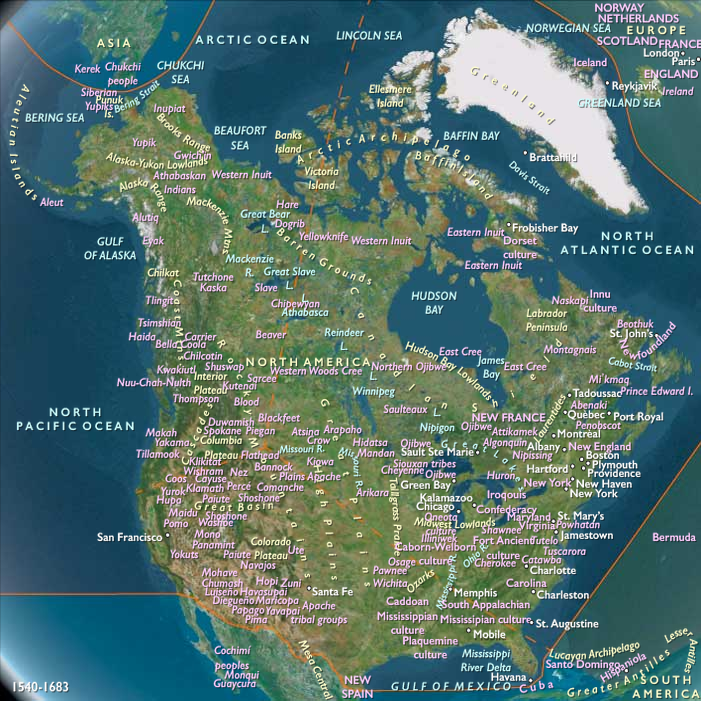
Subregions
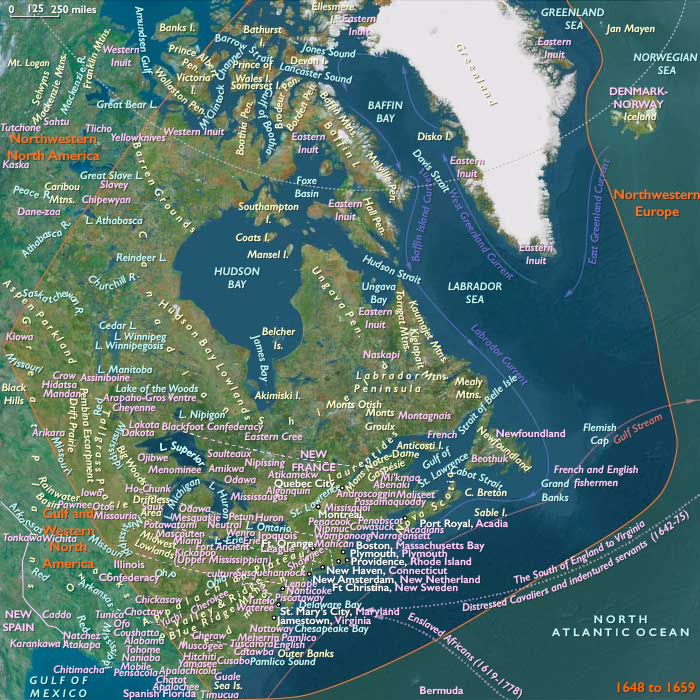
Years: 1648 - 1659
Groups
- Iroquois (Haudenosaunee, also known as the League of Peace and Power, Five Nations, or Six Nations)
- Portuguese people
- Algonquin, or Algonkin, people (Amerind tribe)
- Basque people
- Abenaki people (Amerind tribe)
- Maliseet, or Wolastoqiyik, people (Amerind tribe)
- Mi'kmaq people (Amerind tribe)
- Ho-Chunk (Amerind tribe)
- Beothuk people
- Thule people
- Penobscot people (Amerind tribe)
- English people
- Mohawk people (Amerind tribe)
- Osage Nation (Amerind tribe)
- Wyandot, or Wendat, or Huron people (Amerind tribe)
- England, (Tudor) Kingdom of
- Yankton Sioux Tribe
- Assiniboine people (Amerind tribe)
- Cree (Amerind tribe)
- Tuscarora (Amerind tribe)
- Kickapoo people (Amerind tribe)
- Potawatomi (Amerind tribe)
- Menominee (Amerind tribe)
- Iowa (Amerind tribe)
- Ponca (Amerind tribe)
- Nanticoke people (Amerind tribe)
- Powhatan (Amerind tribe)
- Yuchi (Amerind tribe)
- Kiowa people (Amerind tribe)
- Tsuu T'ina; also Sarcee, Sarsi, Tsu T'ina, Tsuut'ina (Amerind tribe)
- Plains Apache, or Kiowa Apache; also Kiowa-Apache, Naʼisha, Naisha (Amerind tribe)
- Mohegan people (Amerind tribe)
- Massachusett people (Amerind tribe)
- Santee (Amerind tribe)
- Dakota, aka Santee Sioux (Amerind tribe)
- Cherokee, or Tsalagi (Amerind tribe)
- Sauk, or Sac, people (Amerind tribe)
- Meskwaki, or Fox tribe (Amerind tribe)
- Lenape or Lenni-Lenape (later named Delaware Indians by Europeans)
- Ojibwa, or Ojibwe, aka or Chippewa (Amerind tribe)
- Seneca (Amerind tribe)
- Cayuga people(Amerind tribe)
- Onondaga people (Amerind tribe)
- Oneida people (Amerind tribe)
- Erie; also Erielhonan, Eriez, Nation du Chat (Amerind tribe)
- Neutral Nation, or Attawandaron
- Lakota, aka Teton Sioux (Amerind tribe)
- Mahican (Amerind tribe)
- Innu (Montagnais, Naskapi) (Amerind tribe)
- Iroquoians, St. Lawrence
- Susquehannock (Amerind tribe)
- Narragansett people (Amerind tribe)
- Pequots (Amerind tribe)
- Petun (Amerind tribe)
- Wampanoag (Amerind tribe)
- Catawba people (Amerind tribe)
- Quapaw, or Arkansas (Amerind tribe)
- Omaha (Amerind tribe)
- Pawnee (Amerind tribe)
- Kaw, or Kanza, people (Amerind tribe)
- Caddo (Amerind tribe)
- Mandan (Amerind tribe)
- Hidatsa people (Amerind tribe)
- Shoshone, Shoshoni, or Snakes (Amerind tribe)
- Crow people, aka Absaroka or Apsáalooke (Amerind tribe)
- Cheyenne people (Amerind tribe)
- Arapaho people (Amerind tribe)
- Gros Ventre or “Atsina” people (Amerind tribe)
- Spain, Habsburg Kingdom of
- Spaniards (Latins)
- New France (French Colony)
- Jesuits, or Order of the Society of Jesus
- Spain, Habsburg Kingdom of
- Florida (Spanish Colony)
- Netherlands, United Provinces of the (Dutch Republic)
- France, (Bourbon) Kingdom of
- England, (Stuart) Kingdom of
- Plymouth Company, The (also called the Virginia Company of Plymouth)
- London Company, The (also called the Virginia Company of London)
- Virginia (English Colony)
- New Netherland (Dutch Colony)
- Plymouth Council for New England
- Dutch West India Company
- Massachusetts Bay Colony (sometimes called the Massachusetts Bay Company, for its founding institution)
- (Connecticut) River Colony (English)
- Rhode Island (English Colony)
Topics
- Middle Subatlantic Period
- Little Ice Age (LIA)
- Colonization of the Americas, Spanish
- Colonization of Asia, Dutch
- North American Fur Trade
- Colonization of the Americas, English
- Beaver Wars, or French and Iroquois Wars
Commodoties
- Fish and game
- Weapons
- Hides and feathers
- Gem materials
- Domestic animals
- Grains and produce
- Textiles
- Ceramics
- Strategic metals
- Salt
- Fuels, lubricants and sealants
- Manufactured goods
- Tobacco
Subjects
- Commerce
- Public health
- Decorative arts
- Conflict
- Exploration
- Faith
- Government
- Custom and Law
- Technology
- Catastrophe
- Human Migration
Regions
Subregions