
Northeastern North America (1540 to 1551 …
Years: 1540 - 1551
Northeastern North America
(1540 to 1551 CE): Early European Contact, Indigenous Stability, and Shifting Populations
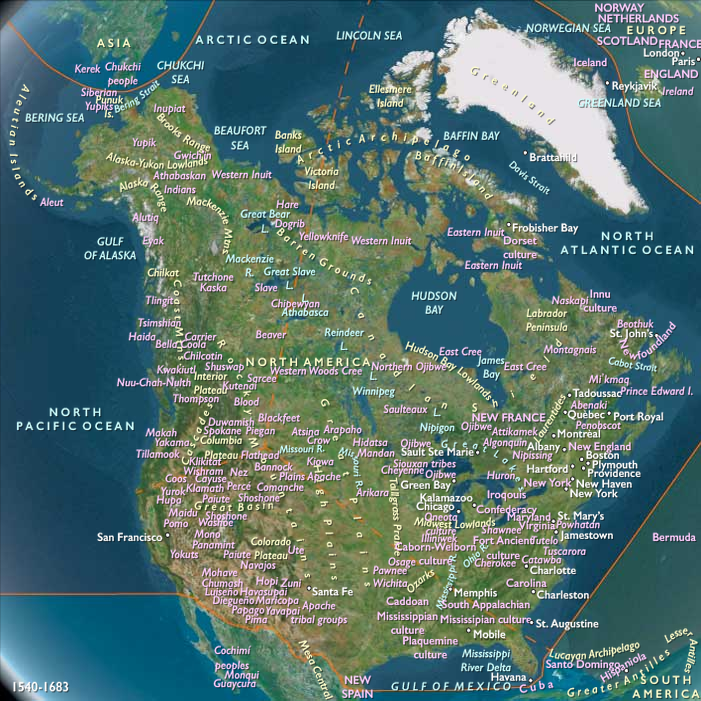
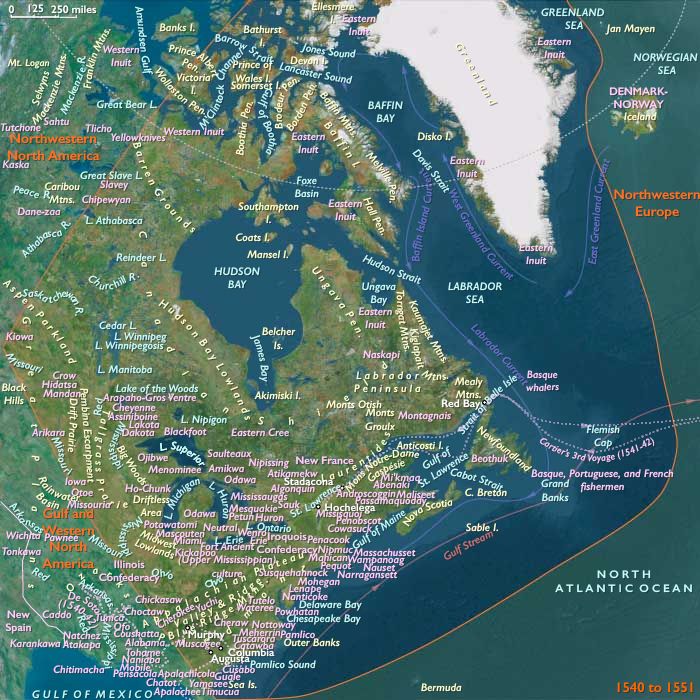
Between 1540 and 1551 CE, Northeastern North America witnessed increasingly regular European presence along coastal regions, especially through Basque whaling expeditions, alongside significant continuity and subtle demographic shifts among indigenous societies. While indigenous communities—ranging from coastal Algonquian tribes to interior groups such as the Haudenosaunee Confederacy, Siouan-speaking peoples, and Thule Inuit—maintained cultural resilience, the era also experienced early impacts of European-introduced diseases, initiating major changes in indigenous populations and territorial dynamics.
European Maritime Activity and Basque Whaling
Basque and Breton Expeditions
Basque fishermen intensified their presence around Terranova (Labrador and Newfoundland), focusing on whaling, particularly at Red Bay, hunting bowhead and right whales. These voyages combined cod fishing and whaling, with whale meat initially preserved in brine and later expeditions specializing in whale oil production.
Early Indigenous-European Interactions
Coastal indigenous peoples, especially the Mi’kmaq and the St. Lawrence Iroquoians, established amicable trade relations with Basque whalers. These interactions led to a simplified trade language influenced by Mi’kmaq vocabulary, facilitating deeper commercial ties and cultural exchanges.
Algonquian Coastal Tribes and Cultural Stability
Coastal Communities
Numerous Algonquian tribes inhabited Atlantic coastal regions at the beginning of this period. These included the Carolina tribes, the Powhatan Confederacy of Virginia, the Nanticoke of the Delmarva Peninsula, the Lenni Lenape (Delaware) groups—Unami, Munsee, and Unalachtigo—in the Middle Atlantic, and further north, the Mahican, Mohegan, Pequot, Narragansett, Wampanoag, and Massachusetts peoples. Farther north lived the Abenaki in Maine and the Mi’kmaq in the Canadian Maritimes.
Newfoundland's Beothuk
Newfoundland’s indigenous Beothuk population, largely isolated, continued a traditional lifestyle during this era. Although their precise linguistic affiliation remained uncertain, the majority of scholars place them within the Algonquian language family.
Great Lakes and Interior Algonquian Peoples
Great Lakes Algonquians
In Michigan, the Potawatomi maintained established settlements, while the Cheyenne, Arapaho, Ojibway, and Cree inhabited areas north of Lake Superior. Below these northern groups were the Kickapoo, Menominee, Sauk, and Fox tribes—also Algonquian-speaking—residing in regions that later became central to trade and conflict.
Shawnee Migration and Cherokee Emergence
The Shawnee nation had divided into two distinct groups by this period: the Western Shawnee, occupying territory south of the Middle Ohio Valley, and the smaller Eastern Shawnee, north of the Savannah River. Emerging powerfully between these two Shawnee groups were the Cherokee, who increasingly dominated the southern Appalachian Mountains, holding the region throughout this era.
Haudenosaunee Confederacy and Reserved Hunting Grounds
Territorial Control and Diplomacy
The Haudenosaunee Confederacy (Five Nations: Mohawk, Oneida, Onondaga, Cayuga, Seneca) maintained internal stability and expanded diplomatic influence. They strategically reserved large regions, notably the Central Appalachians and the Upper Ohio Valley—including eastern Kentucky—as exclusive hunting grounds. The Shawnee term "Kentucky," meaning "dark and bloody ground," references the area's contentious nature.
Ancient Structures and Empty Lands
The mysterious ancient stone fortifications in eastern Kentucky were long abandoned by this era, furthering the enigmatic nature of the region. Its uninhabited status possibly reflected strategic territorial management by the Haudenosaunee, deterring permanent settlements and reinforcing hunting preserves.
Siouan-speaking Peoples and Westward Movements
Eastern Siouan Nations
In the early 1550s, significant Siouan-speaking peoples who would later inhabit the Great Plains—including the Omaha, Iowa, Kansa, Osage, and Quapaw—still roamed the western slopes of the Appalachian Mountains. The Mandan and Hidatsa, originally from regions near the Great Lakes (Upper Michigan and Wisconsin), had already begun their migrations westward onto the plains, driven by shifting alliances and population pressures.
Assiniboine, Dakota, and Winnebago
The Assiniboine and Dakota (Sioux), who later dominated the northeastern Great Plains, still lived in the woodlands of Wisconsin and Upper Michigan alongside their kin, the Winnebago (Ho-Chunk). Their migration toward the Plains, significant in subsequent centuries, had not yet fully commenced.
Pawnee Ancestors and Plains Settlements
Semi-Sedentary Societies
Ancestors of the Pawnee, Caddoan-speaking agriculturalists migrating westward from the Mississippi River valley, established semi-sedentary villages of earth and grass lodges on the Great Plains. Their societies featured social stratification, including priests and hereditary chiefs, and practiced complex rituals involving human sacrifice.
Crow-Hidatsa Migration and Territorial Shifts
Migration from the Great Lakes
The ancestral Crow-Hidatsa people, originating in the Ohio Valley near Lake Erie, had moved northwestward into the vicinity of Lake Winnipeg (Manitoba) and subsequently migrated further southwest into the Devil’s Lake region of North Dakota. The Crow soon split from the Hidatsa and pushed westward, clashing with Shoshone bands ("Bikkaashe," or "People of the Grass Lodges") and allying strategically with local Kiowa and Kiowa Apache groups.
Iowa People: Migration and Pipestone Quarry Use
Western Movement
The Iowa, possibly splitting from the Winnebago tribe during the sixteenth century, continued their migration westward, eventually occupying culturally significant sites such as the Red Pipestone Quarry region in present-day Minnesota.
Population Collapse and Disease
Epidemics and Demographic Decline
Much of Eastern North America experienced substantial population loss immediately preceding intensive European contact, largely due to epidemics of diseases such as smallpox, influenza, measles, and typhus—introduced via limited initial contacts. Whether brought by explorers like Cabot or Verrazzano, Spanish friars, or early fishermen, these diseases devastated indigenous communities, whose immune systems lacked resistance.
Consequences of Disease
Some historians estimate that indigenous populations in parts of North America declined rapidly by as much as ninety percent due to disease. This dramatic demographic collapse created significant shifts in territorial boundaries, migration patterns, and cultural dynamics, reshaping indigenous societies profoundly even before sustained European colonization.
Gros Ventre and Tsuu T'ina (Sarcee)
Northern Interior Groups
The Gros Ventre people lived near Lake Manitoba, while the Tsuu T'ina (Sarcee) occupied forests in northern Saskatchewan. Both groups, part of broader Algonquian linguistic and cultural traditions, maintained their traditional hunting and gathering lifestyles, largely insulated during this early era from direct European influences.
Indigenous Artistic and Ceremonial Continuity
Craftsmanship and Ritual Practices
Across the region, indigenous groups—including the Mi’kmaq, Algonquian coastal tribes, Haudenosaunee, Pawnee ancestors, and Plains-bound Siouan peoples—continued vibrant artistic traditions, producing ceremonial pottery, beadwork, shell gorgets, tobacco pipes, and intricate regalia. Ritual and ceremonial practices persisted strongly, reinforcing cultural cohesion and identity amid early European contact and demographic challenges.
Environmental Context: Little Ice Age Pressures
Ecological Adaptation and Resilience
The ongoing climatic fluctuations of the Little Ice Age challenged indigenous communities, who adapted through diversified agricultural practices, flexible seasonal migration, and sustainable resource management. These strategies allowed indigenous populations to remain resilient and adaptive during a period of early disease epidemics and shifting population patterns.
Legacy of the Era (1540–1551 CE)
The period 1540 to 1551 CE in Northeastern North America represented a complex transitional moment, marked by increasing but still limited European coastal activities, significant demographic disruptions due to early introduced diseases, and indigenous population movements. Indigenous communities demonstrated notable resilience and adaptability, maintaining stable cultural traditions and robust social structures despite initial European influences and dramatic population declines. These foundational shifts laid the groundwork for more substantial European interactions and indigenous adaptations in the ensuing decades.
Groups
- Mound Builders
- Caddoan Mississippian culture
- Mississippian culture
- Algonquin, or Algonkin, people (Amerind tribe)
- Iroquois (Haudenosaunee, also known as the League of Peace and Power, Five Nations, or Six Nations)
- Basque people
- Abenaki people (Amerind tribe)
- Maliseet, or Wolastoqiyik, people (Amerind tribe)
- Penobscot people (Amerind tribe)
- Thule people
- Mi'kmaq people (Amerind tribe)
- Ho-Chunk (Amerind tribe)
- Beothuk people
- Wyandot, or Wendat, or Huron people (Amerind tribe)
- Osage Nation (Amerind tribe)
- Mohawk people (Amerind tribe)
- Pequots (Amerind tribe)
- Wampanoag (Amerind tribe)
- Catawba people (Amerind tribe)
- Quapaw, or Arkansas (Amerind tribe)
- Omaha (Amerind tribe)
- Pawnee (Amerind tribe)
- Kaw, or Kanza, people (Amerind tribe)
- Caddo (Amerind tribe)
- Mandan (Amerind tribe)
- Hidatsa people (Amerind tribe)
- Shoshone, Shoshoni, or Snakes (Amerind tribe)
- Crow people, aka Absaroka or Apsáalooke (Amerind tribe)
- Cheyenne people (Amerind tribe)
- Arapaho people (Amerind tribe)
- Gros Ventre or “Atsina” people (Amerind tribe)
- Assiniboine people (Amerind tribe)
- Cree (Amerind tribe)
- Tuscarora (Amerind tribe)
- Kickapoo people (Amerind tribe)
- Potawatomi (Amerind tribe)
- Menominee (Amerind tribe)
- Iowa (Amerind tribe)
- Ponca (Amerind tribe)
- Nanticoke people (Amerind tribe)
- Powhatan (Amerind tribe)
- Yuchi (Amerind tribe)
- Tsuu T'ina; also Sarcee, Sarsi, Tsu T'ina, Tsuut'ina (Amerind tribe)
- Plains Apache, or Kiowa Apache; also Kiowa-Apache, Naʼisha, Naisha (Amerind tribe)
- Mohegan people (Amerind tribe)
- Massachusett people (Amerind tribe)
- Dakota, aka Santee Sioux (Amerind tribe)
- Yankton Sioux Tribe
- Kiowa people (Amerind tribe)
- Cherokee, or Tsalagi (Amerind tribe)
- Sauk, or Sac, people (Amerind tribe)
- Meskwaki, or Fox tribe (Amerind tribe)
- Lenape or Lenni-Lenape (later named Delaware Indians by Europeans)
- Ojibwa, or Ojibwe, aka or Chippewa (Amerind tribe)
- Seneca (Amerind tribe)
- Cayuga people(Amerind tribe)
- Onondaga people (Amerind tribe)
- Oneida people (Amerind tribe)
- Lakota, aka Teton Sioux (Amerind tribe)
- Mahican (Amerind tribe)
- Innu (Montagnais, Naskapi) (Amerind tribe)
- Iroquoians, St. Lawrence
- Susquehannock (Amerind tribe)
- Narragansett people (Amerind tribe)
Topics
- Little Ice Age (LIA)
- Colonization of the Americas, French
- Colonization of the Americas, English
- Beaver Wars, or French and Iroquois Wars
- Colonization of the Americas, Dutch
- Pequot War
- King Philip's War
Commodoties
- Fish and game
- Gem materials
- Colorants
- Domestic animals
- Grains and produce
- Ceramics
- Strategic metals
- Tobacco
Subjects
- Commerce
- Environment
- Decorative arts
- Conflict
- Exploration
- Faith
- Government
- Custom and Law
- Technology
- Human Migration
Regions
Subregions
Years: 1540 - 1551
Groups
- Mound Builders
- Caddoan Mississippian culture
- Mississippian culture
- Algonquin, or Algonkin, people (Amerind tribe)
- Iroquois (Haudenosaunee, also known as the League of Peace and Power, Five Nations, or Six Nations)
- Basque people
- Abenaki people (Amerind tribe)
- Maliseet, or Wolastoqiyik, people (Amerind tribe)
- Penobscot people (Amerind tribe)
- Thule people
- Mi'kmaq people (Amerind tribe)
- Ho-Chunk (Amerind tribe)
- Beothuk people
- Wyandot, or Wendat, or Huron people (Amerind tribe)
- Osage Nation (Amerind tribe)
- Mohawk people (Amerind tribe)
- Pequots (Amerind tribe)
- Wampanoag (Amerind tribe)
- Catawba people (Amerind tribe)
- Quapaw, or Arkansas (Amerind tribe)
- Omaha (Amerind tribe)
- Pawnee (Amerind tribe)
- Kaw, or Kanza, people (Amerind tribe)
- Caddo (Amerind tribe)
- Mandan (Amerind tribe)
- Hidatsa people (Amerind tribe)
- Shoshone, Shoshoni, or Snakes (Amerind tribe)
- Crow people, aka Absaroka or Apsáalooke (Amerind tribe)
- Cheyenne people (Amerind tribe)
- Arapaho people (Amerind tribe)
- Gros Ventre or “Atsina” people (Amerind tribe)
- Assiniboine people (Amerind tribe)
- Cree (Amerind tribe)
- Tuscarora (Amerind tribe)
- Kickapoo people (Amerind tribe)
- Potawatomi (Amerind tribe)
- Menominee (Amerind tribe)
- Iowa (Amerind tribe)
- Ponca (Amerind tribe)
- Nanticoke people (Amerind tribe)
- Powhatan (Amerind tribe)
- Yuchi (Amerind tribe)
- Tsuu T'ina; also Sarcee, Sarsi, Tsu T'ina, Tsuut'ina (Amerind tribe)
- Plains Apache, or Kiowa Apache; also Kiowa-Apache, Naʼisha, Naisha (Amerind tribe)
- Mohegan people (Amerind tribe)
- Massachusett people (Amerind tribe)
- Dakota, aka Santee Sioux (Amerind tribe)
- Yankton Sioux Tribe
- Kiowa people (Amerind tribe)
- Cherokee, or Tsalagi (Amerind tribe)
- Sauk, or Sac, people (Amerind tribe)
- Meskwaki, or Fox tribe (Amerind tribe)
- Lenape or Lenni-Lenape (later named Delaware Indians by Europeans)
- Ojibwa, or Ojibwe, aka or Chippewa (Amerind tribe)
- Seneca (Amerind tribe)
- Cayuga people(Amerind tribe)
- Onondaga people (Amerind tribe)
- Oneida people (Amerind tribe)
- Lakota, aka Teton Sioux (Amerind tribe)
- Mahican (Amerind tribe)
- Innu (Montagnais, Naskapi) (Amerind tribe)
- Iroquoians, St. Lawrence
- Susquehannock (Amerind tribe)
- Narragansett people (Amerind tribe)
Topics
- Little Ice Age (LIA)
- Colonization of the Americas, French
- Colonization of the Americas, English
- Beaver Wars, or French and Iroquois Wars
- Colonization of the Americas, Dutch
- Pequot War
- King Philip's War
Commodoties
- Fish and game
- Gem materials
- Colorants
- Domestic animals
- Grains and produce
- Ceramics
- Strategic metals
- Tobacco
Subjects
- Commerce
- Environment
- Decorative arts
- Conflict
- Exploration
- Faith
- Government
- Custom and Law
- Technology
- Human Migration
Regions
Subregions