
Northeastern North America (1540–1683 CE): Fishermen, Colonists, …
Years: 1540 - 1683
Northeastern North America (1540–1683 CE): Fishermen, Colonists, and Resilient Woodland Worlds
Geographic & Environmental Context
The subregion of Northeastern North America includes the Atlantic seaboard from Jacksonville, Florida to St. John’s, Newfoundland; Greenland; the Midwest; the Great Lakes; and all Canadian provinces eastward to the Saskatchewan–Alberta line. Anchors include the Great Lakes basin, the St. Lawrence River, the Appalachian piedmont, Hudson Bay, and the Greenland ice sheet. This vast zone combined fertile coastal plains, hardwood and conifer forests, interior prairies, boreal shield country, and Arctic tundra.
Climate & Environmental Shifts
This age fell within the Little Ice Age. Colder winters shortened growing seasons in the Great Lakes and New England; snow and ice cover expanded across Hudson Bay. Greenland saw longer sea-ice seasons, shaping Inuit lifeways and deterring Norse reoccupation. Atlantic storms battered coastlines, while fisheries in Newfoundland and the Gulf of St. Lawrence thrived in cooler, nutrient-rich waters. Droughts occasionally stressed maize cultivation at the southern and western margins of Iroquoian territories.
Subsistence & Settlement
-
Woodland societies: Iroquoian and Algonquian peoples continued farming maize, beans, and squash, but also intensified hunting and fishing to buffer climatic stress. Palisaded villages and longhouses remained common.
-
Great Lakes and Midwest: Horticulturalists cultivated maize in fertile valleys, while mobile Algonquian groups exploited seasonal fisheries and wild rice.
-
Subarctic and Shield: Hunters pursued caribou, moose, and fur-bearing animals; canoes and snowshoes sustained mobility.
-
Greenland Inuit: Adapted to harsher cold with dog sleds, toggling harpoons, and seal-hunting on extended ice.
-
European colonists: By the early 1600s, Spanish Florida (St. Augustine, 1565), French Acadia and Quebec (1604–1608), Dutch New Netherland (1620s), English New England (Plymouth 1620, Massachusetts Bay 1630), and Chesapeake (Jamestown 1607) established lasting footholds. These relied on maize, European grains, livestock, and cod fisheries.
Technology & Material Culture
Indigenous technologies—canoes, bows, fishing weirs, pottery, longhouses, and wampum belts—remained essential. Europeans introduced iron axes, muskets, sailing ships, plows, and domesticated animals. Wooden forts, churches, and early towns rose along the seaboard. Inuit retained umiaks, sledges, and bone/ivory craft. The fur trade transformed material culture, linking Indigenous trapping to European markets for beaver pelts, exchanged for textiles, kettles, knives, and guns.
Movement & Interaction Corridors
-
Rivers and lakes: Canoe highways (St. Lawrence, Great Lakes, Hudson, Connecticut, Mississippi headwaters) tied Native villages to European posts.
-
Atlantic coast: Fisheries at Newfoundland and New England drew fleets from France, Spain, Portugal, and England.
-
Colonial trade: European settlements funneled furs, fish, and timber to Europe; Africans began to be brought in as enslaved labor in southern colonies.
-
Greenland Inuit corridors: Maintained links across Baffin Island and Labrador by umiak and dog sled.
Cultural & Symbolic Expressions
Cultural diversity deepened:
-
Iroquois Confederacy (Haudenosaunee): Consolidated in the 16th century, embodying political unity through council fires and wampum.
-
Algonquian groups: Maintained animist traditions; shamans mediated hunting rituals.
-
Inuit: Celebrated seal festivals and practiced shamanic journeys, adapting cosmology to expanded ice.
-
European colonists: Established Catholic missions (French, Spanish) and Protestant congregations (English, Dutch), embedding churches and schools in frontier towns. Cultural exchanges produced hybrid foodways, dress, and spiritual practices.
Environmental Adaptation & Resilience
Indigenous communities adapted by diversifying diets, forging new alliances, and integrating European goods into traditional systems. Colonists adapted to unfamiliar climates with Indigenous aid—learning maize cultivation, fur-hunting skills, and coastal navigation. European livestock, logging, and agriculture reshaped ecosystems, while Indigenous burning and land use persisted in many areas. Inuit resilience relied on flexible subsistence across seals, fish, and whales.
Transition
By 1683 CE, Northeastern North America was transformed into a multi-cultural frontier.Indigenous nations remained dominant across vast interiors, but European colonies clustered along coasts, fisheries, and river mouths. The fur trade, cod fleets, and plantation outposts tied the region into the Atlantic world. Climatic stress from the Little Ice Age continued, but resilience came through adaptation, exchange, and hybridization. The stage was set for intensified conflict, trade, and settlement in the coming centuries.
People
Groups
- Mound Builders
- Dutch people
- Mississippian culture
- Caddoan Mississippian culture
- Iroquois (Haudenosaunee, also known as the League of Peace and Power, Five Nations, or Six Nations)
- Algonquin, or Algonkin, people (Amerind tribe)
- Basque people
- Maliseet, or Wolastoqiyik, people (Amerind tribe)
- Mi'kmaq people (Amerind tribe)
- Thule people
- Penobscot people (Amerind tribe)
- Ho-Chunk (Amerind tribe)
- English people
- France, (Valois) Kingdom of
- Mohawk people (Amerind tribe)
- Osage Nation (Amerind tribe)
- Wyandot, or Wendat, or Huron people (Amerind tribe)
- England, (Tudor) Kingdom of
- Tuscarora (Amerind tribe)
- Catawba people (Amerind tribe)
- Quapaw, or Arkansas (Amerind tribe)
- Omaha (Amerind tribe)
- Pawnee (Amerind tribe)
- Kaw, or Kanza, people (Amerind tribe)
- Caddo (Amerind tribe)
- Hidatsa people (Amerind tribe)
- Shoshone, Shoshoni, or Snakes (Amerind tribe)
- Crow people, aka Absaroka or Apsáalooke (Amerind tribe)
- Cheyenne people (Amerind tribe)
- Iowa (Amerind tribe)
- Ponca (Amerind tribe)
- Yuchi (Amerind tribe)
- Kiowa people (Amerind tribe)
- Plains Apache, or Kiowa Apache; also Kiowa-Apache, Naʼisha, Naisha (Amerind tribe)
- Massachusett people (Amerind tribe)
- Dakota, aka Santee Sioux (Amerind tribe)
- Yankton Sioux Tribe
- Cherokee, or Tsalagi (Amerind tribe)
- Seneca (Amerind tribe)
- Cayuga people(Amerind tribe)
- Onondaga people (Amerind tribe)
- Oneida people (Amerind tribe)
- Lakota, aka Teton Sioux (Amerind tribe)
- Innu (Montagnais, Naskapi) (Amerind tribe)
- Iroquoians, St. Lawrence
- Susquehannock (Amerind tribe)
- Narragansett people (Amerind tribe)
- Pequots (Amerind tribe)
- Wampanoag (Amerind tribe)
- Protestantism
- New France (French Colony)
- France, (Bourbon) Kingdom of
- Acadian people
- French Canadians
- Ulster Scots people (Scots-Irish)
- Virginia (English Colony)
- Newfoundland (English Colony)
- New Netherland (Dutch Colony)
- Maine, Province of
- Virginia (English Crown Colony)
- Massachusetts Bay Colony (sometimes called the Massachusetts Bay Company, for its founding institution)
- Plymouth Colony (English Colony)
- (Connecticut) River Colony (English)
- New England Confederation (United Colonies of New England)
- Connecticut (English Crown Colony)
- New Netherland (Dutch Colony, restored)
- New Hampshire (English Crown Colony)
Topics
- Little Ice Age (LIA)
- Colonization of the Americas, French
- Little Ice Age, Warm Phase II
- Colonization of the Americas, English
- Beaver Wars, or French and Iroquois Wars
- Colonization of the Americas, Dutch
- Pequot War
- King Philip's War
Commodoties
- Fish and game
- Gem materials
- Colorants
- Domestic animals
- Grains and produce
- Ceramics
- Strategic metals
- Tobacco
Subjects
- Commerce
- Environment
- Decorative arts
- Conflict
- Exploration
- Faith
- Government
- Custom and Law
- Technology
- Human Migration
Regions
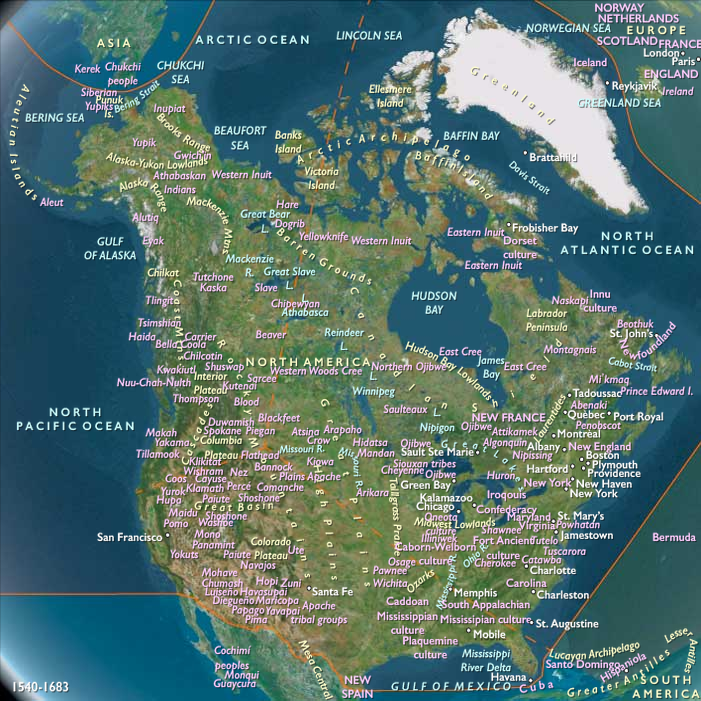
Subregions
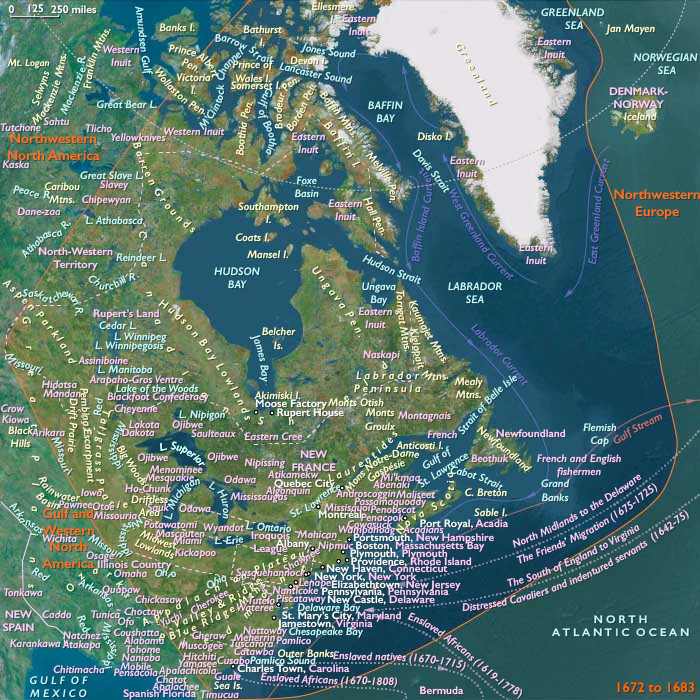
Years: 1540 - 1683
People
Groups
- Mound Builders
- Dutch people
- Mississippian culture
- Caddoan Mississippian culture
- Iroquois (Haudenosaunee, also known as the League of Peace and Power, Five Nations, or Six Nations)
- Algonquin, or Algonkin, people (Amerind tribe)
- Basque people
- Maliseet, or Wolastoqiyik, people (Amerind tribe)
- Mi'kmaq people (Amerind tribe)
- Thule people
- Penobscot people (Amerind tribe)
- Ho-Chunk (Amerind tribe)
- English people
- France, (Valois) Kingdom of
- Mohawk people (Amerind tribe)
- Osage Nation (Amerind tribe)
- Wyandot, or Wendat, or Huron people (Amerind tribe)
- England, (Tudor) Kingdom of
- Tuscarora (Amerind tribe)
- Catawba people (Amerind tribe)
- Quapaw, or Arkansas (Amerind tribe)
- Omaha (Amerind tribe)
- Pawnee (Amerind tribe)
- Kaw, or Kanza, people (Amerind tribe)
- Caddo (Amerind tribe)
- Hidatsa people (Amerind tribe)
- Shoshone, Shoshoni, or Snakes (Amerind tribe)
- Crow people, aka Absaroka or Apsáalooke (Amerind tribe)
- Cheyenne people (Amerind tribe)
- Iowa (Amerind tribe)
- Ponca (Amerind tribe)
- Yuchi (Amerind tribe)
- Kiowa people (Amerind tribe)
- Plains Apache, or Kiowa Apache; also Kiowa-Apache, Naʼisha, Naisha (Amerind tribe)
- Massachusett people (Amerind tribe)
- Dakota, aka Santee Sioux (Amerind tribe)
- Yankton Sioux Tribe
- Cherokee, or Tsalagi (Amerind tribe)
- Seneca (Amerind tribe)
- Cayuga people(Amerind tribe)
- Onondaga people (Amerind tribe)
- Oneida people (Amerind tribe)
- Lakota, aka Teton Sioux (Amerind tribe)
- Innu (Montagnais, Naskapi) (Amerind tribe)
- Iroquoians, St. Lawrence
- Susquehannock (Amerind tribe)
- Narragansett people (Amerind tribe)
- Pequots (Amerind tribe)
- Wampanoag (Amerind tribe)
- Protestantism
- New France (French Colony)
- France, (Bourbon) Kingdom of
- Acadian people
- French Canadians
- Ulster Scots people (Scots-Irish)
- Virginia (English Colony)
- Newfoundland (English Colony)
- New Netherland (Dutch Colony)
- Maine, Province of
- Virginia (English Crown Colony)
- Massachusetts Bay Colony (sometimes called the Massachusetts Bay Company, for its founding institution)
- Plymouth Colony (English Colony)
- (Connecticut) River Colony (English)
- New England Confederation (United Colonies of New England)
- Connecticut (English Crown Colony)
- New Netherland (Dutch Colony, restored)
- New Hampshire (English Crown Colony)
Topics
- Little Ice Age (LIA)
- Colonization of the Americas, French
- Little Ice Age, Warm Phase II
- Colonization of the Americas, English
- Beaver Wars, or French and Iroquois Wars
- Colonization of the Americas, Dutch
- Pequot War
- King Philip's War
Commodoties
- Fish and game
- Gem materials
- Colorants
- Domestic animals
- Grains and produce
- Ceramics
- Strategic metals
- Tobacco
Subjects
- Commerce
- Environment
- Decorative arts
- Conflict
- Exploration
- Faith
- Government
- Custom and Law
- Technology
- Human Migration
Regions
Subregions