
Northeastern North America (1420 to 1431 …
Years: 1420 - 1431
Northeastern North America
(1420 to 1431 CE): Norse Greenland’s Final Records, Haudenosaunee Unification, and Indigenous Adaptations
From 1420 to 1431 CE, Northeastern North America experienced ongoing indigenous cultural adaptations, political consolidations, and environmental pressures. This period notably includes the last documented activities of the Norse Greenland settlements, continued regionalization of Mississippian communities, the establishment of the Haudenosaunee (Iroquois) Confederacy according to legendary tradition, and the stability of indigenous peoples across the Arctic and interior regions.
Decline and Disappearance of Norse Greenland
Final Documented Events at Hvalsey Church
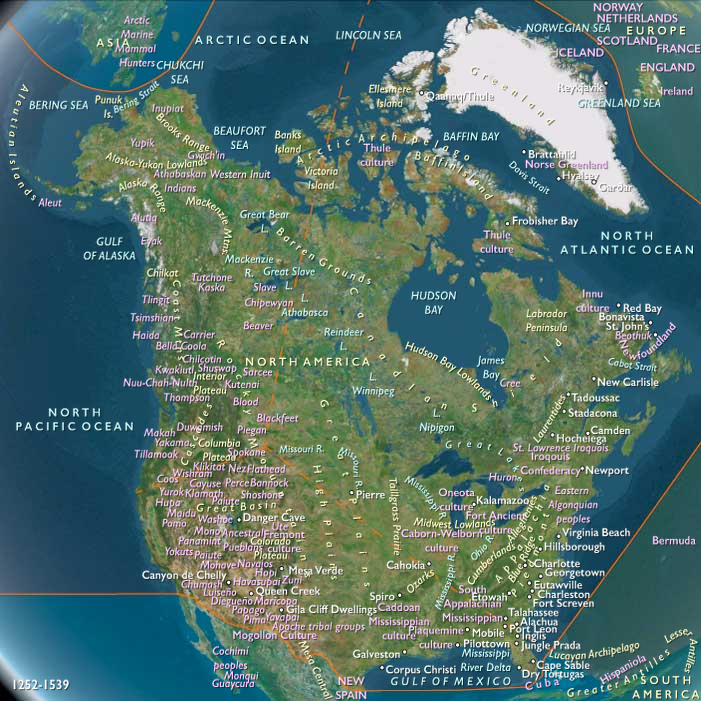
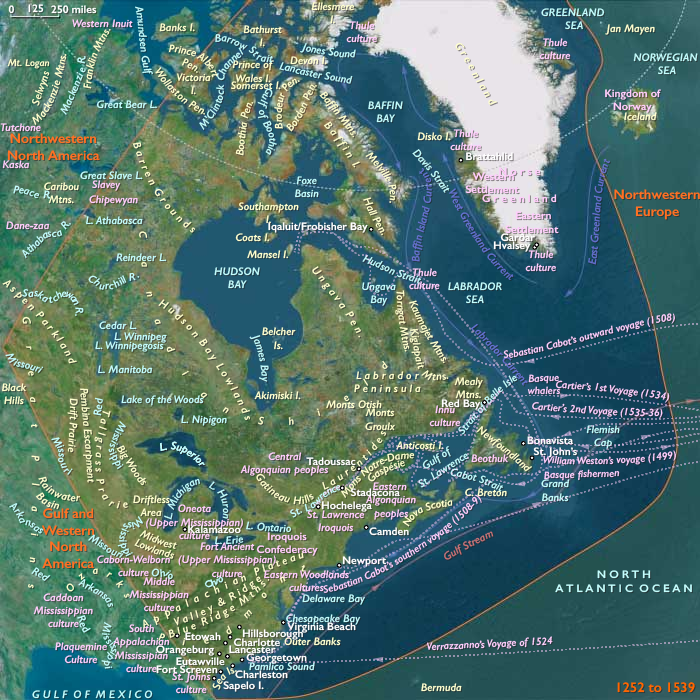
During this era, the Norse settlements in Greenland reached a critical and final stage. The last known written record of the Norse Greenlanders comes from the church at Hvalsey, where a marriage was recorded in 1408 CE. Hvalsey Church, now the best-preserved Nordic ruins in Greenland, symbolizes the endpoint of nearly five centuries of Norse habitation in the region. After this date, historical evidence of the Norse colonies ceases, marking the effective disappearance of these communities.
Economic Isolation and Ivory Trade Collapse
One major factor contributing to Greenland’s abandonment was economic isolation. Greenlanders had relied heavily on trade in walrus ivory, a valuable commodity in medieval Europe. However, by the late fourteenth and early fifteenth centuries, higher-quality elephant ivory from Africa became widely available, drastically reducing European demand for Greenlandic ivory. With little left to trade, Norse Greenlanders faced crippling economic conditions, deepening their isolation and accelerating societal collapse.
Environmental and Dietary Stresses
Scientific evidence—particularly isotope analysis of human bones—reveals increasing dietary dependence on marine food sources, comprising between fifty and eighty percent of the Norse Greenlanders' diet by the late fourteenth century. This shift reflects declining agricultural productivity resulting from soil erosion, overgrazing, deforestation, and the destruction of natural vegetation from intensive farming, turf-cutting, and woodcutting. Human bones from the period exhibit clear signs of malnutrition, suggesting severe dietary stress. Climatic cooling linked to the onset of the Little Ice Age, along with potential armed conflicts or competition with Inuit populations, compounded these ecological hardships, culminating in societal collapse and abandonment.
Haudenosaunee Confederacy: Legendary Formation
Hiawatha and Deganawidah
According to Iroquois tradition, during this era (circa 1400–1450 CE), the legendary Mohawk leader Ha-yo-went-ha (Hiawatha), inspired by the spiritual teachings of the holy man Deganawidah, founded the League of the Five Nations (Haudenosaunee Confederacy). This critical event—later immortalized by Henry Wadsworth Longfellow's celebrated nineteenth-century poem—significantly reduced intertribal conflict, united the Mohawk, Oneida, Onondaga, Cayuga, and Seneca under a common political structure, and laid the foundation for the Confederacy’s sustained political and diplomatic influence in northeastern North America.
Impact of Confederacy Formation
The formation of the Haudenosaunee Confederacy effectively ended frequent feuds and violence among the Iroquois tribes, establishing mechanisms for collective governance, diplomatic negotiation, territorial defense, and resource sharing. This unity provided strategic advantages that facilitated their dominance and stability within a politically fragmented landscape. Women maintained influential roles within the Confederacy, highlighting distinctive matrilineal societal structures compared to neighboring Algonquian societies.
Mississippian Societies: Continued Fragmentation
Smaller-scale, Fortified Chiefdoms
The earlier era’s fragmentation of the Mississippian cultural complex continued. Decentralized and increasingly fortified settlements—such as Etowah (Georgia) and Moundville (Alabama)—remained culturally vibrant, albeit at reduced scales. Defensive fortifications and localized ceremonial practices indicated heightened resource competition and intercommunity tensions. Yet despite these pressures, these smaller chiefdoms demonstrated adaptability and cultural resilience.
Dhegiha Stability in the West
Agricultural Continuity
West of the Mississippi River, Dhegiha-speaking peoples—ancestors of modern-day Quapaw, Omaha, Ponca, Osage, and Kaw tribes—continued thriving in stable agricultural communities. Their villages maintained strong social cohesion and subsistence practices centered on maize agriculture, hunting, and gathering, ensuring consistent community health and cultural identity despite broader regional disruptions.
Arctic and Thule Inuit Dominance
Thule Consolidation and Cultural Adaptations
During this era, the Thule Inuit firmly consolidated their presence across Arctic Canada and Greenland, having already displaced the earlier Dorset culture. Robust subsistence strategies—emphasizing hunting marine mammals with sled dogs, toggling harpoons, and slate knives—ensured their survival amid challenging climatic conditions. Their communities continued to flourish, adapting effectively to the harsh environment.
Limited Norse-Thule Interactions
While Norse Greenland faced imminent collapse, sporadic contacts with Thule Inuit persisted at a minimal level. Archaeological findings show occasional Inuit acquisition of Norse goods, possibly through scavenging abandoned sites or intermittent trade. Nonetheless, the interactions remained limited, leaving little significant historical or cultural exchange.
Stable Coastal and Riverine Indigenous Communities
Continuity of Subsistence Economies
Indigenous groups along northeastern coasts and inland waterways maintained stable and sustainable subsistence economies based on fishing, hunting, trapping, and gathering. Sophisticated fishing technologies—nets, weirs, fish traps—secured food security, cultural stability, and robust territorial boundaries.
Persistent Ceremonial and Artistic Traditions
Localized artistic production continued, including ceremonial pottery, engraved shell gorgets, polished stone tools, and ornate tobacco pipes. While monumental mound-building had largely ceased, ritual and artistic practices persisted, fostering community cohesion and reinforcing cultural identity.
Legacy of the Era (1420–1431 CE)
This era is notably defined by the symbolic final events of Norse Greenland, reflected in the last recorded marriage at Hvalsey Church (1408 CE) and evidence of severe ecological and economic pressures leading to the colony’s abandonment. Simultaneously, indigenous societies demonstrated resilience: the legendary formation of the Haudenosaunee Confederacy reshaped regional politics in the Northeast, Mississippian chiefdoms adapted to changing circumstances, and the Dhegiha peoples remained stable west of the Mississippi. In the Arctic, the Thule Inuit solidified control, adeptly managing climatic challenges. Collectively, these events highlight an era of significant indigenous adaptation and political realignment, providing the foundations for subsequent centuries of interaction, conflict, and transformation in Northeastern North America.
Groups
- Mound Builders
- Dorset culture
- Caddoan Mississippian culture
- Mississippian culture
- Iroquois (Haudenosaunee, also known as the League of Peace and Power, Five Nations, or Six Nations)
- Ho-Chunk (Amerind tribe)
- Tunlit (Dorset culture)
- Thule people
- Penobscot people (Amerind tribe)
- Mi'kmaq people (Amerind tribe)
- Greenland, Norwegian Crown Colony of
- Osage Nation (Amerind tribe)
- Mohawk people (Amerind tribe)
- Wyandot, or Wendat, or Huron people (Amerind tribe)
- Kalmar Union (of Denmark, Norway and Sweden)
- Oneida people (Amerind tribe)
- Susquehannock (Amerind tribe)
- Cherokee, or Tsalagi (Amerind tribe)
- Quapaw, or Arkansas (Amerind tribe)
- Omaha (Amerind tribe)
- Kaw, or Kanza, people (Amerind tribe)
- Caddo (Amerind tribe)
- Tuscarora (Amerind tribe)
- Ponca (Amerind tribe)
- Yuchi (Amerind tribe)
- Catawba people (Amerind tribe)
- Seneca (Amerind tribe)
- Cayuga people(Amerind tribe)
- Onondaga people (Amerind tribe)
Topics
Commodoties
- Fish and game
- Gem materials
- Colorants
- Domestic animals
- Grains and produce
- Ceramics
- Strategic metals
- Tobacco
Subjects
- Commerce
- Environment
- Decorative arts
- Exploration
- Government
- Custom and Law
- Technology
- Human Migration
Regions
Subregions
Years: 1420 - 1431
Groups
- Mound Builders
- Dorset culture
- Caddoan Mississippian culture
- Mississippian culture
- Iroquois (Haudenosaunee, also known as the League of Peace and Power, Five Nations, or Six Nations)
- Ho-Chunk (Amerind tribe)
- Tunlit (Dorset culture)
- Thule people
- Penobscot people (Amerind tribe)
- Mi'kmaq people (Amerind tribe)
- Greenland, Norwegian Crown Colony of
- Osage Nation (Amerind tribe)
- Mohawk people (Amerind tribe)
- Wyandot, or Wendat, or Huron people (Amerind tribe)
- Kalmar Union (of Denmark, Norway and Sweden)
- Oneida people (Amerind tribe)
- Susquehannock (Amerind tribe)
- Cherokee, or Tsalagi (Amerind tribe)
- Quapaw, or Arkansas (Amerind tribe)
- Omaha (Amerind tribe)
- Kaw, or Kanza, people (Amerind tribe)
- Caddo (Amerind tribe)
- Tuscarora (Amerind tribe)
- Ponca (Amerind tribe)
- Yuchi (Amerind tribe)
- Catawba people (Amerind tribe)
- Seneca (Amerind tribe)
- Cayuga people(Amerind tribe)
- Onondaga people (Amerind tribe)
Topics
Commodoties
- Fish and game
- Gem materials
- Colorants
- Domestic animals
- Grains and produce
- Ceramics
- Strategic metals
- Tobacco
Subjects
- Commerce
- Environment
- Decorative arts
- Exploration
- Government
- Custom and Law
- Technology
- Human Migration
Regions
Subregions