
Northeastern North America (1396 to 1407 …
Years: 1396 - 1407
Northeastern North America
(1396 to 1407 CE): Decline of Cahokia, Mississippian Fragmentation, and Arctic Climatic Challenges
From 1396 to 1407 CE, Northeastern North America underwent significant cultural and environmental shifts, prominently marked by the definitive abandonment of Cahokia, further fragmentation of Mississippian chiefdoms, and growing climate pressures impacting the Norse settlements in Greenland. Concurrently, the Haudenosaunee Confederacy continued consolidating its influence, while the Thule Inuit solidified dominance across Arctic regions.
Decline and Abandonment of Cahokia
Dispersal and Decentralization
By approximately 1400 CE, the great Mississippian city of Cahokia, once the largest indigenous urban center north of Mexico, was fully abandoned. Its population, having dispersed gradually throughout the late fourteenth century, may have migrated to smaller, emerging political and ceremonial centers across the region. The original name of the city remains unknown, as its inhabitants left no written records.
Fortified Settlements and Defensive Measures
The abandonment of Cahokia was symptomatic of broader shifts throughout the Mississippian cultural sphere. As this dispersal took place, smaller fortified towns and villages—along with associated farmsteads, hamlets, and hunting and gathering sites—became more common. Populations ranged widely from small communities of a few hundred to larger towns numbering several thousand inhabitants. Increasingly frequent construction of defensive structures at Late Mississippian sites suggests heightened inter-community tensions and resource competition during this era.
Decline in Mound-building and Ceremonialism
Late Mississippian communities generally showed reduced enthusiasm for the elaborate ceremonial mound-building that had characterized earlier centuries. Ritual and ceremonial life became more localized, and some formerly important ceremonial centers saw diminished activity or outright abandonment. Although pockets of Middle Mississippian culture persisted until European contact, most regions experienced considerable social stress and fragmentation by the onset of the sixteenth century.
Norse Greenland in Climatic Crisis
Climatic Deterioration and the Western Settlement
The Norse colonies in Greenland, established in the late tenth century, faced severe challenges in the fourteenth century due to worsening climate conditions. The Western Settlement, once home to approximately one thousand inhabitants, had been abandoned by around 1350 CE, driven by increasingly harsh winters, declining agricultural yields, and isolation resulting from decreased European maritime traffic.
Scientific Evidence of Climatic Cooling
Modern scientific investigations, notably late twentieth-century ice-core drilling into Greenland’s ice caps, confirmed significant climatic shifts beginning approximately 1300 CE. Oxygen isotope analysis from these ice cores revealed a distinct cooling trend following the Medieval Warm Period (c. 800–1200 CE), aligning closely with historical evidence of declining Norse settlements. This climatic cooling, now recognized as part of the onset of the Little Ice Age, severely impacted the survival prospects of Greenland’s Norse colonists.
Haudenosaunee (Iroquois) Consolidation and Identity Formation
Strengthening of the Confederacy
In this era, the Haudenosaunee Confederacy (Mohawk, Oneida, Onondaga, Cayuga, Seneca) continued to strengthen politically and culturally. Through internal governance and structured council decision-making, the Confederacy maintained territorial security and effective diplomatic interactions with neighboring indigenous groups.
Iroquoian Linguistic Distinctiveness
Iroquoian languages by now had clearly branched into Northern and Southern divisions, with the Northern branch encompassing the Five Nations (Mohawk, Oneida, Seneca, Onondaga, Cayuga), Susquehannock, Tuscarora, and Huron, and the Southern branch represented solely by the Cherokee. Algonquian communities regarded the Iroquoians as powerful outsiders from the east, reinforcing their distinct cultural identity and historical narratives.
Thule Inuit Dominance in the Arctic
Dorset Displacement Completed
By the early fifteenth century, the Thule Inuit had fully displaced the Dorset (Tuniit) culture throughout Arctic Canada and Greenland. Technological superiority—including dogsleds, toggling harpoons, and slate knives—enabled the Thule’s rapid and comprehensive spread. Inuit oral traditions preserved memories of the Tuniit as physically imposing yet ultimately outcompeted due to technological disadvantages.
Thule-Norse Interaction
Limited contacts between Thule Inuit and the declining Norse Greenlanders continued into this era. Norse references to indigenous peoples as skrælingar persisted, though interactions—whether through trade, conflict, or coexistence—remained sparse, leaving little historical or archaeological evidence of sustained relationships.
Stable Indigenous Economies and Cultural Continuity
Localized Coastal and Riverine Communities
Along Atlantic coasts and inland rivers, indigenous communities continued to maintain stable, sustainable economies based on fishing, trapping, hunting, and gathering. Sophisticated subsistence technologies—nets, weirs, and fish traps—supported stable population levels, ensured food security, and sustained cultural practices largely unaffected by broader continental shifts.
Artistic and Ceremonial Traditions
Mississippian cultural legacies endured in continued regional artistic production, including engraved shell gorgets, polished stone tools, elaborate ceramics, and ceremonial tobacco pipes. While ceremonial mound-building declined, local communities retained rich ritual traditions, embedding regional identities and spiritual practices in day-to-day life.
Legacy of the Era (1396–1407 CE)
This period was marked by the decisive abandonment of Cahokia, the continued fragmentation of Mississippian political and social structures, and significant climatic pressures driving the decline of Greenland’s Norse settlements. Indigenous societies across Northeastern North America demonstrated notable resilience and adaptability, establishing the foundations of localized chiefdoms, fortified villages, and stable cultural identities. In the Arctic, Thule Inuit populations successfully adapted to environmental challenges, solidifying dominance and effectively completing the displacement of earlier Dorset communities. Collectively, these events underscore a critical era of cultural and environmental realignments, foreshadowing transformations soon to intensify with sustained European exploration and colonization in subsequent centuries
Groups
- Mound Builders
- Dorset culture
- Caddoan Mississippian culture
- Mississippian culture
- Iroquois (Haudenosaunee, also known as the League of Peace and Power, Five Nations, or Six Nations)
- Ho-Chunk (Amerind tribe)
- Tunlit (Dorset culture)
- Thule people
- Penobscot people (Amerind tribe)
- Mi'kmaq people (Amerind tribe)
- Greenland, Norwegian Crown Colony of
- Denmark, Kingdom of (Personal Union of Denmark and Norway)
- Osage Nation (Amerind tribe)
- Mohawk people (Amerind tribe)
- Wyandot, or Wendat, or Huron people (Amerind tribe)
- Kalmar Union (of Denmark, Norway and Sweden)
- Susquehannock (Amerind tribe)
- Cherokee, or Tsalagi (Amerind tribe)
- Quapaw, or Arkansas (Amerind tribe)
- Omaha (Amerind tribe)
- Kaw, or Kanza, people (Amerind tribe)
- Caddo (Amerind tribe)
- Tuscarora (Amerind tribe)
- Ponca (Amerind tribe)
- Yuchi (Amerind tribe)
- Catawba people (Amerind tribe)
- Seneca (Amerind tribe)
- Cayuga people(Amerind tribe)
- Onondaga people (Amerind tribe)
- Oneida people (Amerind tribe)
Topics
Commodoties
- Fish and game
- Gem materials
- Colorants
- Domestic animals
- Grains and produce
- Ceramics
- Strategic metals
- Tobacco
Subjects
- Commerce
- Environment
- Decorative arts
- Exploration
- Government
- Custom and Law
- Technology
- Human Migration
Regions
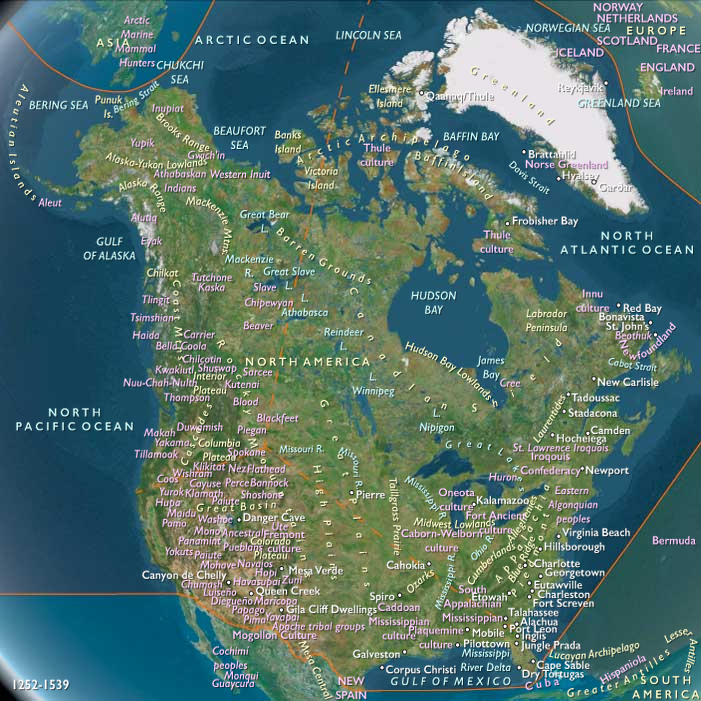
Subregions
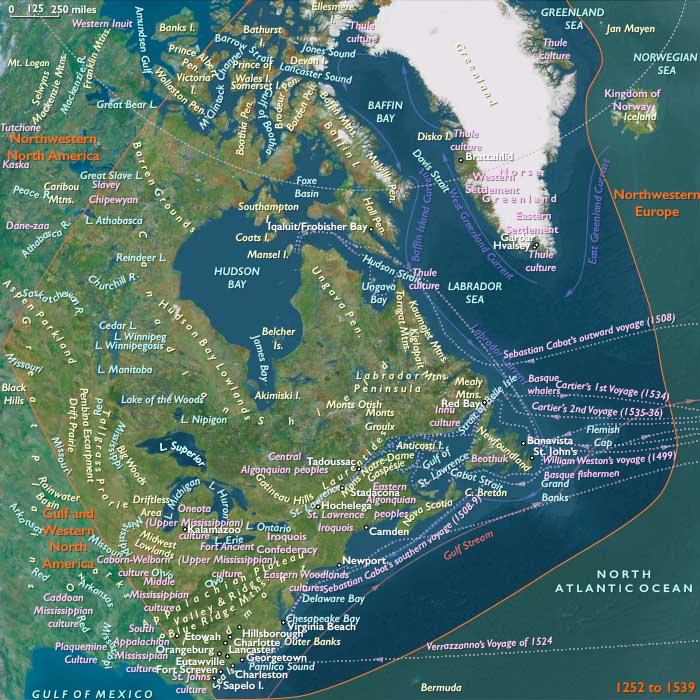
Years: 1396 - 1407
Groups
- Mound Builders
- Dorset culture
- Caddoan Mississippian culture
- Mississippian culture
- Iroquois (Haudenosaunee, also known as the League of Peace and Power, Five Nations, or Six Nations)
- Ho-Chunk (Amerind tribe)
- Tunlit (Dorset culture)
- Thule people
- Penobscot people (Amerind tribe)
- Mi'kmaq people (Amerind tribe)
- Greenland, Norwegian Crown Colony of
- Denmark, Kingdom of (Personal Union of Denmark and Norway)
- Osage Nation (Amerind tribe)
- Mohawk people (Amerind tribe)
- Wyandot, or Wendat, or Huron people (Amerind tribe)
- Kalmar Union (of Denmark, Norway and Sweden)
- Susquehannock (Amerind tribe)
- Cherokee, or Tsalagi (Amerind tribe)
- Quapaw, or Arkansas (Amerind tribe)
- Omaha (Amerind tribe)
- Kaw, or Kanza, people (Amerind tribe)
- Caddo (Amerind tribe)
- Tuscarora (Amerind tribe)
- Ponca (Amerind tribe)
- Yuchi (Amerind tribe)
- Catawba people (Amerind tribe)
- Seneca (Amerind tribe)
- Cayuga people(Amerind tribe)
- Onondaga people (Amerind tribe)
- Oneida people (Amerind tribe)
Topics
Commodoties
- Fish and game
- Gem materials
- Colorants
- Domestic animals
- Grains and produce
- Ceramics
- Strategic metals
- Tobacco
Subjects
- Commerce
- Environment
- Decorative arts
- Exploration
- Government
- Custom and Law
- Technology
- Human Migration
Regions
Subregions