
Northeastern North America (1408 to 1419 …
Years: 1408 - 1419
Northeastern North America
(1408 to 1419 CE): Continued Regional Adaptations, Arctic Consolidation, and Cultural Realignments
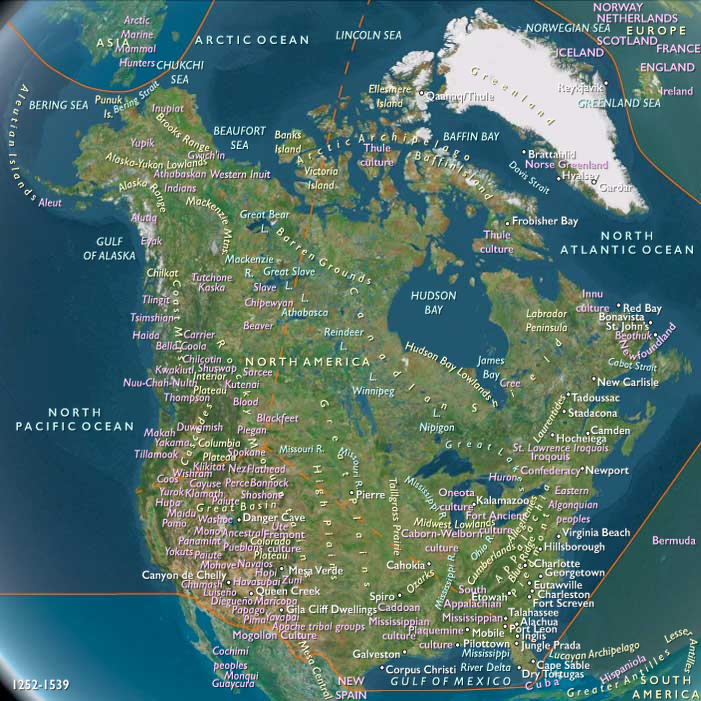
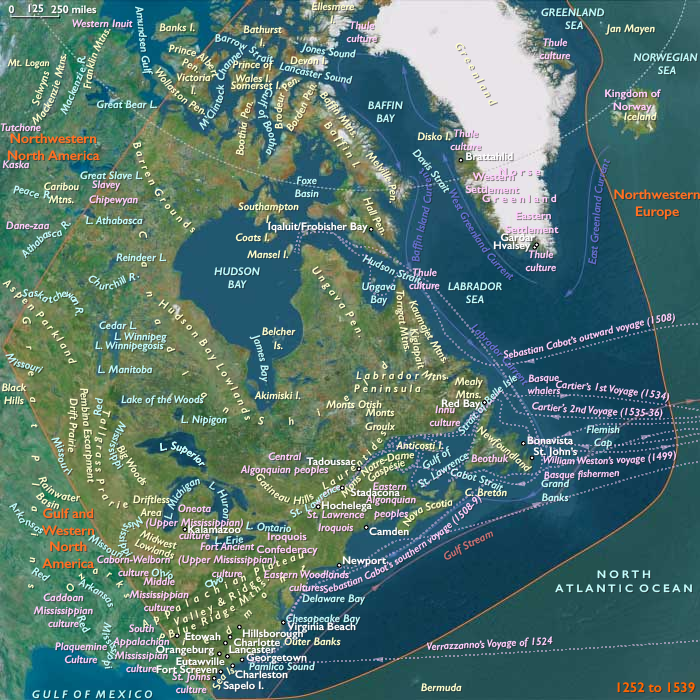
The era from 1408 to 1419 CE in Northeastern North America marked ongoing cultural realignment and regional adaptation, characterized by the dispersal of former Mississippian populations into smaller communities, continued strengthening of the Haudenosaunee Confederacy, stability among Dhegiha-speaking peoples, and the increasing dominance of Thule Inuit culture in Arctic regions. The period reflects gradual yet important shifts, with indigenous societies adapting to new ecological realities, political landscapes, and intergroup relations in the aftermath of Cahokia’s collapse and amid the climatic pressures impacting the Norse colonies in Greenland.
Mississippian Cultural Fragmentation and Regionalization
Smaller Chiefdoms and Localized Societies
By 1410 CE, the larger Mississippian ceremonial centers and urban complexes, exemplified by the now-abandoned Cahokia, had fragmented into smaller, more decentralized chiefdoms. Communities became increasingly localized, often fortified, reflecting heightened intergroup competition over resources and shifting territorial dynamics. Centers such as Etowah (Georgia) and Moundville (Alabama) continued as key regional hubs, although with reduced populations compared to previous centuries.
Decline of Ceremonial Monumentality
Monumental mound-building and associated elaborate ceremonialism notably diminished during this period. Ritual activities became more localized and community-focused, shifting away from expansive regional ceremonial events toward localized rites that supported regional identities and internal cohesion.
Haudenosaunee Consolidation and Regional Influence
Confederacy Strengthening
During this period, the Haudenosaunee Confederacy—comprising the Mohawk, Oneida, Onondaga, Cayuga, and Seneca nations—continued solidifying internal political structures, collective decision-making processes, and territorial unity. This political organization allowed the Confederacy to navigate diplomatic relationships and occasional tensions with neighboring Algonquian-speaking tribes, reinforcing their position as a dominant regional power in the Northeast.
Cultural and Linguistic Identity
By now, the Iroquoian languages were distinctly branched into Northern (Mohawk, Oneida, Seneca, Onondaga, Cayuga, Susquehannock, Tuscarora, Huron) and Southern (Cherokee) divisions. These linguistic distinctions underscored enduring cultural identities and social practices, with the Five Nations, in particular, reinforcing their narrative of migration and cultural differentiation from neighboring Algonquian-speaking peoples who viewed them as powerful outsiders.
Dhegiha Cultural Stability
Established Villages and Agricultural Systems
The Dhegiha-speaking peoples—ancestors of the Quapaw, Omaha, Ponca, Osage, and Kaw—maintained stable agricultural settlements west of the Mississippi River during this era. Their villages, supported by maize agriculture and supplemented with hunting and gathering, remained culturally cohesive, organized around strong kinship networks and localized leadership structures. Their stability was based primarily on internal cultural continuity rather than external pressures or conflict.
Thule Inuit Arctic Dominance
Completion of Dorset Displacement
The Thule Inuit, having fully displaced the Dorset (Tuniit) culture by the beginning of this era, solidified their dominance across the Canadian Arctic and Greenland. Inuit oral traditions regarding the Tuniit persisted, but archaeological evidence shows clearly that technological advantages—especially the use of sled dogs, slate knives, toggling harpoons, and effective marine mammal hunting methods—allowed the Thule to thrive in the challenging Arctic environment.
Thule-Norse Interactions
Limited interactions continued between the Thule Inuit and remaining Norse Greenland settlements, which by this time faced increasing isolation and severe climatic challenges. Archaeological finds indicate sparse and intermittent contact between these groups, with Inuit occasionally obtaining Norse items through trade, scavenging, or conflict. However, interactions remained sporadic, and Norse references to indigenous populations (collectively called skrælingar) offered little detailed documentation of their exchanges.
Decline of Norse Greenland
Intensifying Climatic Challenges
During this era, Norse Greenland settlements, already weakened by the cooling climate since approximately 1300 CE, faced mounting survival pressures. The earlier abandonment of the Western Settlement (c. 1350) left the remaining Eastern Settlement increasingly isolated and vulnerable, struggling with declining agricultural yields, scarcity of resources such as timber and iron, and dwindling trade opportunities with Europe.
Evidence from Ice Core Research
Modern scientific investigations of Greenland’s ice cores confirmed significant climatic cooling, which continued throughout the fifteenth century. These climatic trends, part of the onset of the Little Ice Age, severely restricted agricultural viability and resource availability, pushing Norse Greenland closer to eventual abandonment.
Persistent Indigenous Economies and Regional Trade Networks
Coastal and Riverine Stability
Indigenous communities along the northeastern coast and inland waterways continued to sustain stable, self-sufficient economies based on fishing, trapping, hunting, and gathering. Fishing technologies such as nets, weirs, and traps supported robust food security and territorial integrity, ensuring cultural and social stability within these localized groups.
Artistic and Ceremonial Continuity
Artisans maintained sophisticated traditions of craftsmanship—shell gorgets, ceremonial pottery, polished stone tools, and ornate tobacco pipes. Ritual and artistic traditions endured, reinforcing community identity and social structures despite broader regional transformations. While large-scale ceremonialism declined, localized ritual practices remained central to community cohesion.
Legacy of the Era (1408–1419 CE)
This period exemplifies continued adaptation, cultural realignment, and regionalization in Northeastern North America. Mississippian societies fragmented further into smaller chiefdoms, reinforcing localized identities amid diminishing ceremonial monumentality. The Haudenosaunee Confederacy steadily strengthened its regional political power, setting the stage for future territorial and diplomatic roles. Stable Dhegiha villages demonstrated cultural continuity and agricultural resilience west of the Mississippi. In the Arctic, Thule Inuit groups thrived, having consolidated their territorial control and fully displaced the Dorset culture. Concurrently, the Norse Greenland colonies faced mounting ecological pressures, further diminishing prospects for survival. These cumulative trends shaped enduring regional identities and laid the foundations for the complex interactions soon to unfold with sustained European contact in subsequent generations.
Groups
- Mound Builders
- Dorset culture
- Caddoan Mississippian culture
- Mississippian culture
- Iroquois (Haudenosaunee, also known as the League of Peace and Power, Five Nations, or Six Nations)
- Ho-Chunk (Amerind tribe)
- Tunlit (Dorset culture)
- Thule people
- Penobscot people (Amerind tribe)
- Mi'kmaq people (Amerind tribe)
- Greenland, Norwegian Crown Colony of
- Osage Nation (Amerind tribe)
- Mohawk people (Amerind tribe)
- Wyandot, or Wendat, or Huron people (Amerind tribe)
- Kalmar Union (of Denmark, Norway and Sweden)
- Oneida people (Amerind tribe)
- Susquehannock (Amerind tribe)
- Cherokee, or Tsalagi (Amerind tribe)
- Quapaw, or Arkansas (Amerind tribe)
- Omaha (Amerind tribe)
- Kaw, or Kanza, people (Amerind tribe)
- Caddo (Amerind tribe)
- Tuscarora (Amerind tribe)
- Ponca (Amerind tribe)
- Yuchi (Amerind tribe)
- Catawba people (Amerind tribe)
- Seneca (Amerind tribe)
- Cayuga people(Amerind tribe)
- Onondaga people (Amerind tribe)
Topics
Commodoties
- Fish and game
- Gem materials
- Colorants
- Domestic animals
- Grains and produce
- Ceramics
- Strategic metals
- Tobacco
Subjects
- Commerce
- Environment
- Decorative arts
- Exploration
- Government
- Custom and Law
- Technology
- Human Migration
Regions
Subregions
Years: 1408 - 1419
Groups
- Mound Builders
- Dorset culture
- Caddoan Mississippian culture
- Mississippian culture
- Iroquois (Haudenosaunee, also known as the League of Peace and Power, Five Nations, or Six Nations)
- Ho-Chunk (Amerind tribe)
- Tunlit (Dorset culture)
- Thule people
- Penobscot people (Amerind tribe)
- Mi'kmaq people (Amerind tribe)
- Greenland, Norwegian Crown Colony of
- Osage Nation (Amerind tribe)
- Mohawk people (Amerind tribe)
- Wyandot, or Wendat, or Huron people (Amerind tribe)
- Kalmar Union (of Denmark, Norway and Sweden)
- Oneida people (Amerind tribe)
- Susquehannock (Amerind tribe)
- Cherokee, or Tsalagi (Amerind tribe)
- Quapaw, or Arkansas (Amerind tribe)
- Omaha (Amerind tribe)
- Kaw, or Kanza, people (Amerind tribe)
- Caddo (Amerind tribe)
- Tuscarora (Amerind tribe)
- Ponca (Amerind tribe)
- Yuchi (Amerind tribe)
- Catawba people (Amerind tribe)
- Seneca (Amerind tribe)
- Cayuga people(Amerind tribe)
- Onondaga people (Amerind tribe)
Topics
Commodoties
- Fish and game
- Gem materials
- Colorants
- Domestic animals
- Grains and produce
- Ceramics
- Strategic metals
- Tobacco
Subjects
- Commerce
- Environment
- Decorative arts
- Exploration
- Government
- Custom and Law
- Technology
- Human Migration
Regions
Subregions