
Northeast Europe (1108 – 1251 CE): Crusades, …
Years: 1108 - 1251
Northeast Europe (1108 – 1251 CE): Crusades, Novgorodian Influence, and Scandinavian Kingdoms
Geographic and Environmental Context
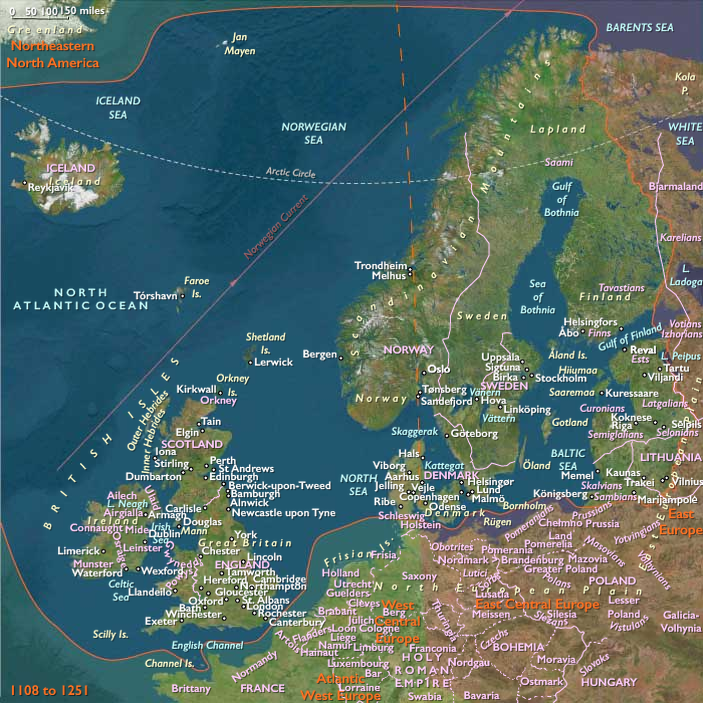
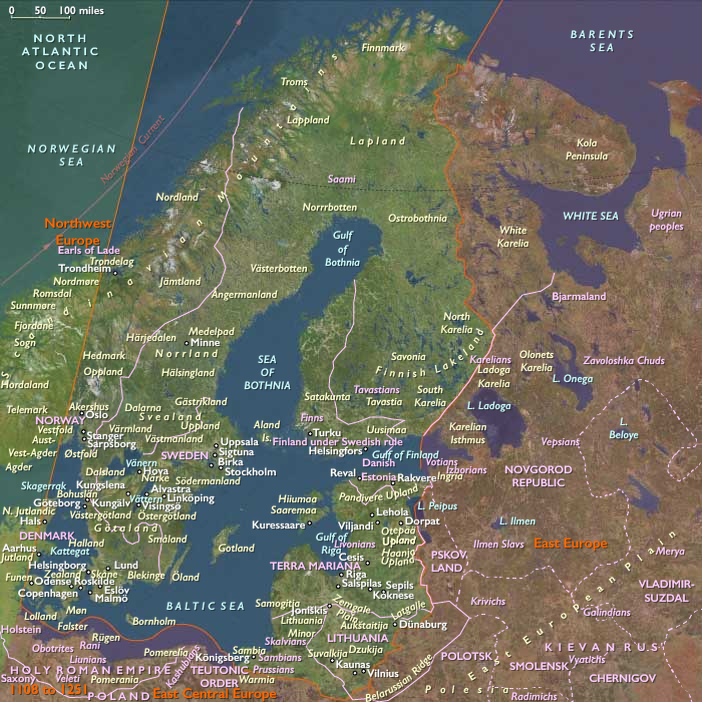
Northeast Europe includes Sweden, Finland, Lithuania, Latvia, Estonia, eastern Denmark, and eastern Norway (including Copenhagen and Oslo).
-
The Baltic Sea and Gulf of Finland served as vital maritime corridors linking Scandinavia, Rus’, and Western Europe.
-
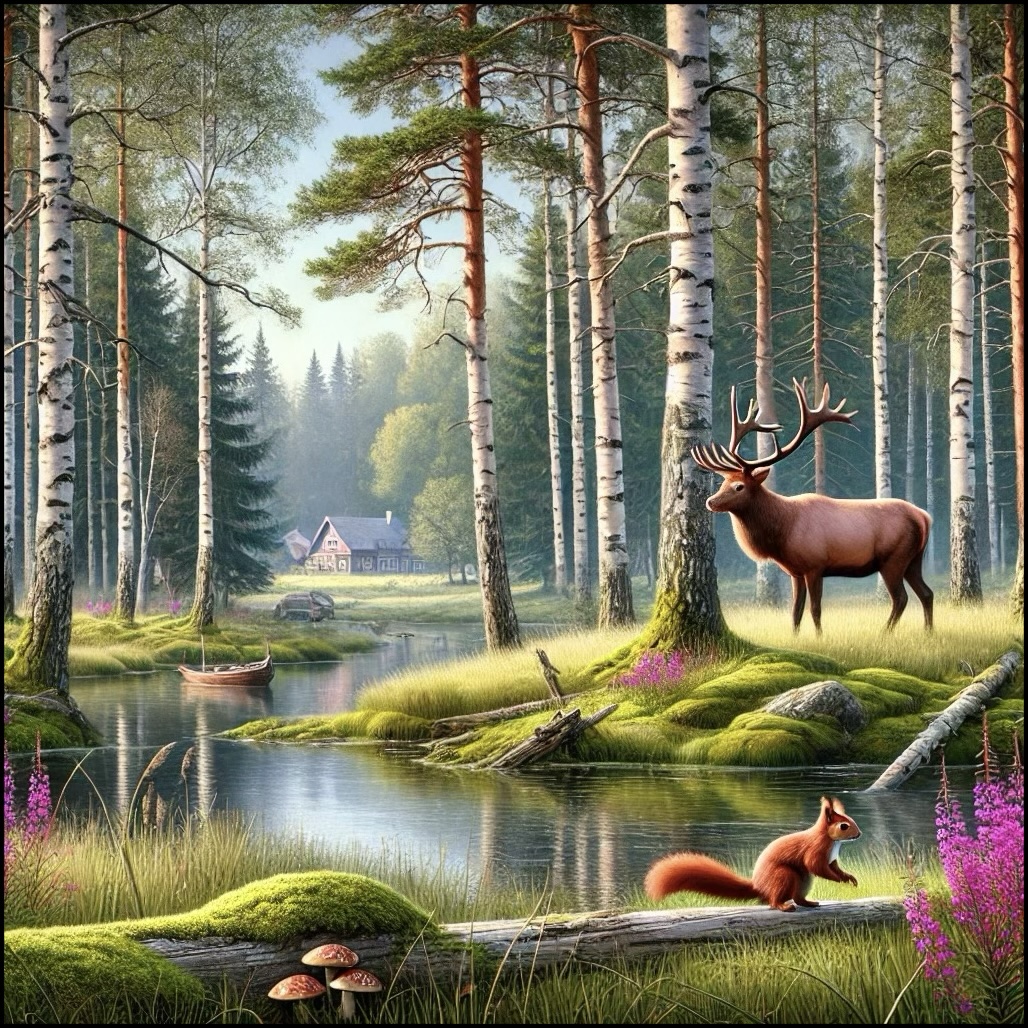
The forests and lakes of Finland and the Baltic lands sustained hunting, fishing, and limited agriculture.
-
Eastern Denmark and Norway anchored trade and military expeditions into the Baltic.
Climate and Environmental Shifts
-
The Medieval Warm Period favored agricultural expansion in Sweden, Denmark, and the Baltic littoral.
-
Longer growing seasons allowed cereals and livestock to spread into areas previously dependent on foraging.
-
Forest and marine resources remained abundant, buffering communities against agricultural shortfalls.
Societies and Political Developments
-
Scandinavia:
-
Sweden consolidated under kings who expanded eastward, seeking influence over Finland and Baltic trade.
-
Denmark asserted dominance over the southern Baltic, with Copenhagen and other towns growing as trading hubs.
-
Norway maintained maritime power, with Oslo developing as a regional center.
-
-
Finland: Populated by Finnic tribes, semi-independent but increasingly contested by Swedes, Danes, and Novgorod.
-
Novgorod: Expanded influence into Karelia and Finland, establishing forts and Orthodox missions.
-
Baltic lands (Latvia, Estonia, Lithuania): Pagan societies resisted Christianization.
-
The Northern Crusades (from the 12th century) brought German, Danish, and Swedish crusaders into Estonia and Latvia.
-
The Livonian Brothers of the Sword (est. 1202) conquered parts of Latvia and Estonia, later merging with the Teutonic Order (1237).
-
Lithuania, though still pagan, grew into a strong polity resisting crusaders.
-
Economy and Trade
-
Agriculture: Rye, barley, oats, and livestock expanded in Scandinavia and the Baltic.
-
Fur, wax, honey, and fish were exported from Finnic and Baltic lands to Novgorod and Western Europe.
-
Hanseatic trade began to develop, with German merchants linking the Baltic to Lübeck and Hamburg.
-
Maritime commerce tied Denmark, Sweden, and Norway into broader North Sea and Baltic economies.
Subsistence and Technology
-
Scandinavian farmers employed iron ploughs, watermills, and sailing ships for trade and warfare.
-
Finnic and Baltic peoples relied on slash-and-burn agriculture, hunting, and riverine fishing.
-
Fortified hilltop settlements and wooden castles dotted Estonia and Latvia.
-
The crusading orders built stone fortresses, symbols of Christian power.
Movement and Interaction Corridors
-
The Baltic Sea was the central artery of movement, carrying merchants, crusaders, and missionaries.
-
River routes tied the Baltic to Novgorod and Rus’, especially the Neva and Volkhov systems.
-
Crusader campaigns opened military corridors into Livonia and Estonia.
-
Scandinavian and German fleets patrolled and fought for dominance of Baltic trade.
Belief and Symbolism
-
Scandinavia: By this period, Christianity was firmly established, with churches, monasteries, and cathedrals reinforcing royal power.
-
Finnic and Baltic peoples: Maintained animist traditions centered on forests, rivers, and sky deities.
-
Northern Crusades: Framed conquest as a Christian mission, blending religious zeal with political and economic ambitions.
-
Novgorod advanced Orthodox Christianity in Karelia and Finland, competing with Latin Christianity.
Adaptation and Resilience
-
Agricultural expansion and trade sustained Scandinavian kingdoms, allowing them to project power eastward.
-
Baltic pagan societies adapted through fortified defenses and guerrilla tactics against crusaders.
-
Novgorod adapted through hybrid diplomacy and warfare, balancing trade interests with missionary activity.
-
Finnic groups maintained resilience through ecological knowledge, shifting between farming, hunting, and fishing.
Long-Term Significance
By 1251 CE, Northeast Europe had become a frontier of crusade and colonization. Scandinavia consolidated as Christian monarchies, Novgorod extended eastward influence, and German crusading orders established footholds in Estonia and Latvia. Lithuania emerged as a resistant pagan power, soon to become a major state. The region’s blend of crusading conquest, trade networks, and cultural contestation positioned Northeast Europe as a decisive frontier between Latin Christendom, Orthodox Rus’, and enduring pagan traditions.
Northeast Europe (with civilization) ©2024-25 Electric Prism, Inc. All rights reserved.
Groups
- Polytheism (“paganism”)
- Finns
- Balts
- Latvians, or Letts (Eastern Balts)
- Lithuanians (Eastern Balts)
- Estonians
- Estonia, independent
- Denmark, Kingdom of
- Norway, independent Kingdom of
- Hanseatic league (informally organized)
- Sweden, Kingdom of
- Christians, Roman Catholic
- Cistercians, Order of the (White Friars)
- Knights of the Sword (Order of the Livonian Brothers of the Sword, or Livonian Knights)
- Dominicans, or Order of St. Dominic
- Estonia, Danish
- Ordensstaat (Monastic state of the Teutonic Knights)
Topics
Commodoties
Subjects
Regions
Subregions
Years: 1108 - 1251
Northeast Europe (with civilization) ©2024-25 Electric Prism, Inc. All rights reserved.
Groups
- Polytheism (“paganism”)
- Finns
- Balts
- Latvians, or Letts (Eastern Balts)
- Lithuanians (Eastern Balts)
- Estonians
- Estonia, independent
- Denmark, Kingdom of
- Norway, independent Kingdom of
- Hanseatic league (informally organized)
- Sweden, Kingdom of
- Christians, Roman Catholic
- Cistercians, Order of the (White Friars)
- Knights of the Sword (Order of the Livonian Brothers of the Sword, or Livonian Knights)
- Dominicans, or Order of St. Dominic
- Estonia, Danish
- Ordensstaat (Monastic state of the Teutonic Knights)
Topics
Commodoties
Subjects
Regions
Subregions