
North Europe (964 – 1107 CE): Baltic …
Years: 964 - 1107
North Europe (964 – 1107 CE): Baltic Silver Age, Norman Conquest, and the Making of a Christian North
Geographic and Environmental Context
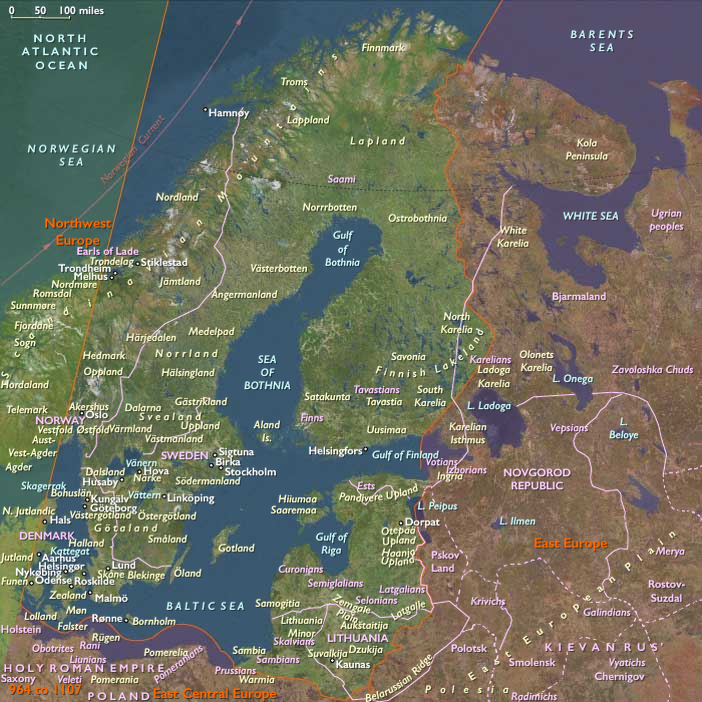
North Europe spanned the Baltic and North Sea worlds:
-
Northeast Europe: Sweden, Finland, Lithuania, Latvia, Estonia, eastern Denmark (Zealand–Skåne), and eastern Norway (Oslofjord), with Copenhagen and Oslo as rising nodes.
-
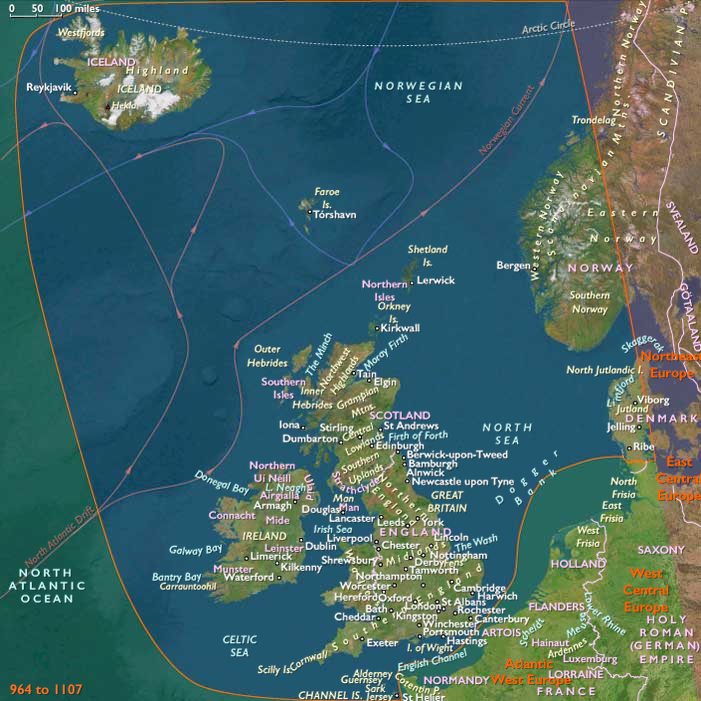
Northwest Europe: Iceland, Ireland, the United Kingdom (England–Scotland–Wales), Faroe, Shetland, Orkney, Channel Islands, and the western coastal zones of Norway and Denmark (west of 10°E).
The Øresund–Skåne choke point linked Baltic lanes to the North Sea, while Gotland, Sigtuna, Lund, Oslo, London, York, Dublin, Bergen, and Trondheim formed a necklace of maritime towns. Archipelagos (Orkney–Shetland–Faroe–Iceland) bridged Norway to the open Atlantic; the Bothnian and Finnish gulfs carried forest and fur frontiers into the Baltic exchange.
Climate and Environmental Shifts
The Medieval Warm Period (c. 950–1250) lengthened growing seasons, lifted cereal yields in southern Scandinavia and the eastern Baltic, and widened navigation windows by reducing seasonal ice in the Gulf of Bothnia and Gulf of Finland.
Stable marine ecologies sustained herring and cod from the North Sea to Iceland, while expansive forests underwrote fur, wax, honey, and tar exports. Periodic steppe drought signals nudged mobility on eastern Baltic frontiers but did not disrupt the main maritime arteries.
Societies and Political Developments
Danish and Norwegian Consolidation (Eastern portions + Atlantic coasts)
Harald Bluetooth (r. c. 958–986) unified Denmark, embraced Christianity (c. 965), and set royal markers at Jelling; royal tolls at the Øresund monetized Baltic–North Sea traffic. In Norway, Oslofjord chieftains turned toward kingship; Olaf II (St. Olaf, d. 1030) strengthened royal authority as coastal earls from Bergen–Trondheim managed Atlantic ties.
Sweden and the Eastern Baltic
With Birka’s decline (c. 975), Sigtuna rose as a royal mint-town; Svear and Götar assemblies coexisted with growing kingship. Christian influence deepened after c. 1000, though Uppsala’s cults persisted into the 11th century. Estonian, Livonian, Curonian, Semigallian, Latgalian, and Lithuanian hillfort polities taxed rivers and raided coasts; Finnicgroups in Åland–southwest Finland–Tavastia balanced autonomy with trade/tribute ties to Swedes and Novgorodians.
Insular and British Realms; Norman Reordering
England moved from late Anglo-Saxon consolidation through Cnut’s North Sea empire (1016–1035) to the Norman Conquest (1066) under William, introducing castles, feudal estates, and the Domesday survey (1086).
Ireland saw powerful dála kingships and Norse towns (Dublin–Waterford–Cork) negotiating autonomy; Brian Boru’s rise and death (1014) framed the high-king dynamic.
Scotland (Malcolm II–III) consolidated Lowland cores while Norse jarls held sway in Orkney–Hebrides.
Iceland Christianized c. 1000; the Althing preserved self-rule even as Norwegian overlordship gathered later in the century.
Christian Missions and Structures
Imperial support from Otto II–III backed Hamburg–Bremen missions to Scandinavia and the Baltic. By c. 1100, Denmark and Norway were Christian monarchies; Sweden maintained mixed forms; Baltic tribes and Finlandlargely resisted conversion until the 12th–13th centuries.
Economy and Trade
Exports: furs, wax, honey, amber, falcons, slaves (eastern Baltic); timber, tar, iron, fish (Norway–Iceland–North Sea); grain and livestock from southern Scandinavia.
Imports: silver (first Islamic dirhams via Rus’, later German/Anglo-Saxon coin), wine, silk, weapons, glass.
Monetization shift: the dirham inflow collapsed after c. 970; hack-silver hoards thin by c. 1050 as Lund and Sigtuna mint local coin and German money circulates.
Nodes and corridors:
-
Gotland as entrepôt with vast silver hoards; Sigtuna–Lund–Oslo as craft/market towns.
-
Øresund tolls knit Zealand–Skåne to the Rhine–Channel world.
-
Dvina/Daugava/Nemunas rivers opened the Baltic to Novgorod, Kiev, and the Polish interior.
-
London emerged as a major European port; Rouen–Seine, La Rochelle–Bordeaux, and Dublin–York handled Atlantic flows.
-
Flanders’ cloth towns (across your regional line) were prime outlets for English wool and Scandinavian raw goods.
Subsistence and Technology
Mixed farming expanded (rye, barley, oats + cattle/swine), while swidden persisted in Finland/eastern Baltic.
Fishing & sealing supported surplus in gulfs and archipelagos; offshore cod fisheries linked Norway–Iceland–Orkney.
Ironworking from bog ores supplied tools/axes; high-grade blades arrived from the Rhineland.
Shipbuilding excelled in clinker-built longships and broad-beamed knarrs; wool sails extended range.
Fortification & ecclesiastical build: timber–earth hillforts dotted the Baltic; stone churches and royal halls rose in Denmark/Sweden; motte-and-bailey castles spread in Norman England and the Isles.
Movement and Interaction Corridors
-
Baltic blueways: Gotlanders and Swedes ran east to Rus’ and south via Øresund to German–Flemish markets.
-
Øresund–Skåne bottleneck: Danish kings taxed passage between seas.
-
Eastern rivers: Dvina/Daugava to Novgorod; Nemunas toward Prussia/Poland.
-
Oslofjord–Skåne choke point linked Norway’s east to Danish and Swedish marts.
-
North Sea–Atlantic: Orkney–Shetland–Faroe–Iceland as stepping stones; London–York–Winchester, Dublin–Waterford–Cork, Bergen–Trondheim as hubs; Channel routes connected England to Normandy and Flanders.
Belief and Symbolism
Norse paganism persisted longest in Sweden (Uppsala) and among Baltic tribes; thunder gods (Perkūnas/Ukko) and sacred groves anchored ritual.
Christianity consolidated in Denmark and Norway by c. 1000; Sweden’s rulers converted mid-century; mission probes reached Finland and Livonia.
On the Atlantic rim, monastic expansion in England–Ireland–Scotland and Norman Romanesque reshaped sacred landscapes.
Burials show hybridization—stone churches and Christian graves in Denmark/Sweden alongside boat burials and cremations in the Baltic lands.
Adaptation and Resilience
-
Trade pivot: after dirhams waned, Baltic merchants shifted to German coin and barter bundles (furs–amber–wax), keeping circuits liquid.
-
Urban frameworks: royal towns (Sigtuna, Lund) concentrated minting, craft, and law; London, Dublin, York, Bergen scaled up port governance.
-
Dual economies: farming–fishing–raiding portfolios and seasonal mobility buffered shock.
-
Legal assemblies (things) stabilized transitions to kingship and Christianity; in the Isles, Althing and regional things sustained consensual rule.
Long-Term Significance
By 1107 CE, North Europe had crossed the threshold to a Christian, monetizing, and maritime-integrated world:
-
Denmark and Norway stood as consolidated Christian monarchies controlling the Øresund and North Atlantic gateways.
-
Sweden advanced toward full Christian kingship while Uppsala’s cult lingered; Finland and the Baltic tribes preserved autonomy and pagan traditions, foreshadowing 12th–13th-century crusades.
-
The Norman Conquest knit the Channel into a single political–military field; Iceland and the Isles formalized Christian law within assembly polities.
-
Gotland, London, and Dublin flourished as entrepôts, even as silver streams shifted from Islamic dirhams to western coin.
The age fixed the Baltic–North Sea system as a commercial hinge of northern Eurasia and set the institutional patterns—kingship, councils, coin, church, and ships—that would drive the 12th-century northern expansion.
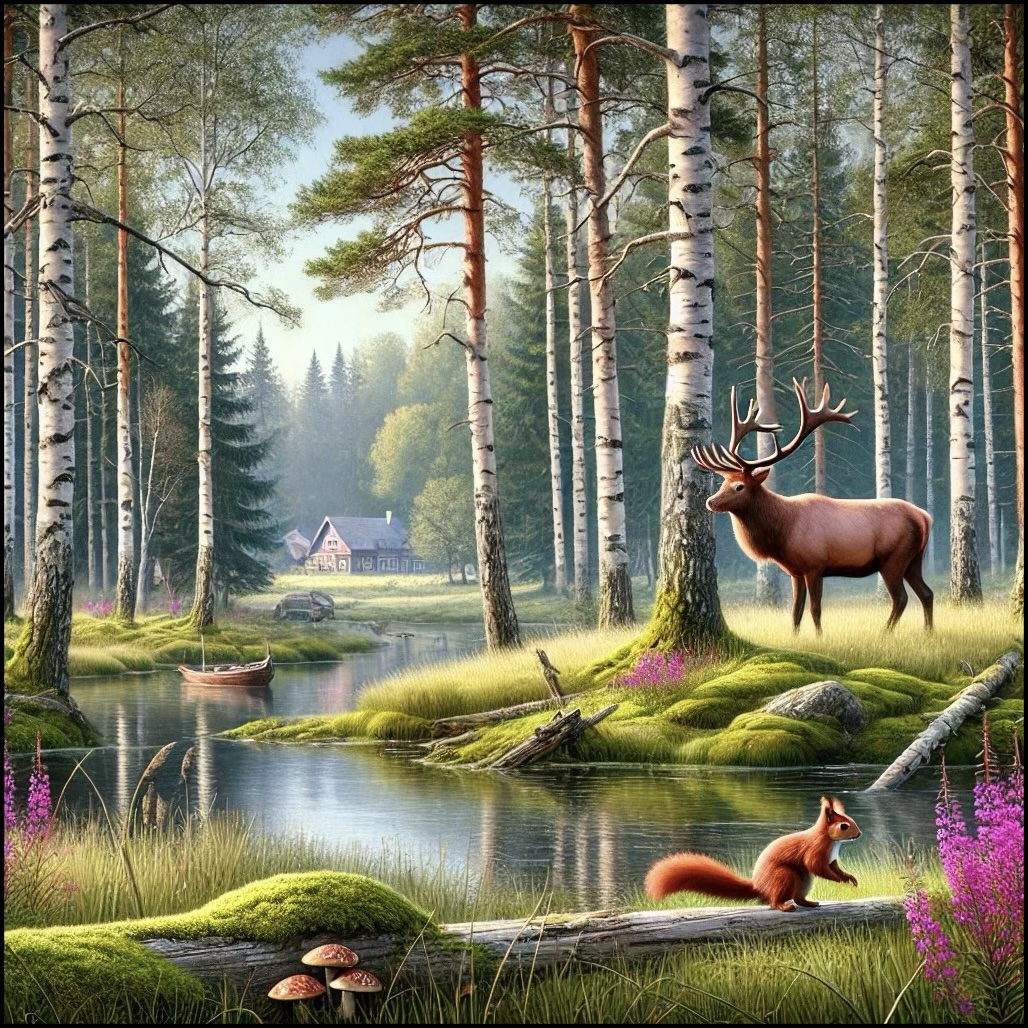
Northeast Europe (with civilization) ©2024-25 Electric Prism, Inc. All rights reserved.
People
Groups
- Polytheism (“paganism”)
- Prussians, Old, or Baltic (Western Balts)
- Finns
- Este culture
- Sami people
- Karelians
- Tavastians
- Curonians (Western Balts)
- Latgalians (Eastern Balts)
- Selonians (Eastern Balts)
- Yotvingians, or Sudovians (Western Balts)
- Galindians, Western (Western Balts)
- Skalvians, or Scalovians (Western Balts)
- Sambians (Western Balts)
- Latvians, or Letts (Eastern Balts)
- Lithuanians (Eastern Balts)
- Aukstaitians, or Highland Lithuanians (Eastern Balts)
- Galindians, Eastern (Eastern Balts)
- Estonians
- Samogitians, or Lowland Lithuanians (Eastern Balts)
- Semigallians (Eastern Balts)
- Estonia, independent
- Christianity, Chalcedonian
- Denmark, Kingdom of
- Varangians
- Danes (Scandinavians)
- Swedes (North Germanic tribe)
- Norse
- Götaland, (Scandinavian) Kingdom of
- Svealand, (Scandinavian) Kingdom of
- Norway, independent Kingdom of
- Sweden, Kingdom of
- Christians, Roman Catholic
Topics
Commodoties
Subjects
Regions

Subregions
Years: 964 - 1107
Northeast Europe (with civilization) ©2024-25 Electric Prism, Inc. All rights reserved.
People
Groups
- Polytheism (“paganism”)
- Prussians, Old, or Baltic (Western Balts)
- Finns
- Este culture
- Sami people
- Karelians
- Tavastians
- Curonians (Western Balts)
- Latgalians (Eastern Balts)
- Selonians (Eastern Balts)
- Yotvingians, or Sudovians (Western Balts)
- Galindians, Western (Western Balts)
- Skalvians, or Scalovians (Western Balts)
- Sambians (Western Balts)
- Latvians, or Letts (Eastern Balts)
- Lithuanians (Eastern Balts)
- Aukstaitians, or Highland Lithuanians (Eastern Balts)
- Galindians, Eastern (Eastern Balts)
- Estonians
- Samogitians, or Lowland Lithuanians (Eastern Balts)
- Semigallians (Eastern Balts)
- Estonia, independent
- Christianity, Chalcedonian
- Denmark, Kingdom of
- Varangians
- Danes (Scandinavians)
- Swedes (North Germanic tribe)
- Norse
- Götaland, (Scandinavian) Kingdom of
- Svealand, (Scandinavian) Kingdom of
- Norway, independent Kingdom of
- Sweden, Kingdom of
- Christians, Roman Catholic
Topics
Commodoties
Subjects
Regions
Subregions