
North Europe (909 BCE – 819 CE): …
Years: 909BCE - 819
North Europe (909 BCE – 819 CE): Forest Kingdoms, Maritime Worlds, and the Dawn of the North
Regional Overview
From the fjords of Norway to the amber shores of the Baltic, North Europe was a world of forests, lakes, and seas bound by wind and current rather than by walls or roads.
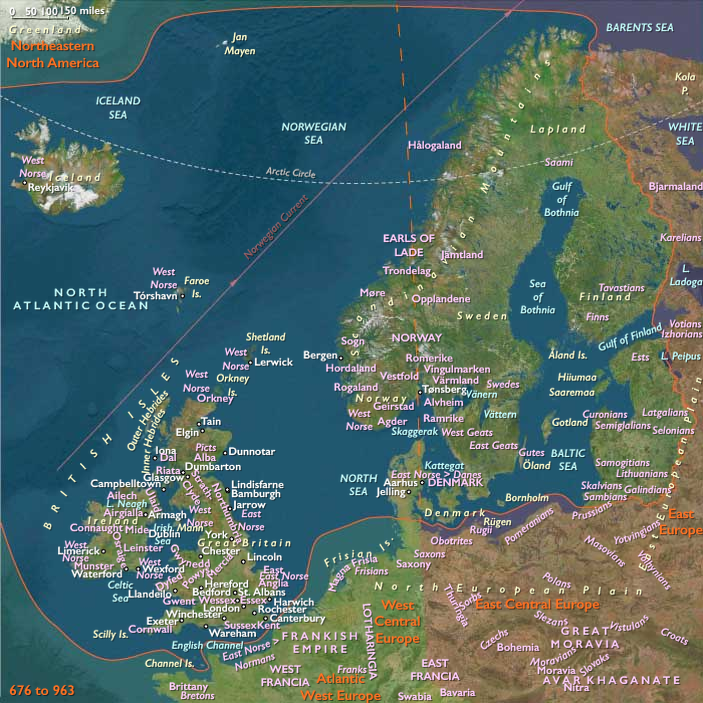
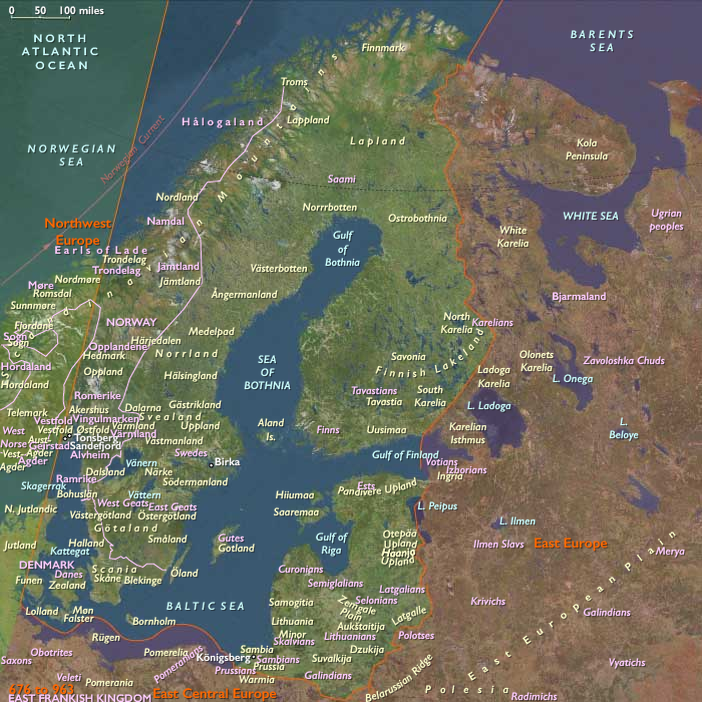
Two great environmental and cultural spheres defined it: the Northeast, a mosaic of Finnic and Baltic foragers and hillfort farmers along inland lakes and amber coasts; and the Northwest, a maritime arc of Celtic and Germanic kingdoms and monastic communities edging the North Sea and Atlantic.
By the close of this epoch the two were drawing together—trading, raiding, and exchanging faith and technology—laying the foundations of the Viking Age and the Christian north.
Geography and Environment
North Europe’s geography formed a seamless gradient from boreal forest to storm-washed archipelago.
-
The Northeast stretched across the Baltic rim—Sweden, Finland, Estonia, Latvia, and Lithuania—into the inland lakes of Karelia and the Uppland–Mälaren basin. Thick spruce and birch forests, interlaced with waterways, created natural corridors for canoe travel and trapping.
-
The Northwest encompassed the British Isles, western Scandinavia, and Denmark’s archipelagos—rugged coasts, fjords, and islands facing the open Atlantic.
Cold, moist climates encouraged mixed subsistence: forest hunting, shifting agriculture, and coastal fishing. Storms and long winters shaped durable architectures—timber halls, turf houses, and stone ringforts—and fostered the technologies of shipbuilding and preservation that would soon knit the northern seas together.
Societies and Political Developments
Northeast Europe: Forest Tribes and Hillfort Chiefdoms
By the first millennium BCE, Finnic and Baltic communities occupied nearly every river and lake basin.
Baltic hillforts such as those along the Daugava and Nemunas emerged by 500 BCE, coordinating agriculture, trade, and defense.
Amber routes connected these uplands to the Mediterranean, while forest hunters supplied furs and wax to southern traders.
In Sweden and eastern Denmark, the Nordic Iron Age transformed villages into organized chiefdoms, their power expressed in burial mounds and weapon hoards.
From the 2nd century CE onward, early Norse seafarers probed the Baltic coasts, founding trading enclaves that linked Scandinavia to Finnic and Baltic hinterlands; by the 7th–8th centuries, ports such as Grobiņa and Staraya Ladoga foreshadowed the Viking emporia to come.
Northwest Europe: Kingdoms, Monasteries, and Sea Routes
Across the British Isles and Scandinavia, Celtic and Germanic peoples forged dynamic polities.
In Ireland and western Britain, Celtic kingdoms such as Dal Riata, Dyfed, and Gwynedd coexisted with emerging Anglo-Saxon realms—Wessex, Mercia, and Northumbria.
North of the Forth, Pictish confederations endured; across the sea, Norwegian and Danish societies consolidated coastal lordships that would soon drive outward expansion.
By the 6th–8th centuries, Irish monasticism created a network of learning and mission—scriptoria at Iona, Kells, and Lindisfarne radiated faith and artistry throughout the North Atlantic.
Economy and Trade
Across both subregions, economic life rested on diversified resource webs.
-
In the forests and lake zones, hunting, beekeeping, and small-field cultivation of barley and rye complemented fishing and amber gathering.
-
Along the coasts, cereal farming, livestock, and ocean fisheries merged with shipborne trade.
Amber, furs, and iron moved southward; wine, glassware, and silver came north. Riverways—the Dvina, Vistula, and Neva—and sea lanes across the Skagerrak and North Sea carried this commerce. By the late 8th century, these routes had fused into a northern economic sphere stretching from the Dnieper portages to Ireland’s monasteries.
Technology and Material Culture
Iron tools and weapons spread steadily from 700 BCE onward. Tar production, pitch caulking, and clinker-built ship construction advanced in Scandinavia; by the early centuries CE, longboats capable of open-sea voyages appeared.
Hillforts and burial mounds dominated the Baltic interior, while stone crosses and timber churches began to punctuate western landscapes.
Metalwork—Baltic spiral ornaments, Insular brooches, and Nordic animal interlace—revealed the shared artistry of a region communicating by sea.
Belief and Symbolism
Religion in North Europe remained a layered synthesis of animism, ancestor veneration, and emergent Christianity.
In the east, sacred groves, springs, and stones embodied the spirits of forest and water. Among Norse and Germanic peoples, polytheistic cults to Odin, Thor, and Freyja gained form in hilltop sanctuaries and rune stones.
In the British Isles, Christianity spread from both Roman and Celtic missions, creating a hybrid faith of monasteries and miracle tales. The illuminated manuscripts of Ireland and Northumbria stand as the visual theology of this cultural fusion.
Adaptation and Resilience
Ecological balance defined northern resilience. Mixed economies—hunting, herding, tillage, and fishing—buffered climatic swings. Timber, turf, and stone dwellings resisted storms; smoked fish and fermented grain carried communities through dark seasons.
Politically, kinship alliances and sea mobility allowed rapid regrouping after conflict or famine. Monastic networks provided education, diplomacy, and surplus storage, while trading ties spread risk across wide distances.
Regional Synthesis and Long-Term Significance
By 819 CE, North Europe had entered the threshold of the Viking and Carolingian centuries.
In the Northeast, Baltic and Finnic chiefdoms, tied by amber and fur trade to the Norse, stood poised for incorporation into the Scandinavian and Rus’ spheres.
In the Northwest, Christianized kingdoms and monastic centers anchored a seaborne world economy that would soon span from Iceland to the Dnieper.
Together these complementary realms—forest and sea, pagan and Christian, barter and written law—defined the northern frontier of Eurasian civilization.
Their natural division into Baltic–Finnic and Atlantic–Insular spheres reveals not isolation but balance: one supplied resources and trade corridors, the other literacy and long-distance navigation.
From their convergence arose the dynamic maritime cultures that would, in the centuries to follow, link the North Atlantic to every shore of the known world.
Groups
- Prussians, Old, or Baltic (Western Balts)
- Finns
- Este culture
- Sami people
- Karelians
- Tavastians
- Semigallians (Eastern Balts)
- Latgalians (Eastern Balts)
- Selonians (Eastern Balts)
- Yotvingians, or Sudovians (Western Balts)
- Galindians, Western (Western Balts)
- Skalvians, or Scalovians (Western Balts)
- Sambians (Western Balts)
- Latvians, or Letts (Eastern Balts)
- Lithuanians (Eastern Balts)
- Aukstaitians, or Highland Lithuanians (Eastern Balts)
- Galindians, Eastern (Eastern Balts)
- Estonians
- Samogitians, or Lowland Lithuanians (Eastern Balts)
- Curonians (Western Balts)
- Estonia, independent
- Varangians
- Danes (Scandinavians)
- Swedes (North Germanic tribe)
- Norse
Topics
- Viking Raids in England, Early
- Viking Raids in Ireland
- Viking Raids
- Viking Raids in France, Early
- Viking Raids in the North Sea
Commodoties
- Fish and game
- Weapons
- Hides and feathers
- Gem materials
- Domestic animals
- Grains and produce
- Ceramics
- Strategic metals
- Slaves
- Lumber
Subjects
Regions
Subregions
Related Events
Showing 6 events out of 6 total
Years: 909BCE - 819
Groups
- Prussians, Old, or Baltic (Western Balts)
- Finns
- Este culture
- Sami people
- Karelians
- Tavastians
- Semigallians (Eastern Balts)
- Latgalians (Eastern Balts)
- Selonians (Eastern Balts)
- Yotvingians, or Sudovians (Western Balts)
- Galindians, Western (Western Balts)
- Skalvians, or Scalovians (Western Balts)
- Sambians (Western Balts)
- Latvians, or Letts (Eastern Balts)
- Lithuanians (Eastern Balts)
- Aukstaitians, or Highland Lithuanians (Eastern Balts)
- Galindians, Eastern (Eastern Balts)
- Estonians
- Samogitians, or Lowland Lithuanians (Eastern Balts)
- Curonians (Western Balts)
- Estonia, independent
- Varangians
- Danes (Scandinavians)
- Swedes (North Germanic tribe)
- Norse
Topics
- Viking Raids in England, Early
- Viking Raids in Ireland
- Viking Raids
- Viking Raids in France, Early
- Viking Raids in the North Sea
Commodoties
- Fish and game
- Weapons
- Hides and feathers
- Gem materials
- Domestic animals
- Grains and produce
- Ceramics
- Strategic metals
- Slaves
- Lumber
Subjects
Regions
Subregions