
North Europe (820 – 963 CE): Viking …
Years: 820 - 963
North Europe (820 – 963 CE): Viking Networks, Baltic Gateways, and the Birth of Northern Christendom
Geographic and Environmental Context
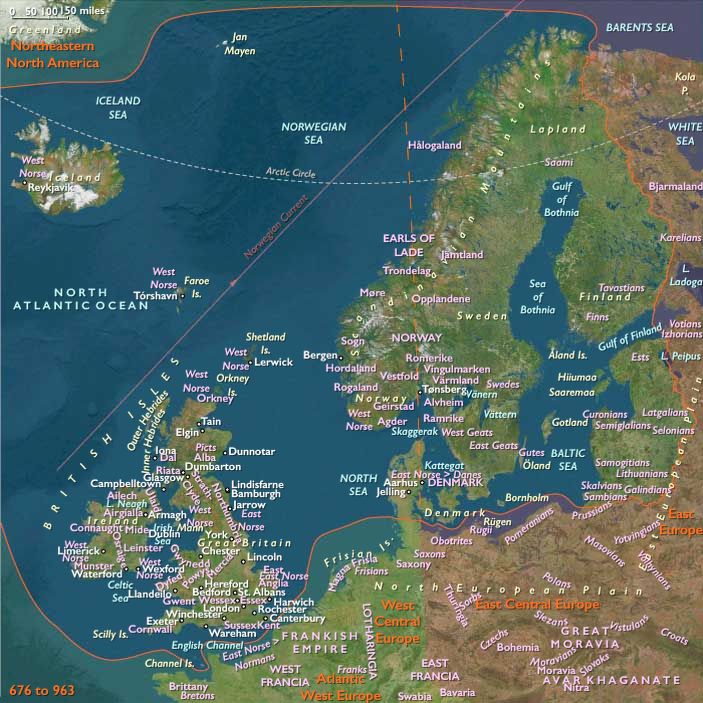
North Europe extended from the Baltic and Gulf of Finland to the North Sea and North Atlantic archipelagos, encompassing Scandinavia, the British Isles, the Baltic coasts, and the northern forest–sea frontier.
Two complementary maritime worlds defined the region:
-
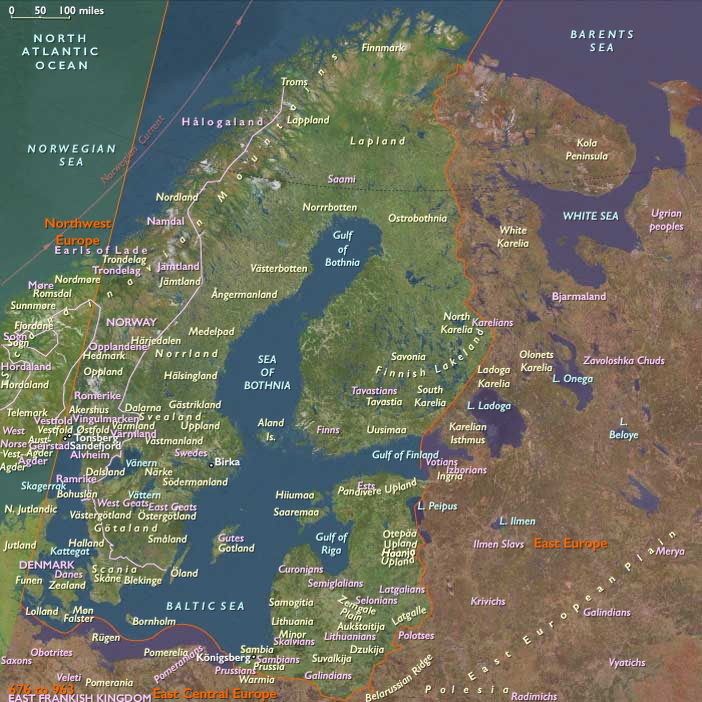
Northeast Europe—Sweden, Finland, the Baltic lands, and eastern Denmark and Norway—linked by the Baltic–Rus’ river networks and fur trade.
-
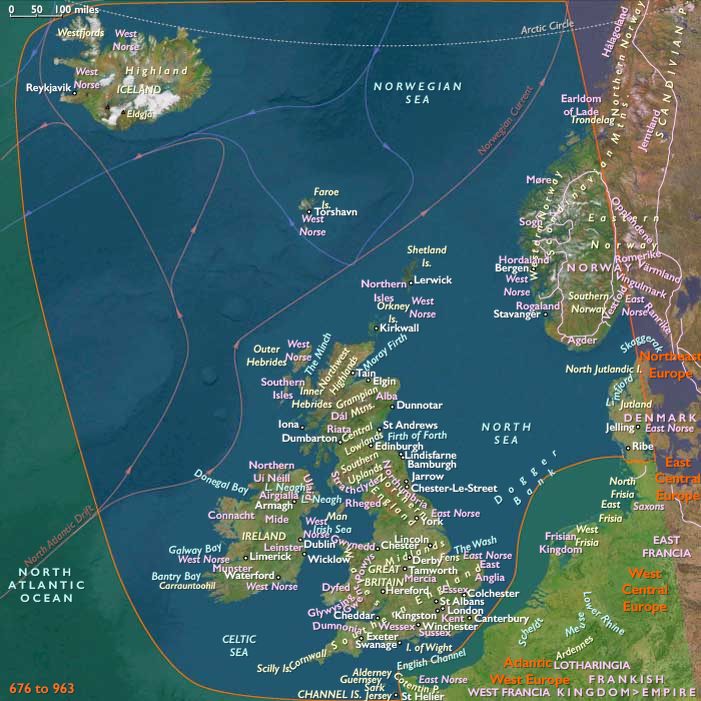
Northwest Europe—the British Isles, North Sea coasts, and Norwegian fjords—dominated by Viking raiding, settlement, and state formation.
Together they formed a single northern thalassocracy, bound by ships, silver, and sagas.
A cool-temperate climate persisted, but by c. 950 the Medieval Warm Period brought milder seasons, enabling longer sailing windows and expanding grain and pasture zones from Denmark to Iceland.
Societies and Political Developments
Northeast Europe: Baltic Traders and Forest Kingdoms
-
Sweden and Gotland: Powerful chiefdoms organized around Birka (c. 750–975), a premier Viking kaupang on Lake Mälaren linked to the Rus’–Volga silver routes. Assemblies (ting), cult centers (Uppsala), and retinues maintained balance between kings and nobles.
-
Eastern Denmark (Zealand/Skåne): Danish rulers from Horik to Gorm the Old (d. 958) controlled Baltic straits and tolls, fostering proto-urban markets and early royal ideology.
-
Eastern Norway (Viken/Oslofjord): Chieftains around the Oslofjord oriented toward Baltic commerce; Harald Fairhair’s consolidation (late 9th c.) bound western fjords but left Viken semi-autonomous.
-
Finland and Åland: Finnic communities blended swidden farming, fishing, and fur trade, connecting via Swedish merchants to Ladoga and Volga Bulgar markets.
-
Baltic tribes (Estonians, Livonians, Curonians, Semigallians, Lithuanians, Latgalians): Fortified hillfort societies managed sea–river interfaces, trading furs, wax, and slaves for Islamic silver and Byzantine goods. The Curonians built sea-raiding fleets that rivaled Scandinavian expeditions.
-
Christian missions: Ansgar’s embassies to Birka (829, 852) opened tentative dialogue with Christendom, but pagan traditions remained dominant.
Northwest Europe: Viking Age and Insular Consolidation
-
England: The Great Heathen Army (865) carved the Danelaw, ruling from York and East Anglia. Alfred the Great (871–899) defended Wessex, initiating English unification.
-
Ireland: Norse–Gaelic towns—Dublin, Waterford, Limerick—became trading and slave hubs linking Ireland, Britain, and Scandinavia.
-
Scotland: Orkney, Shetland, and the Hebrides came under Norse jarls; Gaelic and Norse traditions intertwined along the western seaways.
-
Iceland: Settled c. 870–930; the Althing (930) became Europe’s earliest continuous parliamentary assembly.
-
Norway: Coastal chieftains unified under Harald Fairhair (872), establishing a hereditary kingship while continuing raids westward.
-
Denmark: Gorm’s line unified the Danish heartland and projected power into the North Sea and Baltic.
-
Flanders and Normandy: Viking settlement produced cultural hybrids—the Norman Duchy (911) under Rollobalanced Norse vigor with Frankish feudal order.
Economy and Trade
-
Exports: furs, wax, honey, tar, amber, falcons, iron (from bog ore), slaves, and dried fish.
-
Imports: silver dirhams from the Islamic world, glass beads, silks, and fine metalwork from Byzantium and the Caliphate.
-
Dirham hoards across Gotland, Uppland, Åland, and the eastern Baltic attest to intensive exchange through Volga–Bulghar and Dnieper–Rus’ corridors.
-
Market towns (kaupangar): Birka, Hedeby, Kaupang (Norway), Zealand/Skåne ports, and Curonian trading forts served as transshipment nodes between the Baltic, Rus’, and North Sea.
-
Agrarian base: rye, barley, oats, flax, and livestock; mixed farming around lakes and river valleys; swidden agriculture in the north; seal and whale fisheries along arctic coasts.
-
Monetary flows: silver from Samanid Central Asia enriched northern economies and underwrote craft specialization.
Subsistence and Technology
-
Mixed economies: field crops, herding, hunting, and fisheries balanced subsistence with market surplus.
-
Shipbuilding: clinker-built longships (langskip) for warfare and broad-hulled knarr for trade; riveted planks, wool sails, tar caulking, and standard keel design revolutionized mobility.
-
Crafts: smithing of bog-iron; bead and comb workshops at Birka and Ribe; bone, antler, and amber ornamentation.
-
Fortifications: ringforts (e.g., Trelleborg), timber–earth hillforts, and coastal redoubts guarded inlets and trade routes.
-
Legal and political forms: things (assemblies) mediated law and kin disputes; oath-bound retinues underpinned early kingship.
Movement and Interaction Corridors
-
Baltic sea-roads: Gotlandic and Swedish fleets reached Estonia and Livonia, then moved upriver via Dvina, Neva, and Volkhov to Ladoga, Novgorod, and the Rus’ routes to Byzantium and the Caliphate.
-
Kattegat–Öresund straits: Danish toll points joined Baltic and North Sea trade.
-
North Sea routes: connected England, Norway, and Denmark to Ireland, Scotland, and the Frankish coast.
-
Gulfs of Finland & Bothnia: seasonal navigation tied Finland to Uppland and Estonia; winter sled routes kept furs moving when seas froze.
-
North Atlantic expansion: Norse settlers reached Faroe, Shetland, Orkney, Iceland, and by the next age Greenland.
-
River portages: canoe and boat hauls across watersheds maintained silver and slave flow to Baltic markets.
Belief and Symbolism
-
Norse cosmology: Odin, Thor, and Freyr dominated ritual life; Uppsala’s cult complex anchored royal legitimacy; ship burials and Thor’s hammer amulets expressed continuity with seafaring life.
-
Baltic and Finnic paganism: thunder and fertility deities—Perkūnas, Ukko—and sacred groves bound clans to landscape.
-
Christian presence: survived in Ireland, Anglo-Saxon England, and the Carolingian fringe; Ansgar’s missions (829, 852) reached Birka; later conversions awaited royal patronage.
-
Runic inscriptions and art: blended myth, law, and memorial, spreading literacy through image and rune.
Adaptation and Resilience
-
Dual economies—farm and fur, raid and trade—provided stability across volatile markets.
-
Route redundancy: when steppe conflicts disrupted Dnieper trade, merchants diverted to Volga or western river systems; when Baltic storms closed sea-lanes, over-ice and portage routes sustained traffic.
-
Kin networks and legal assemblies ensured compensation systems that stabilized commerce.
-
Maritime craftsmanship and cooperative ship labor reduced transport risk and spread technology rapidly.
-
Ecological flexibility: communities adapted from coastal fisheries to forest foraging and long-range voyaging as seasons demanded.
Long-Term Significance
By 963 CE, North Europe had become an interconnected maritime and riverine commonwealth:
-
Birka, Hedeby, and Gotland served as the mercantile hinge between Baltic fur frontiers and Eurasian silver routes.
-
Normandy, Denmark, and England anchored a new North Sea order, while Iceland embodied Norse self-governance through the Althing.
-
Finnic and Baltic hillfort societies balanced raiding with brokerage, linking forest hinterlands to global exchange.
This age forged the economic and cultural circuits of the Viking world, laying the foundations for Christianization, royal consolidation, and the medieval Baltic–North Sea trading system that would define Northern Europe in the following centuries.

Northeast Europe (with civilization) ©2024-25 Electric Prism, Inc. All rights reserved.
People
Groups
- Prussians, Old, or Baltic (Western Balts)
- Finns
- Este culture
- Sami people
- Karelians
- Tavastians
- Semigallians (Eastern Balts)
- Latgalians (Eastern Balts)
- Selonians (Eastern Balts)
- Yotvingians, or Sudovians (Western Balts)
- Galindians, Western (Western Balts)
- Skalvians, or Scalovians (Western Balts)
- Sambians (Western Balts)
- Latvians, or Letts (Eastern Balts)
- Lithuanians (Eastern Balts)
- Aukstaitians, or Highland Lithuanians (Eastern Balts)
- Galindians, Eastern (Eastern Balts)
- Estonians
- Samogitians, or Lowland Lithuanians (Eastern Balts)
- Curonians (Western Balts)
- Estonia, independent
- Varangians
- Rus' Khaganate
- Danes (Scandinavians)
- Swedes (North Germanic tribe)
- Norse
- Götaland, (Scandinavian) Kingdom of
- Svealand, (Scandinavian) Kingdom of
- Goryeo
Topics
Commodoties
- Fish and game
- Weapons
- Hides and feathers
- Gem materials
- Domestic animals
- Oils, gums, resins, and waxes
- Grains and produce
- Ceramics
- Strategic metals
- Slaves
- Sweeteners
- Lumber
- Fuels, lubricants and sealants
- Money
- Naval stores
Subjects
- Commerce
- Language
- Watercraft
- Decorative arts
- Exploration
- Faith
- Government
- Custom and Law
- Technology
- Metallurgy
Regions
Subregions
Related Events
Showing 10 events out of 54673 total
Years: 820 - 963
Northeast Europe (with civilization) ©2024-25 Electric Prism, Inc. All rights reserved.
People
Groups
- Prussians, Old, or Baltic (Western Balts)
- Finns
- Este culture
- Sami people
- Karelians
- Tavastians
- Semigallians (Eastern Balts)
- Latgalians (Eastern Balts)
- Selonians (Eastern Balts)
- Yotvingians, or Sudovians (Western Balts)
- Galindians, Western (Western Balts)
- Skalvians, or Scalovians (Western Balts)
- Sambians (Western Balts)
- Latvians, or Letts (Eastern Balts)
- Lithuanians (Eastern Balts)
- Aukstaitians, or Highland Lithuanians (Eastern Balts)
- Galindians, Eastern (Eastern Balts)
- Estonians
- Samogitians, or Lowland Lithuanians (Eastern Balts)
- Curonians (Western Balts)
- Estonia, independent
- Varangians
- Rus' Khaganate
- Danes (Scandinavians)
- Swedes (North Germanic tribe)
- Norse
- Götaland, (Scandinavian) Kingdom of
- Svealand, (Scandinavian) Kingdom of
- Goryeo
Topics
Commodoties
- Fish and game
- Weapons
- Hides and feathers
- Gem materials
- Domestic animals
- Oils, gums, resins, and waxes
- Grains and produce
- Ceramics
- Strategic metals
- Slaves
- Sweeteners
- Lumber
- Fuels, lubricants and sealants
- Money
- Naval stores
Subjects
- Commerce
- Language
- Watercraft
- Decorative arts
- Exploration
- Faith
- Government
- Custom and Law
- Technology
- Metallurgy
Regions
Subregions