
North Europe (49,293 – 28,578 BCE): Upper …
Years: 49293BCE - 28578BCE
North Europe (49,293 – 28,578 BCE): Upper Pleistocene I — Ice Margins, Steppe Corridors, and the Fragmented North
Geographic and Environmental Context
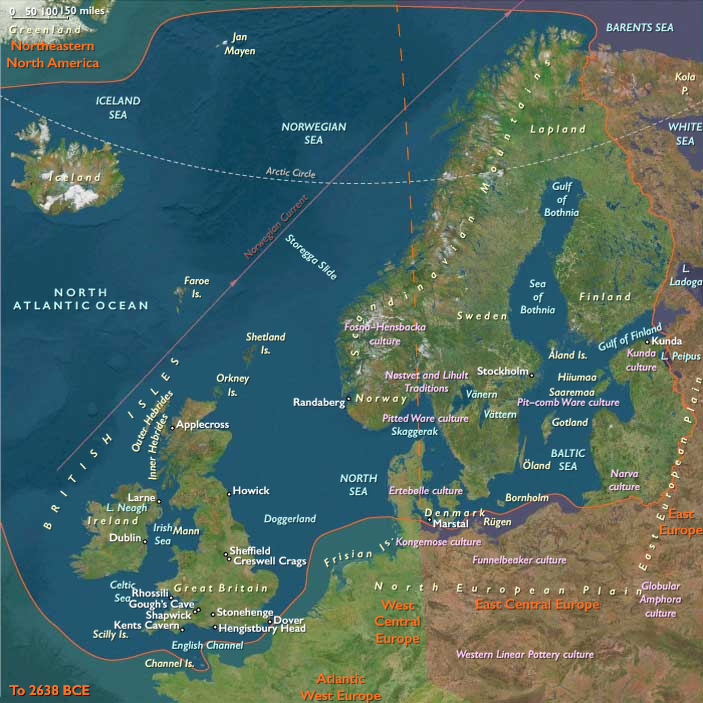
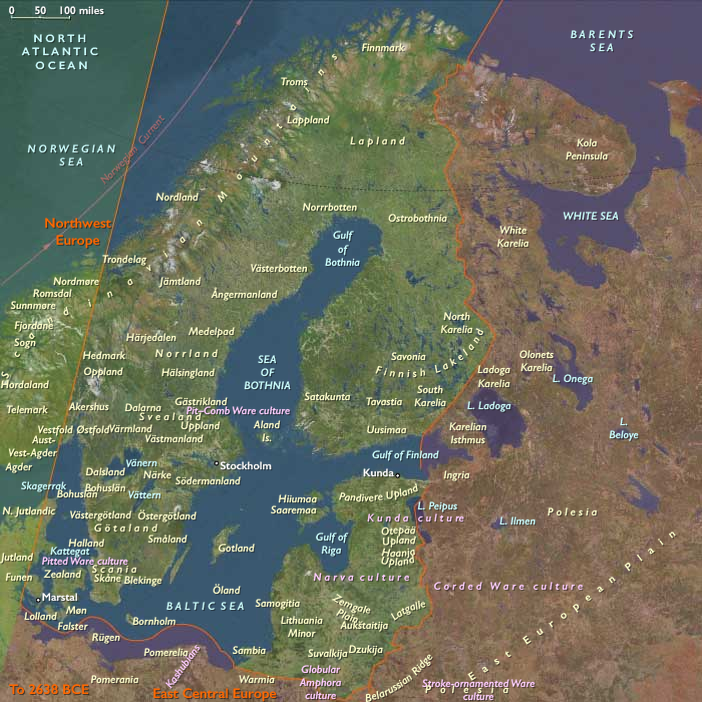
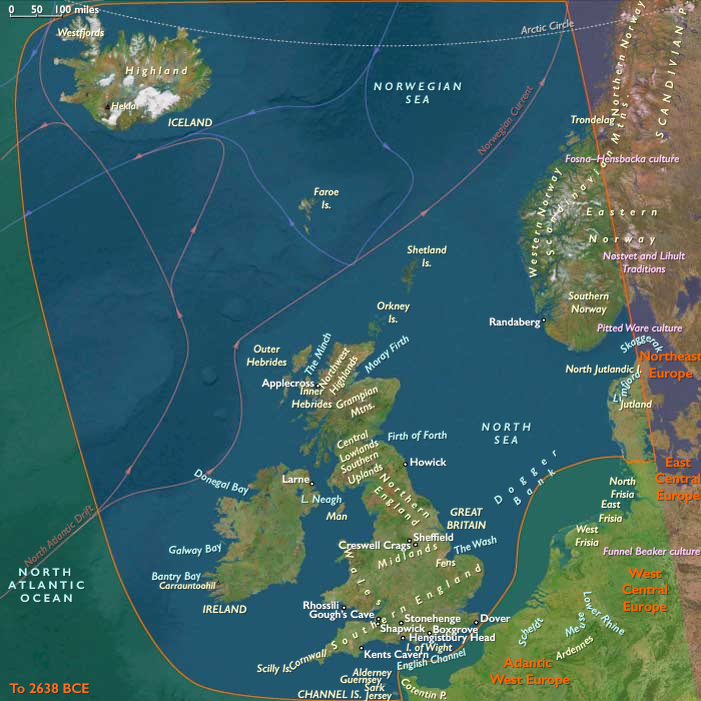
By the late Pleistocene, North Europe stood as the northern hinge of the continent, divided by the reach of the great Fennoscandian Ice Sheet. It was not one region, but two distinct glacial worlds:
-
Northeast Europe, the Baltic–Fennoscandian frontier, stretched from the southern edges of the Scandinavian ice dome through the Baltic States and the Gulf of Finland to the upper Volga and Lake Ladoga basin.
It was a zone of ice, loess, and meltwater—a cold periglacial steppe, where life clung to the southern coastal margins of what would later become the Baltic Sea. -
Northwest Europe, by contrast, encompassed the Atlantic–North Sea plains and the ice-free slopes of western Norway, Denmark, and the British uplands.
This was the world of the Doggerland plains and fjord coasts: broad, wind-swept, seasonally productive, and comparatively mild under Atlantic influence.
Between these worlds lay no continuous population but a moving frontier of life, expanding and contracting with each climatic pulse. What united them was not contiguity, but parallel adaptation to the ice’s edge.
Climate and Environmental Shifts
The climate of North Europe oscillated violently under Dansgaard–Oeschger and Heinrich rhythms.
-
In the northeast, the Fennoscandian ice sheet repeatedly advanced southward, covering most of Scandinavia and suppressing forest growth. South of the ice, tundra–steppe vegetation dominated the Baltic plain, punctuated by short interstadial bursts of birch and pine. Proglacial lakes formed and drained in cycles, carving channels that became the future Daugava, Nemunas, and Vistula systems.
-
In the northwest, the Atlantic moderated extremes but not instability. During interstadials, reindeer, horse, and bison grazed the grasslands of Doggerland and Britain; in stadials, cold desert conditions prevailed, dunes marched eastward, and ice tongues advanced down the Norwegian fjords.
Together these cycles forged a landscape of radical seasonality: half the year locked in permafrost, half a surge of meltwater, light, and migration. Human existence followed those rhythms.
Lifeways and Settlement Patterns
Human occupation was confined to the ice-free southern and western rims, forming two contrasting ecological economies.
-
In Northeast Europe, foragers lived on the margins of the ice, exploiting reindeer and horse herds that migrated along meltwater valleys. Small, mobile bands camped on loess ridges above floodplains, using hearth clusters, windbreaks, and stone pavements to endure the cold. Fish and waterfowl supplemented diets in thaw seasons. Settlement was seasonal and opportunistic, retreating south during harsh stadials.
-
In Northwest Europe, the exposed Doggerland plains and the English–Dutch coasts supported larger, more stable hunting territories. Reindeer and red deer herds were followed across open river valleys, while coastal groups took fish, shellfish, and seals in warmer phases. Western Norway’s fjords and Scottish seaboard provided rich marine refugia for small wintering groups.
Each subregion reflected a different axis of survival: the continental steppe pulse in the northeast, and the coastal–estuarine cycle in the northwest.
Technology and Material Culture
Despite distance and climatic severity, material traditions reveal a common technological ancestry within the European Upper Paleolithic, adapted locally to ice-edge conditions.
-
Blade and microblade toolkits of high-quality flint and chert were dominant; burins, endscrapers, and tanged or backed points typify both regions.
-
Bone and antler industries produced points, harpoons, and eyed needles for fur clothing—essential for Arctic survival.
-
Amber ornaments in the Baltic south and perforated shells and teeth in the Atlantic west suggest shared symbolic vocabularies, even as materials differed.
-
Ochre, used in burials and personal decoration, marked continuity with symbolic practices farther south.
Innovation was not in form but in durability and cold-weather adaptation: composite weapons, insulated clothing, and shelters of hide and bone that allowed habitation closer to the ice than ever before.
Movement and Interaction Corridors
Even under glacial constraint, movement tied both halves of North Europe to larger continental systems.
-
In the northeast, the Daugava–Nemunas–Vistula corridors served as arterial routes for herds and hunters alike, linking the Baltic steppe to Central Europe’s loess plains and the Dnieper frontier beyond.
-
In the northwest, the Doggerland lowlands formed a vast connective plain between Britain and the continent, facilitating seasonal aggregation and the circulation of stone, pigment, and ornament styles.
-
Fjord coasts of Norway and Scotland, intermittently ice-free, provided maritime corridors—perhaps the earliest footholds of a North Atlantic tradition that would re-emerge after the glacial maximum.
These corridors made the North less an isolated periphery than a mobile bridge—its people the edge-dwellers of Europe’s greatest ecological frontier.
Cultural and Symbolic Expressions
Though few sites preserve rich art, what survives suggests enduring symbolic continuity with Upper Paleolithic Europe.
Engraved bone plaquettes and ivory animal motifs—reindeer, elk, mammoth—appear along the Baltic fringe; ochred burials and personal ornaments echo the spiritual grammar of the south.
In the west, decorated antlers, amber beads, and ochre scatters mark ritualized reuse of certain campsites.
These traces imply memory landscapes, where people returned generation after generation to the same terraces or shelters, layering presence with pigment, ornament, and fire.
Environmental Adaptation and Resilience
Adaptation in North Europe meant mastering instability.
-
Northeast populations relied on extraordinary mobility and foresight, tracking migratory prey over hundreds of kilometers and caching tools and fuel along known routes.
-
Northwest populations practiced diversification—alternating terrestrial hunting with aquatic and coastal harvesting when game retreated.
-
Both depended on technological insulation (tailored clothing, deep hearths, semi-subterranean shelters) and social insulation (information and alliance networks across the steppe).
Survival was thus collective, predicated on knowledge exchange and ritual reaffirmation more than any single resource.
Transition Toward the Last Glacial Maximum
By 28,578 BCE, North Europe stood at the threshold of the Last Glacial Maximum:
-
Northeast Europe contracted into a narrow, frozen corridor between ice and steppe, its human populations withdrawing south toward the Dnieper and Carpathian refugia.
-
Northwest Europe persisted longer, its coastal shelves and mild fjords offering intermittent refuges as the North Sea basin froze and permafrost advanced.
The two subregions never coalesced into a single cultural sphere; each looked outward—to Central Europe, to the Atlantic, to the open steppe—for kin and connection.
Thus the northern world epitomized The Twelve Worlds’ central insight: that regions fracture under stress, yet remain coherent through exchange, their strength lying not in unity but in the fluid movement of people and meaning along the shifting edge of ice.
Topics
Commodoties
Subjects
Regions
Subregions
Related Events
Showing 10 events out of 69706 total
Years: 49293BCE - 28578BCE
Topics
Commodoties
Subjects
Regions
Subregions