
Northeast Europe (1888–1889 CE): National Awakening, Economic …
Years: 1888 - 1899
Northeast Europe (1888–1889 CE): National Awakening, Economic Shifts, and Emerging Social Challenges
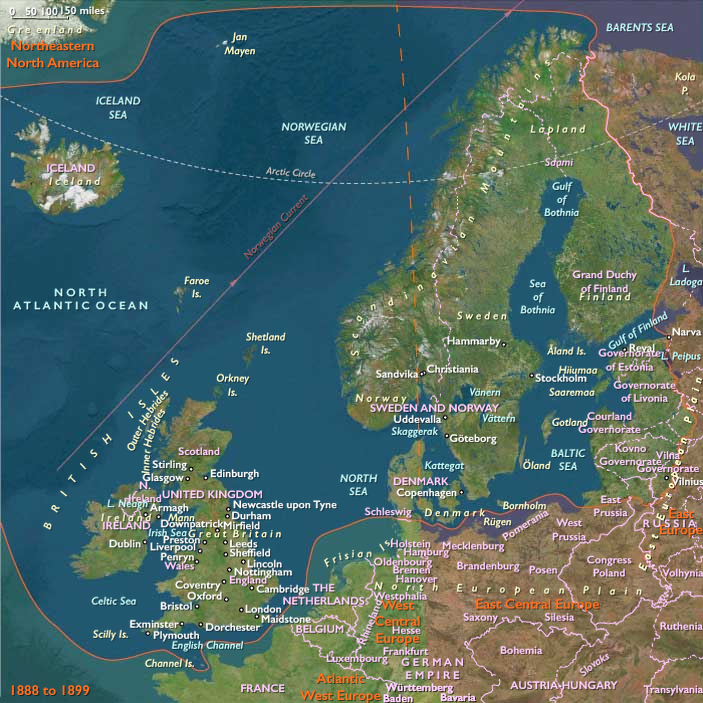
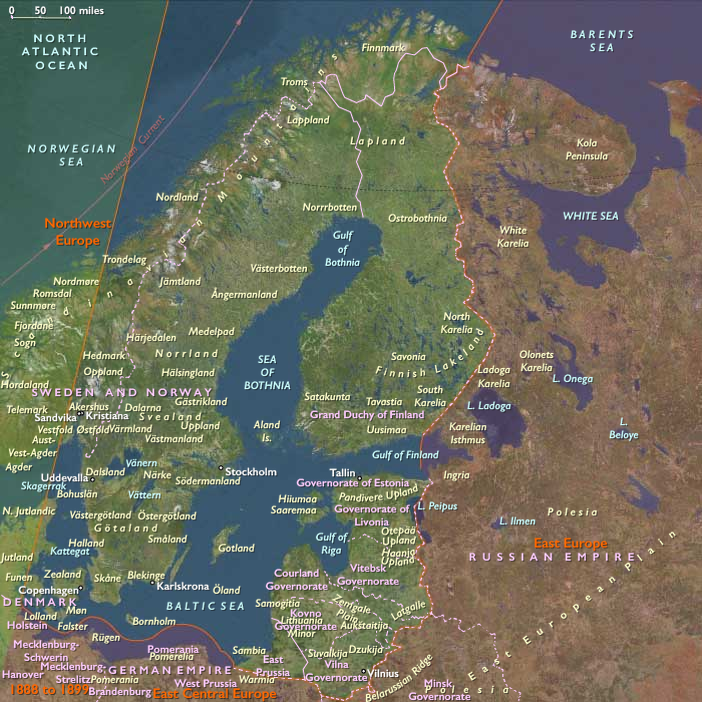
Between 1888 and 1889 CE, Northeast Europe experienced deepening industrial growth, intensified national awakenings, mounting labor mobilization, and rising pressures from Russian Russification policies. Finland grappled with the social consequences of industrialization alongside an increasingly precarious agricultural sector. Estonia, Latvia, and Lithuania saw further reinforcement of cultural identities despite Russification, while Sweden continued dealing with emigration and economic challenges. Norway took significant strides toward political liberalization, and Germany's increasing dominance notably shaped regional economic and geopolitical dynamics.
Finland: Industrialization, Rural Challenges, and Labor Mobilization
Finland's robust industrial expansion—particularly within its timber, paper, textile, and metal industries—continued during this era. Alongside this growth emerged a substantial urban working class, whose harsh conditions spurred the formation of trade unions, first legalized in 1883, that drew inspiration from Marxist doctrines prevalent in Germany. These unions laid the foundations for future labor organizations such as the Finnish Trade Union Federation (Suomen Ammattijärjestö—SAJ).
Despite its industrial advances, Finland remained predominantly agrarian. Agricultural modernization, initiated with the introduction of the potato in the eighteenth century and progressively enhanced through scientific farming techniques during the nineteenth century, had significantly improved productivity. Consequently, Finland’s population surged from 865,000 in 1810 to nearly 2,950,000 by 1910.
Yet, limited arable land meant that much of Finland’s surplus rural population—approximately two-thirds—remained relegated to tenant farming or landless agricultural labor. The precarious conditions of this agrarian class, vulnerable to economic uncertainty and indifferent governance by both the Russian authorities and the Finnish Diet (dominated by middle-class interests), intensified societal tensions. From approximately 1870 to 1920, these pressures prompted the emigration of around 380,000 Finns, over ninety percent of whom moved to the United States.
Those remaining in rural Finland initially supported labor movements such as the developing Finnish Social Democratic Party (Suomen Sosialidemokraattinen Puolue—SDP). However, the SDP's increasing Marxist radicalization and advocacy for land nationalization later alienated many rural supporters.
Lithuania: Reinforced Cultural Resilience Amid Russian Pressure
In Lithuania, cultural resilience remained robust despite aggressive Russian Russification. A Lithuanian national awakening led by secular and clerical intellectuals gained momentum, intensifying demands for self-governance. Though the Russian government attempted to suppress Lithuanian-language education and religious institutions, clandestine schooling networks and underground literature flourished, reinforcing Lithuanian identity.
Estonia: Industrial Expansion and Cultural Vitality in Narva
Estonia experienced significant industrial expansion, most notably in Narva, which became the leading industrial center in the region. Initiated by Ludwig Knoop’s Krenholm Manufacturing Company in 1857, Narva’s cotton mills utilized inexpensive hydropower from the powerful Narva waterfalls. By the late nineteenth century, the Krenholm mill employed approximately ten thousand workers, making it one of Europe's largest textile enterprises. Estonia's first industrial strike had occurred at Krenholm in 1872, signaling growing labor unrest.
Narva, part of the Saint Petersburg Governorate under Russian rule, maintained strategic significance until 1863, despite limited military necessity. The establishment of Estonia’s first railway in 1870, connecting Narva to Saint Petersburg and Tallinn, further bolstered its economic prominence.
Despite intense Russification efforts, Estonia’s cultural institutions continued to thrive, preserving Estonian language and national identity through education and cultural production.
Latvia: Continued Cultural Development
Latvia similarly maintained its national cultural awakening, reinforcing Latvian identity through literature, education, and resistance to Russification and Germanization. Urban centers, particularly Riga, fostered strong national sentiments and cultural developments, significantly shaping Latvian national consciousness.
Sweden: Continued Socioeconomic Struggles and Emigration
Sweden faced ongoing socioeconomic challenges, including persistent poverty and limited industrialization compared to Western Europe. Emigration continued at substantial levels, with roughly one percent of Sweden's population leaving annually during this period, predominantly for North America. While relieving some domestic pressures, mass emigration underscored structural weaknesses in Sweden’s economy and prompted discussions of needed reforms.
Norway: Democratic Expansion and Cultural Innovations
In 1889, Norway advanced significantly toward democratic reforms. Universal male suffrage would be granted in 1898, followed by women’s suffrage in 1913. Meanwhile, Norway made notable cultural contributions: painter Edvard Munch began pioneering techniques and themes in his artwork that anticipated the German Expressionist movement, profoundly influencing European art.
Denmark: Stability and Economic Advancement
Denmark continued its steady economic and political development, bolstered by advances in agriculture, dairy exports, and infrastructure improvements, notably railway expansions. The growth of trade unions and urban populations reinforced social cohesion and democratic stability.
Rising Russian Nationalism and Russification Pressures
In the late nineteenth century, the Russian Empire faced significant internal challenges and growing authoritarian nationalism, increasingly targeting non-Russian minorities for cultural assimilation and political control. Policies intensified Russian language use in schools and administration, impacting Poland most severely, but soon extending pressures to other minorities.
By the late 1880s, Russian nationalists increasingly viewed Finland’s autonomy as incompatible with imperial unity. Rising Finnish nationalism, commercial competition beginning in the 1880s, and geopolitical concerns—particularly fears that Germany might leverage its influence over Sweden to use Finland as a staging ground for invasion—further motivated Russian policy shifts toward Finland. Additionally, there emerged calls for Finnish conscription into the Russian army to bolster imperial defense.
These motivations culminated, by 1898–1899, in harsh Russification measures. In October 1898, the appointment of Russian General Nikolai Ivanovich Bobrikov as Governor-General of Finland signaled intensified assimilationist policies. The critical February Manifesto of 1899 explicitly asserted imperial authority to govern Finland without consulting the Finnish Senate or Diet, effectively reducing Finland’s autonomy to that of ordinary Russian provinces. Finnish opposition rapidly mobilized, with the massive Great Address petition gathering over five hundred thousand signatures in protest. However, Tsar Nicholas II ignored this unprecedented outcry, setting the stage for deepening Finnish-Russian tensions.
Germany: Economic Dominance and Regional Influence
Under Kaiser Wilhelm II (r. 1888–1918), Germany continued to assert its regional economic influence, particularly through trade and technological dominance. Germany's expanding economic interactions deeply influenced Northeast European economies, particularly Finland’s growing industrial exports and Denmark’s agricultural markets. Königsberg (Kaliningrad) maintained its prominence as an economic hub, reinforcing Germany’s diplomatic and economic presence throughout the region.
Urbanization and Regional Economic Integration
Major urban centers such as Helsinki, Stockholm, Copenhagen, Riga, Narva, and Reval (Tallinn) continued rapid expansion, driven by industrialization and infrastructure improvements. Enhanced regional connectivity and commerce bolstered economic stability, supporting cultural vibrancy and solidifying national identities across Northeast Europe.
Cultural and Intellectual Vibrancy
Throughout this era, cultural and intellectual life flourished. Finnish literary and educational initiatives advanced significantly, reinforced by national awakening. Lithuania’s resilient cultural underground preserved national identity amid oppression, and Latvia and Estonia sustained robust cultural developments despite external pressures. Danish and Norwegian intellectual and cultural innovations, notably Edvard Munch’s artistic contributions, significantly enriched European cultural traditions.
Legacy of the Era
The period from 1888 to 1889 CE was marked by substantial sociopolitical transformations. Finland’s intensified industrialization and rural pressures accelerated urban labor mobilization and national tensions. Lithuania, Latvia, and Estonia’s strengthened national consciousness laid crucial foundations for future autonomy. Sweden’s ongoing emigration revealed deep socioeconomic challenges, while Norway’s democratic advances and cultural contributions anticipated significant political changes. Denmark’s steady economic and political progress contributed regional stability. Russia’s intensified Russification policies, especially against Finland, presaged significant future conflicts. Germany’s regional dominance significantly influenced regional economic and diplomatic dynamics.
Collectively, these developments profoundly shaped Northeast Europe’s trajectory toward the twentieth century, setting the stage for future political transformations, economic realignments, and national aspirations.
People
Groups
- Polytheism (“paganism”)
- Latvians, or Letts (Eastern Balts)
- Lithuanians (Eastern Balts)
- Estonians
- Christians, Roman Catholic
- Lutheranism
- Russian Empire
- Estonia, Governorate of
- Livonia, Governorate of
- Baltic governorates
- Vilna Governorate
- Courland Governorate
- Austrian Empire
- Finland, Grand Duchy of
- Sweden and Norway, Union between the Kingdoms of
- Denmark, Kingdom of
- Norway, dependent Swedish kingdom of
- France, Second Empire of
- German Empire (“Second Reich”)
Topics
Subjects
Regions
Subregions
Years: 1888 - 1899
People
Groups
- Polytheism (“paganism”)
- Latvians, or Letts (Eastern Balts)
- Lithuanians (Eastern Balts)
- Estonians
- Christians, Roman Catholic
- Lutheranism
- Russian Empire
- Estonia, Governorate of
- Livonia, Governorate of
- Baltic governorates
- Vilna Governorate
- Courland Governorate
- Austrian Empire
- Finland, Grand Duchy of
- Sweden and Norway, Union between the Kingdoms of
- Denmark, Kingdom of
- Norway, dependent Swedish kingdom of
- France, Second Empire of
- German Empire (“Second Reich”)
Topics
Subjects
Regions
Subregions