
North Europe (1828–1971 CE) Industrial Transformation, …
Years: 1828 - 1971
North Europe (1828–1971 CE)
Industrial Transformation, Welfare States, and the Balance Between Tradition and Modernity
Geography & Environmental Context
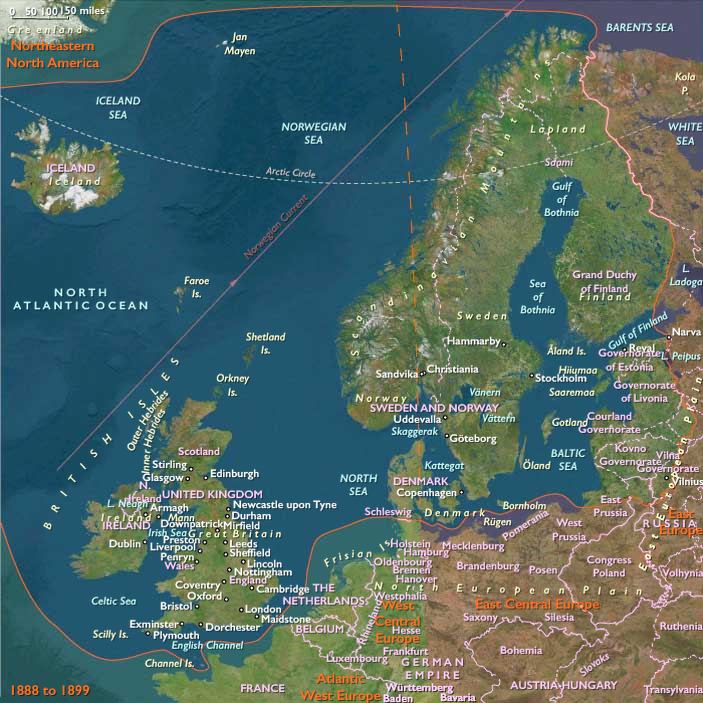
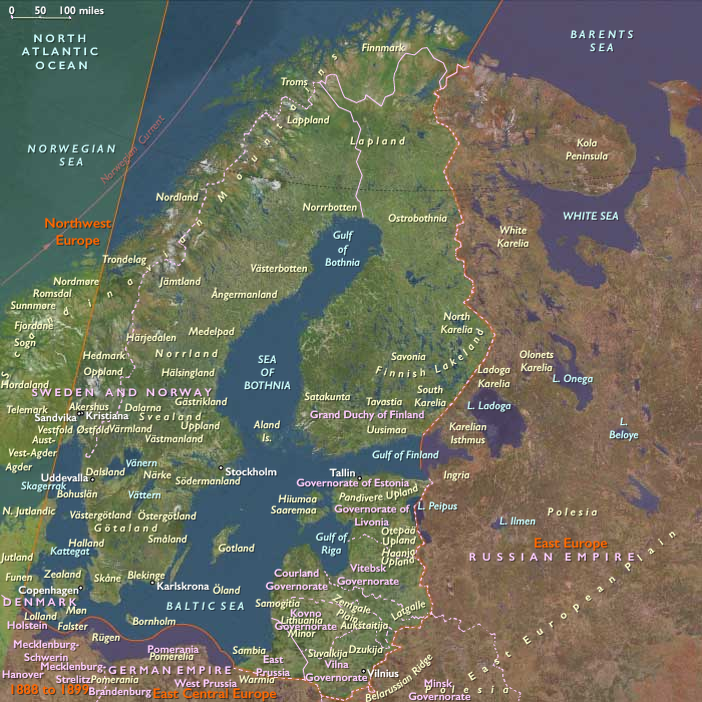
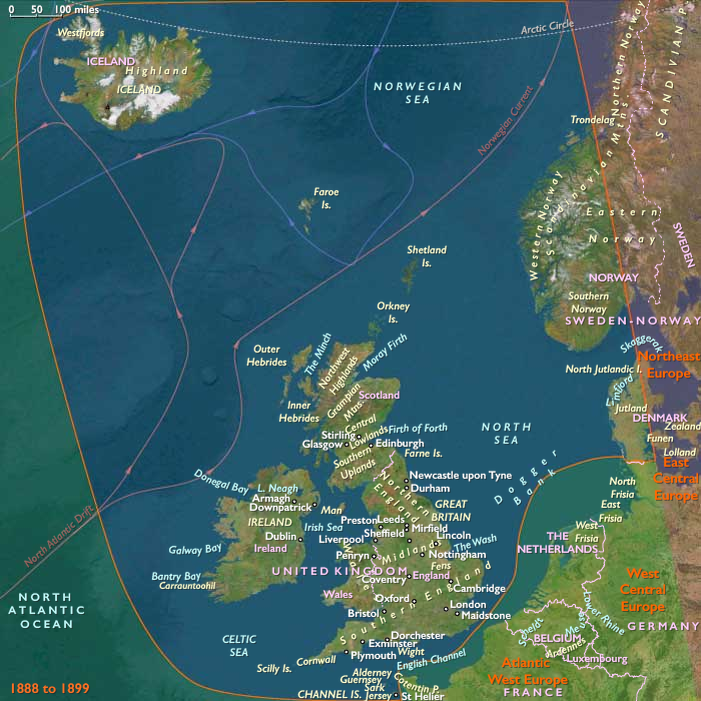
North Europe includes two fixed subregions:
-
Northeast Europe — Sweden, Finland, Lithuania, Latvia, Estonia, eastern Denmark, eastern Norway, and the Russian enclave of Kaliningrad.
-
Northwest Europe — Iceland, Ireland, the United Kingdom, western Norway, and western Denmark.
Anchors include the Baltic Sea, North Sea, and Norwegian Sea, the Scandinavian Mountains, and the North Atlantic islands. Major urban and cultural centers included Stockholm, Helsinki, Copenhagen, Oslo, Reykjavík, Dublin, Belfast, Edinburgh, Glasgow, and London. The subregion’s mix of fjords, forests, and fertile lowlands underpinned both agrarian heritage and maritime expansion.
Climate & Environmental Shifts
A temperate to subarctic climate defined the region. The 19th century brought short agricultural seasons and heavy reliance on fisheries and forestry. Industrial coal use caused early urban pollution in British and Scandinavian cities. The 20th century’s warming trend moderated winters, improving crop yields and extending growing zones in Scandinavia. Hydroelectric dams in Norway, Sweden, and Finland harnessed mountain rivers, while coastal engineering in the Netherlands and Denmark mitigated storm surges.
Subsistence & Settlement
-
Agrarian modernization: Land reforms and cooperative movements in Denmark, Sweden, and Finland raised productivity; dairy and timber industries grew.
-
Industrialization: Britain’s early Industrial Revolution spread to Scandinavia and the Baltics, with shipbuilding, textiles, steel, and engineering as core sectors.
-
Urbanization: By the early 20th century, London, Manchester, and Glasgow ranked among the world’s largest industrial cities; Stockholm, Copenhagen, and Oslo modernized with public housing and electrified transport.
-
Postwar economies: Reconstruction and social-democratic planning in the Nordic countries created prosperous welfare states; Britain transitioned from empire to post-industrial society.
-
Migration: Rural exodus to cities accelerated; Irish emigration to North America and Britain persisted; Baltic populations endured wartime deportations and Soviet resettlements.
Technology & Material Culture
Coal-fired industry, railways, and steam navigation defined the 19th century. British engineers exported rail technology worldwide. The 20th century saw electrification, radio, aviation, and shipbuilding innovation. Architecture evolved from Gothic revival and neoclassicism to functionalism and modernism—exemplified by Stockholm City Hall (1923)and London’s postwar reconstruction. Nordic design—Alvar Aalto, Arne Jacobsen—became globally influential for its simplicity and craftsmanship.
Movement & Interaction Corridors
-
Maritime trade: The North Sea and Baltic remained major arteries linking Britain, Scandinavia, and continental Europe. Liverpool, London, Bergen, and Copenhagen were vital Atlantic ports.
-
Rail and telegraph networks: Integrated interior trade by the 1870s; air corridors in the 20th century linked northern capitals to the world.
-
Colonial and global circuits: Britain’s imperial shipping routes spanned all oceans; Norwegian and Icelandic seafarers joined global fleets.
-
Wartime and Cold War lines: The region formed the northern flank of both world wars and later the NATO–Warsaw Pact divide.
Cultural & Symbolic Expressions
-
Romantic nationalism: Writers and artists—Hans Christian Andersen, Henrik Ibsen, Edvard Grieg, Akseli Gallen-Kallela—revived folklore and national epics.
-
Industrial and imperial culture: Britain’s Victorian Age merged empire, science, and literature—Charles Dickens, George Eliot, Alfred Tennyson, Charles Darwin reflected industrial modernity.
-
20th-century innovation: Modernist movements in design, architecture, and literature flourished in the Nordic world; British and Irish literature—from W. B. Yeats, James Joyce, and Virginia Woolf to Samuel Beckett—reshaped global modernism.
-
Religion and society: Protestantism remained dominant in Scandinavia and Britain; secularism and ecumenism grew by mid-century. Music—from Edward Elgar to Jean Sibelius—bridged nationalism and cosmopolitanism.
Environmental Adaptation & Resilience
Nordic societies pioneered cooperative forestry and sustainable fisheries. Hydroelectric and geothermal power (Iceland) reduced reliance on imported fuel. Welfare-state planning integrated housing, health, and environmental standards. Coastal flood control (e.g., the Delta Plan, Netherlands; Thyborøn Barrier, Denmark) and Arctic research expanded environmental awareness by the 1960s.
Political & Military Shocks
-
Reform and union changes: The Reform Acts in Britain broadened suffrage; Norway’s independence from Sweden (1905) redefined Nordic diplomacy.
-
World War I: Britain, Ireland, and the Nordic countries were affected by blockade and neutrality tensions; Ireland’s Easter Rising (1916) marked the drive for independence.
-
Interwar transformations: Ireland became a Free State (1922); Finland and the Baltics gained independence after the Russian Revolution.
-
World War II: Britain endured the Blitz; Norway and Denmark were occupied by Germany; Finland fought the USSR; Sweden remained neutral; Iceland hosted Allied bases.
-
Postwar reconstruction: Britain dismantled its empire; Scandinavia developed social democracy; Finland balanced between East and West.
-
Cold War alignments: Norway, Denmark, and Britain joined NATO (1949); Sweden and Finland remained neutral; the Baltics were annexed by the USSR.
Transition
Between 1828 and 1971, North Europe evolved from an industrial and maritime heartland of empire into a zone of social democracy, neutrality, and cultural innovation. Britain’s industrial dominance yielded to Nordic welfare models; Ireland and Finland secured independence; the Baltics lost theirs under Soviet rule. War, reconstruction, and integration produced some of the world’s highest living standards. By 1971, North Europe stood as both a bastion of stability and a frontier of modern design, environmental consciousness, and egalitarian governance—its fjords, harbors, and forests emblematic of resilience in a turbulent century.
People
Groups
- Finns
- Latvians, or Letts (Eastern Balts)
- Lithuanians (Eastern Balts)
- Estonians
- Christians, Roman Catholic
- Baltic Germans
- Estonian Swedes
- Lutheranism
- Protestantism
- Livonia, Governorate of
- Russian Empire
- Estonia, Governorate of
- Baltic governorates
- Vilna Governorate
- Courland Governorate
- Finland, Grand Duchy of
- Sweden and Norway, Union between the Kingdoms of
- Denmark, Kingdom of
- Poland, Congress Kingdom of
- German Confederation
- German Confederation, North
- German Empire (“Second Reich”)
- Norway
- Sweden, (third) Kingdom of
- Poland, (Regency) Kingdom of
- Finland, Republic of
- Latvia
- Poland, Second Republic of
- Estonia, independent republic of
- Lithuanian Soviet Socialist Republic
- Lithuanian-Byelorussian Soviet Socialist Republic
- Central Lithuania, Republic of
- Union of Soviet Socialist Republics (USSR), or Soviet Union
- Lithuanian Soviet Socialist Republic
- Latvian Soviet Socialist Republic
- Estonian Soviet Socialist Republic
- Poland, Republic of
- NATO (North Atlantic Treaty Organization)
- Poland, People's Republic of Poland, or Polish People's Republic
Topics
Commodoties
Subjects
Regions
Subregions
Years: 1828 - 1971
People
Groups
- Finns
- Latvians, or Letts (Eastern Balts)
- Lithuanians (Eastern Balts)
- Estonians
- Christians, Roman Catholic
- Baltic Germans
- Estonian Swedes
- Lutheranism
- Protestantism
- Livonia, Governorate of
- Russian Empire
- Estonia, Governorate of
- Baltic governorates
- Vilna Governorate
- Courland Governorate
- Finland, Grand Duchy of
- Sweden and Norway, Union between the Kingdoms of
- Denmark, Kingdom of
- Poland, Congress Kingdom of
- German Confederation
- German Confederation, North
- German Empire (“Second Reich”)
- Norway
- Sweden, (third) Kingdom of
- Poland, (Regency) Kingdom of
- Finland, Republic of
- Latvia
- Poland, Second Republic of
- Estonia, independent republic of
- Lithuanian Soviet Socialist Republic
- Lithuanian-Byelorussian Soviet Socialist Republic
- Central Lithuania, Republic of
- Union of Soviet Socialist Republics (USSR), or Soviet Union
- Lithuanian Soviet Socialist Republic
- Latvian Soviet Socialist Republic
- Estonian Soviet Socialist Republic
- Poland, Republic of
- NATO (North Atlantic Treaty Organization)
- Poland, People's Republic of Poland, or Polish People's Republic
Topics
Commodoties
Subjects
Regions
Subregions