
North Europe (1684–1827 CE) Imperial Borderlands, …
Years: 1684 - 1827
North Europe (1684–1827 CE)
Imperial Borderlands, Oceanic Gateways, and Peasant Resilience
Geography & Environmental Context
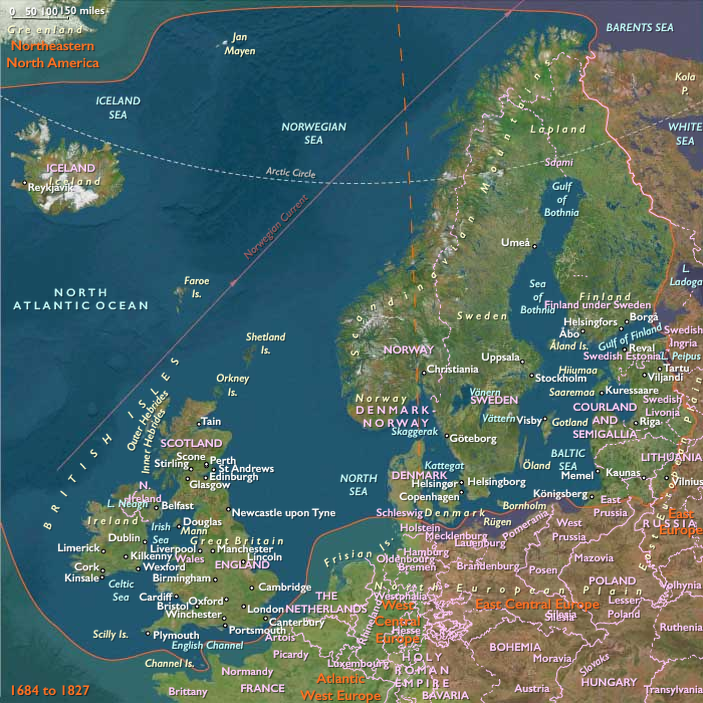
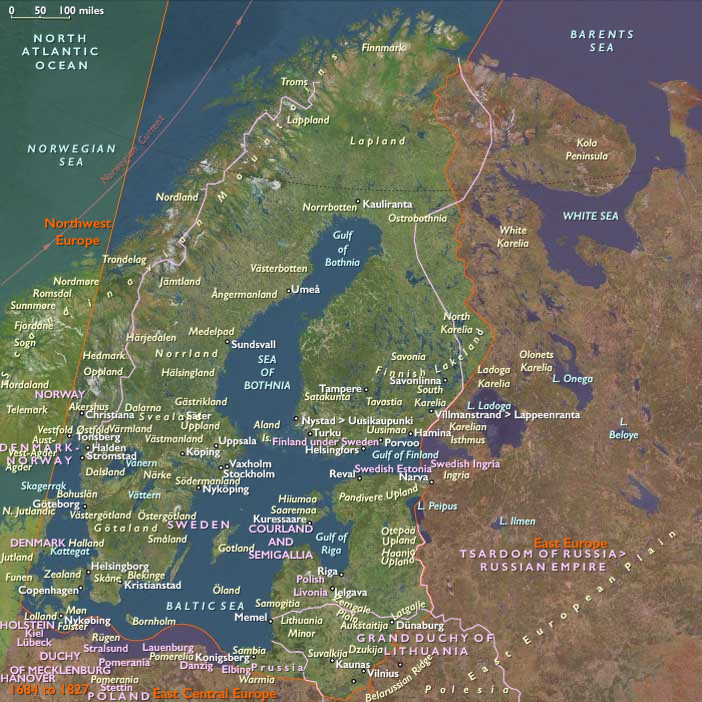
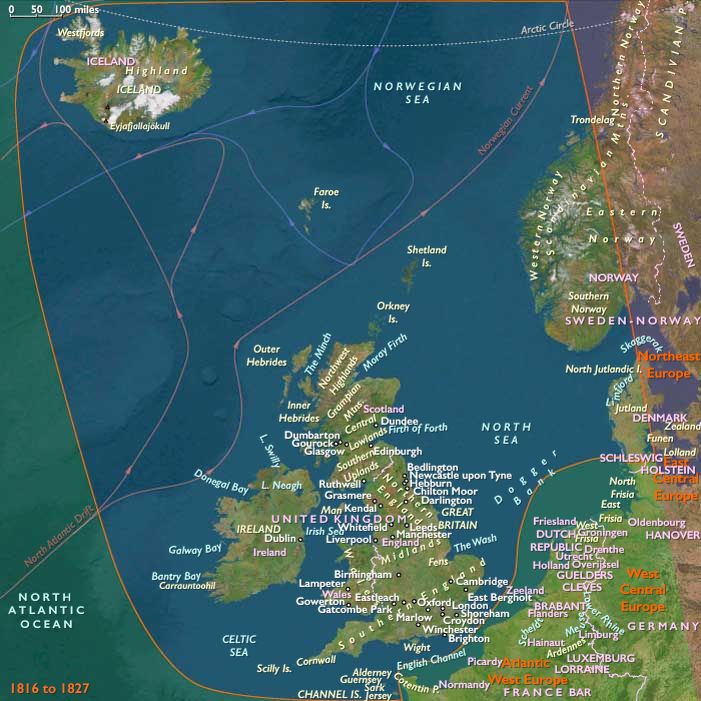
North Europe here unites two interlocking maritime rims: the Northeast Baltic world—Sweden, Finland, Lithuania, Latvia, Estonia, Kaliningrad, and eastern Denmark & Norway (with Copenhagen and Oslo)—and the Northwest Atlantic world—Iceland, Ireland, the United Kingdom, western Norway, and western Denmark. Anchors ranged from the Åland–Stockholm archipelagos, Gulf of Finland/Bothnia, and Daugava–Nemunas basins to the Thames, Mersey, Clyde, the Norwegian fjords, and the Øresund strait. Forested interiors, lake belts, fertile lowlands, and ice-bound seas met stormy Atlantic corridors—a geography built for timber, tar, grain, fish, and ships.
Climate & Environmental Shifts
The Little Ice Age lingered: long, freezing winters locked the Baltic, delaying sailings; poor summers in the 1690sdrove famines in Finland and the Baltic provinces. On the Atlantic rim, gales and storm surges battered coasts; Laki (1783–84) darkened Iceland and chilled Europe; Tambora (1816–17) brought the “Year Without a Summer,” spiking dearth from Ireland to the Baltic. Fisheries and fuelwood buffered many communities; so did later adoption of potatoesand fodder crops.
Subsistence & Settlement
-
Scandinavian/Baltic belt: Mixed grain (rye, barley, oats), livestock, and forestry; svedjebruk (slash-and-burn) persisted in Finland; Baltic estates worked serf labor for export rye and oats.
-
Norway & Iceland: Cod/herring and smallholder farming sustained fjord and island settlements; inland Norwegians blended grain, timber, and stock.
-
Britain & Ireland: Southeast England specialized in wheat; oats/potatoes/cattle dominated Ireland and the Scottish Highlands (amid Clearances).
-
Urban nodes: Stockholm, Riga, Tallinn, Vilnius, Copenhagen, Oslo, London, Dublin, Edinburgh, Bergen—administrative and mercantile hubs for grain, tar, timber, sailcloth, and fish.
Technology & Material Culture
-
Agro-forestry: Danish and Swedish drainage and rotations raised yields; Baltic baronial estates scaled up grain and flax; Norwegian sawmills and Swedish tar/iron fed navies.
-
Ship & sea: Copper-sheathed hulls, chronometers, and improved rigs extended range; Copenhagen’s dockyards and British yards turned out fleets.
-
Industry & crafts: Meissen-influenced porcelains in the Baltic towns; hemp, flax, sailcloth, potash, and pitch supplied Europe’s maritime expansion. In Britain, early steam engines, canals, and mechanized textiles signaled industrial takeoff.
Movement & Interaction Corridors
-
Baltic highway: Danzig–Riga–Stockholm–Copenhagen to Amsterdam/London moved rye, timber, tar, hemp, and sailcloth.
-
Øresund tolls: Gave Copenhagen leverage over Baltic traffic until Napoleonic disruption.
-
Atlantic lanes: The Thames–Clyde–Mersey estuaries connected coal, iron, and textiles to imperial routes; Irish cattle, butter, and linen provisioned fleets.
-
Overland ties: Riga–Vilnius–Tallinn linked to Moscow/Warsaw; Scottish drovers’ roads, Irish canals, and British turnpikes integrated hinterlands.
Cultural & Symbolic Expressions
-
Confessions & capitals: Lutheran parish life shaped Sweden, Denmark, Norway, and Finland; Catholictraditions anchored Lithuania and parts of Ireland; Orthodox communities persisted in the eastern Baltic.
-
Learning & letters: Uppsala, Lund, Copenhagen fostered Enlightenment science; Vilnius shone in Jesuit scholarship; London/Edinburgh powered the Scottish Enlightenment.
-
Popular cultures: Pansori-like analogues here were folk epics, sagas, runo-songs, woodcarving, and embroidery—arts that carried identity across shifting borders.
Environmental Adaptation & Resilience
-
Risk portfolios: Slash-and-burn rye, tar production, and forest by-products hedged poor harvests in the north; cod/herring filled lean years.
-
Communal welfare: Lutheran parish relief, Orthodox brotherhoods, Catholic confraternities, and municipal granaries mitigated famine.
-
Agrarian change: Potatoes, clover, and enclosure (Britain/Denmark) lifted yields; Baltic households added gardens, flax, and seasonal wage-work to survive volatility.
Political & Military Shocks
-
Great Northern War (1700–1721): Sweden’s imperial retreat; Estonia, Livonia, Ingria ceded to Russia.
-
State realignments: Finland ceded to Russia (1809, Grand Duchy); Denmark–Norway split after the Gunboat War and Copenhagen (1807)—Norway entered union with Sweden (1814).
-
British ascendancy: Naval supremacy, Acts of Union (1707, 1801), and global war redirected trade and industry; blockades reshaped Baltic exports.
-
Napoleonic era: Øresund politics, privateering, and neutral convoys re-routed shipping; Dutch decline opened room for British and Russian leverage in northern seas.
Transition
From 1684 to 1827, North Europe shifted from Swedish–Danish dominance in a frozen sea to a Russian Baltic and British Atlantic order. Borders moved—Finland to Russia, Norway to union with Sweden—yet parish life, commons, and fisheries underwrote endurance. By the 1820s, the region was knit into global circuits as supplier of grain, timber, tar, sailcloth, fish, coal, iron, and textiles. The age ended with monarchies restored, but with industrial, maritime, and national currents already remapping the northern rim of Europe.
People
Groups
- Polytheism (“paganism”)
- Finns
- Sami people
- Karelians
- Tavastians
- Lithuanians (Eastern Balts)
- Estonians
- Germans
- Balts
- Latvians, or Letts (Eastern Balts)
- Christians, Roman Catholic
- Finland under Swedish rule
- Baltic Germans
- Estonian Swedes
- Kalmar Union (of Denmark, Norway and Sweden)
- Holy Roman Empire
- Lutheranism
- Protestantism
- Sweden, (second) Kingdom of
- Denmark-Norway, Kingdom of
- Russia, Tsardom of
- Courland and Semigallia, Duchy of
- Estonia, Duchy of (Swedish Estonia)
- Swedish Empire
- Polish-Lithuanian Commonwealth (Commonwealth of the Two Nations)
- Finland, (Swedish) Grand Duchy of
- Norway, dependent Danish kingdom of
- Brandenburg-Prussia
- Livonia, Swedish
- Pomerania, Swedish
- Bremen-Verden
- Pomerania, Swedish
- Estonia, Governorate of
- Russian Empire
- Livonia, Governorate of
- Vilna Governorate
- Courland Governorate
- Warsaw, Duchy of
- Finland, Grand Duchy of
- Norway, dependent Swedish kingdom of
- Denmark, Kingdom of
- Sweden and Norway, Union between the Kingdoms of
- Poland, Congress Kingdom of
Topics
- Enlightenment, Age of
- Great Famine of Finland (1695-1697)
- Great Famine of Estonia (1696–1698)
- Narva, Battle of
- Great Northern War plague outbreak
- East Prussia: Famine of 1708-11
- Poltava, Battle of
- Norway: Famine of 1741
- Napoleonic Wars
Commodoties
Subjects
Regions
Subregions
Years: 1684 - 1827
People
Groups
- Polytheism (“paganism”)
- Finns
- Sami people
- Karelians
- Tavastians
- Lithuanians (Eastern Balts)
- Estonians
- Germans
- Balts
- Latvians, or Letts (Eastern Balts)
- Christians, Roman Catholic
- Finland under Swedish rule
- Baltic Germans
- Estonian Swedes
- Kalmar Union (of Denmark, Norway and Sweden)
- Holy Roman Empire
- Lutheranism
- Protestantism
- Sweden, (second) Kingdom of
- Denmark-Norway, Kingdom of
- Russia, Tsardom of
- Courland and Semigallia, Duchy of
- Estonia, Duchy of (Swedish Estonia)
- Swedish Empire
- Polish-Lithuanian Commonwealth (Commonwealth of the Two Nations)
- Finland, (Swedish) Grand Duchy of
- Norway, dependent Danish kingdom of
- Brandenburg-Prussia
- Livonia, Swedish
- Pomerania, Swedish
- Bremen-Verden
- Pomerania, Swedish
- Estonia, Governorate of
- Russian Empire
- Livonia, Governorate of
- Vilna Governorate
- Courland Governorate
- Warsaw, Duchy of
- Finland, Grand Duchy of
- Norway, dependent Swedish kingdom of
- Denmark, Kingdom of
- Sweden and Norway, Union between the Kingdoms of
- Poland, Congress Kingdom of
Topics
- Enlightenment, Age of
- Great Famine of Finland (1695-1697)
- Great Famine of Estonia (1696–1698)
- Narva, Battle of
- Great Northern War plague outbreak
- East Prussia: Famine of 1708-11
- Poltava, Battle of
- Norway: Famine of 1741
- Napoleonic Wars
Commodoties
Subjects
Regions
Subregions