Northeast Europe (1828–1971 CE): Nordic Neutralities, Baltic Nationhood, and a Sea of Corridors
Geography & Environmental Context
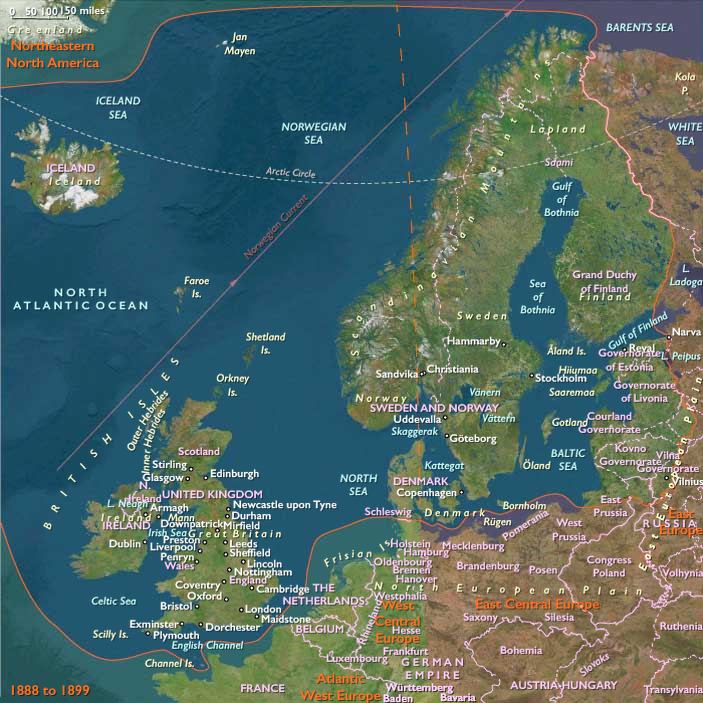
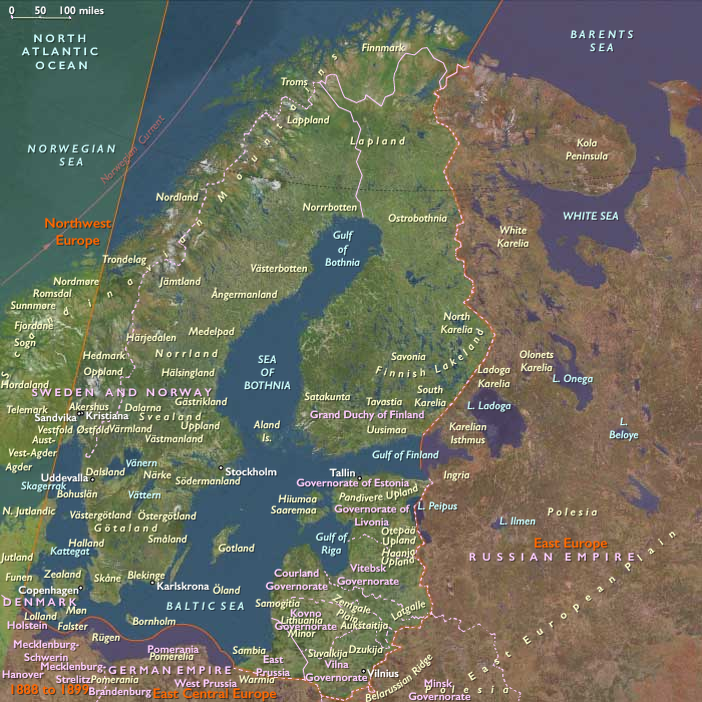
Northeast Europe includes Sweden, Finland, Lithuania, Latvia, Estonia, the Russian enclave of Kaliningrad, and eastern Denmark and eastern Norway (including Copenhagen and Oslo). Anchors span the Baltic Sea littoral—Stockholm’s skerries, the Åland and Estonian archipelagos, the Gulf of Finland and Bothnia, and the Vistula Lagoon/Kaliningrad—together with lake-and-forest interiors (Sweden’s Småland–Norrland, Finland’s Lakeland). Capitals Stockholm, Helsinki, Tallinn, Riga, Vilnius, Copenhagen, and Oslo formed a dense ring of maritime nodes.
Climate & Environmental Shifts
A cool temperate regime brought long winters and short, capricious summers. Crop crises struck periodically—the Finnish Great Famine (1866–68) was the worst—while forest and storm-fell events shaped upland livelihoods. Hydropowerable rivers in Sweden, Finland, and Norway enabled 20th-century electrification. By the late 1960s, Baltic eutrophication and industrial pollution emerged as regional stresses, even as afforestation and wildlife protections expanded.
Subsistence & Settlement
-
19th century countryside: Mixed farms (rye, oats, barley, potatoes) with dairy and forestry incomes; fishing (herring, Baltic cod) fed coasts.
-
Timber & tar to pulp & paper: Sweden and Finland shifted from sawn timber and tar exports to pulp, paper, and engineered wood, spawning mill towns along rivers.
-
Urbanization: Ports and capitals boomed—Stockholm, Helsinki, Copenhagen, Oslo—alongside Baltic hubs Tallinn, Riga, Vilnius; interwar conurbations spread around shipyards and rail junctions. Post-1945, new suburbs and modernist estates housed industrial workforces.
Technology & Material Culture
Railways bound forests to ports; icebreakers kept winter trade moving. Engineering clusters emerged: shipyards in Turku and Helsinki, Swedish steel and machine tools, optics and telecoms, and later vehicle and aircraft industries. Hydropower stations, district heating, and cooperative dairies transformed everyday life; by the 1960s, cars, radios, and televisions were commonplace from Stockholm to Tallinn.
Movement & Interaction Corridors
-
Baltic Sea highways: Ferries and freighters knit Stockholm–Turku–Helsinki, Tallinn–Riga–Klaipėda, and Copenhagen–Malmö; the Øresund remained the gate to the North Sea.
-
Resource flows: Ore and timber moved to Baltic smelters and mills; dairy and fish to urban markets.
-
War and peace lines: In WWII, sea lanes became battle zones; after 1945, NATO (Denmark, Norway), neutral Sweden, and Finland’s treaty constraints created tightly managed but busy frontiers with the Soviet sphere including the annexed Baltic republics.
Cultural & Symbolic Expressions
-
National awakenings: Kalevala publication (1835) in Finland; Song Festivals in Estonia and Latvia; Lithuania’s clandestine press during the press ban (1864–1904) and the knygnešiai (book-smugglers) forged modern identities.
-
Golden ages & modernisms: Sibelius and Nielsen in music; Strindberg, Hamsun, and Sillanpää in letters; Munch (Oslo) and Nordic functionalist architecture; Baltic avant-gardes in interwar Riga, Tallinn, and Kaunas.
-
Welfare imaginaries: Lutheran people’s movements and cooperative traditions fed into 20th-century Nordic welfare models, shaping education, health, and housing.
Environmental Adaptation & Resilience
-
Forestry regimes: Scientific silviculture, replanting, and state forests balanced sawmill demand; log-driving gave way to rail and truck transport.
-
Agrarian modernization: Land consolidation, dairying co-ops, and sugar-beet belts stabilized farm incomes; state grain stores buffered lean years.
-
Cold adaptation: Ice roads, heated district systems, and winterized housing normalized life at high latitudes.
Political & Military Shocks
-
1848–1905 reform wave: Constitutional and social reforms expanded suffrage (notably early in the Nordics) and strengthened parliaments.
-
Independence of the Baltic states (1918): Estonia, Latvia, Lithuania emerged from WWI; interwar authoritarian turns (Ulmanis, Smetona) followed economic shocks.
-
Winter War & Continuation War (1939–44): Finland fought the USSR, ceded Karelia, and resettled evacuees while retaining sovereignty.
-
Baltic occupations (1940, 1944): The three Baltic states were annexed by the USSR; deportations (1941, 1949)and Sovietization transformed society.
-
Denmark & Norway (1940–45): German occupation; resistance, sabotage, and postwar NATO alignment (1949). Sweden remained neutral, a humanitarian and industrial hub.
-
Cold War settlement: Finland’s YYA Treaty (1948) balanced Western trade with Soviet security demands; Nordic Council (1952) deepened regional cooperation; North Sea oil discovery (1969) began to reorient Norway’s economy.
Transition
Between 1828 and 1971, Northeast Europe traveled from rural timber and tar economies through industrialization, welfare-state construction, and Cold War partition. Sweden and the Nordic capitals built neutral or Western-aligned prosperity on forestry, hydropower, and engineering; Finland navigated survival between blocs; the Baltic states experienced independence, then Soviet annexation and profound coercion. By 1971, ferries, cables, and welfare institutions ringed the Baltic, even as an ideological frontier cut across its waters—setting the stage for détente, environmental cleanup, and, decades later, renewed Baltic sovereignty.