
Northeast Europe (1684–1827 CE) Imperial Borderlands, …
Years: 1684 - 1827
Northeast Europe (1684–1827 CE)
Imperial Borderlands, Enlightenment Currents, and Peasant Resilience
Geography & Environmental Context
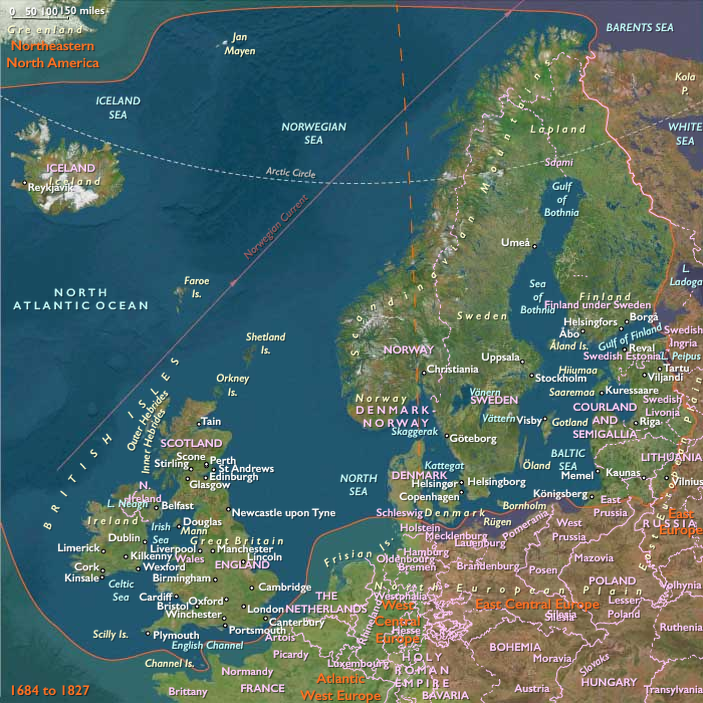
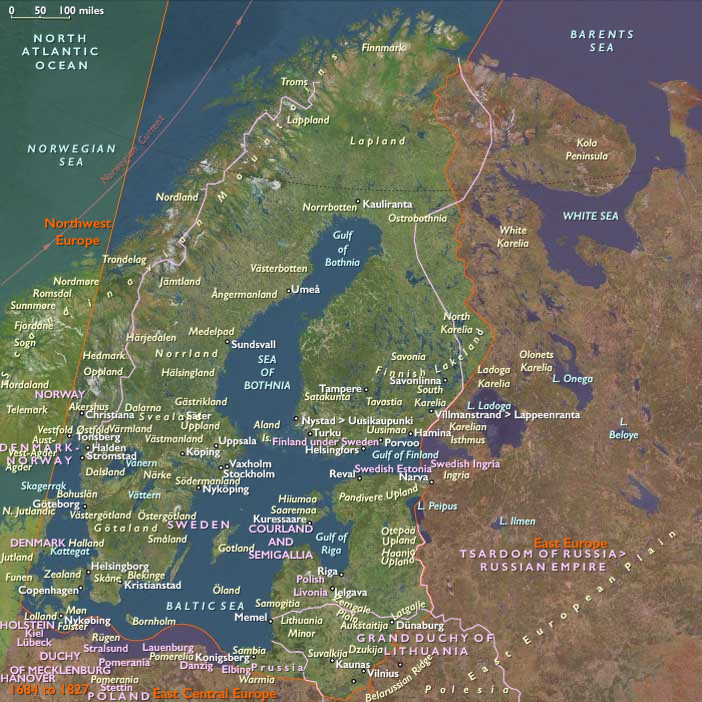
Northeast Europe includes Sweden, Finland, Lithuania, Latvia, Estonia, the Russian enclave of Kaliningrad, and eastern Denmark and Norway (including Copenhagen and Oslo). Anchors include the Baltic Sea littoral (from Skåne to Riga), the archipelagos of Åland and Stockholm, the Gulf of Finland and Gulf of Bothnia, the forests and lakes of Karelia, the Daugava and Nemunas river basins, and the capitals Stockholm, Copenhagen, Oslo, Riga, Tallinn, and Vilnius. The landscape mixed maritime corridors, forested interiors, fertile plains, and ice-bound winters, making it one of Europe’s most contested frontiers between Scandinavia, Russia, and Central Europe.
Climate & Environmental Shifts
The Little Ice Age remained influential: long winters froze the Baltic for months, delaying shipping until late spring. Grain harvests faltered in Finland and the Baltic provinces during poor summers, producing recurrent famines (notably in the 1690s). Storm surges damaged Danish and Swedish coasts, while in Norway and Finland fisheries buffered crop failures. By the early 19th century, climatic swings—such as the Tambora eruption in 1815—again caused food shortages, heightening social vulnerability.
Subsistence & Settlement
-
Scandinavia: Mixed farming dominated Denmark and southern Sweden, while northern zones relied on rye, barley, livestock, forestry, and coastal fisheries. Finland combined shifting cultivation and rye paddies with slash-and-burn (svedjebruk).
-
Baltic provinces: Grain estates worked by serfs supplied rye, oats, and barley for export. Forests yielded tar, pitch, and timber.
-
Norway: Coastal communities depended on cod and herring, supplemented by small-scale farming.
-
Urban centers: Riga, Tallinn, Vilnius, Copenhagen, and Stockholm grew as administrative and mercantile hubs, tied to the Baltic’s export economy.
Technology & Material Culture
-
Agriculture: Crop rotations and drainage projects in Denmark and Sweden improved yields; serf estates in the Baltic stuck to older forms but increased scale.
-
Forestry & shipbuilding: Norwegian and Swedish timber fed shipyards; Danish naval bases like Copenhagen flourished.
-
Crafts & trade goods: Baltic hemp, flax, tar, and sailcloth were vital for European navies. Riga exported rye and potash; Vilnius and Kaunas were centers for crafts and printing.
-
Architecture & arts: Lutheran churches in Sweden, Orthodox and Catholic cathedrals in Lithuania and Latvia, neoclassical palaces in Copenhagen and Stockholm, and manor houses across the Baltic baronies reflected elite culture.
Movement & Interaction Corridors
-
Baltic Sea: A commercial highway linking Danzig, Riga, Stockholm, and Copenhagen to Amsterdam and London.
-
Sound (Øresund): Danish tolls on shipping gave Copenhagen leverage until the early 19th century.
-
Overland routes: Connected Vilnius, Riga, and Tallinn to Moscow and Warsaw, carrying merchants, soldiers, and ideas.
-
Imperial expansion: Sweden’s empire contracted after the Great Northern War (1700–1721), ceding Estonia, Livonia, and Ingria to Russia. Denmark–Norway maintained its dual monarchy until 1814, when Norway entered union with Sweden. Finland was ceded by Sweden to Russia in 1809, becoming the Grand Duchy of Finland.
Cultural & Symbolic Expressions
-
Sweden: Lutheran orthodoxy shaped village schools and parish life; universities at Uppsala and Lund fostered Enlightenment scholarship.
-
Finland: Oral poetry, later recorded in the Kalevala, preserved mythic traditions alongside Lutheran faith.
-
Baltic provinces: German-speaking elites dominated serf peasantry; manor culture expressed baroque and later neoclassical aesthetics.
-
Lithuania: Catholic baroque churches flourished; Vilnius was a major Jesuit intellectual center until Russian annexation.
-
Denmark and Norway: Lutheran culture intertwined with maritime traditions; Copenhagen became a hub of Enlightenment philosophy and art.
-
Across the region, folk songs, woodcarving, embroidery, and festival calendars sustained peasant lifeways despite shifting political frontiers.
Environmental Adaptation & Resilience
-
Northern strategies: Slash-and-burn rye cultivation in Finland, cod and herring fisheries in Norway, and tar production in Sweden hedged against grain shortfalls.
-
Estate economies: Baltic serfs produced surpluses for export, but households relied on gardens, livestock, and forest foraging to survive lean years.
-
Communal institutions: Lutheran parish relief, Orthodox brotherhoods, and Catholic confraternities offered famine and sickness support.
-
Diversification: Households engaged in spinning, weaving, and seasonal labor to buffer instability.
Transition
Between 1684 and 1827, Northeast Europe shifted from Swedish dominion to Russian ascendancy. The Great Northern War ended Swedish imperial ambitions; Denmark–Norway was reshaped in Napoleonic diplomacy; Finland and the Baltic lands were absorbed into the Russian Empire. Yet resilience remained grounded in parish life, peasant commons, and the Baltic export economy. By the early 19th century, the region was enmeshed in global trade as a supplier of grain, tar, timber, and fish, even as shifting borders and climatic shocks continually tested its social fabric.
People
Groups
- Polytheism (“paganism”)
- Finns
- Sami people
- Karelians
- Tavastians
- Lithuanians (Eastern Balts)
- Estonians
- Germans
- Balts
- Latvians, or Letts (Eastern Balts)
- Christians, Roman Catholic
- Finland under Swedish rule
- Baltic Germans
- Estonian Swedes
- Kalmar Union (of Denmark, Norway and Sweden)
- Holy Roman Empire
- Lutheranism
- Protestantism
- Sweden, (second) Kingdom of
- Denmark-Norway, Kingdom of
- Russia, Tsardom of
- Courland and Semigallia, Duchy of
- Estonia, Duchy of (Swedish Estonia)
- Swedish Empire
- Polish-Lithuanian Commonwealth (Commonwealth of the Two Nations)
- Finland, (Swedish) Grand Duchy of
- Norway, dependent Danish kingdom of
- Brandenburg-Prussia
- Livonia, Swedish
- Pomerania, Swedish
- Bremen-Verden
- Pomerania, Swedish
- Estonia, Governorate of
- Russian Empire
- Livonia, Governorate of
- Vilna Governorate
- Courland Governorate
- Warsaw, Duchy of
- Finland, Grand Duchy of
- Norway, dependent Swedish kingdom of
- Denmark, Kingdom of
- Sweden and Norway, Union between the Kingdoms of
- Poland, Congress Kingdom of
Topics
- Enlightenment, Age of
- Great Famine of Finland (1695-1697)
- Great Famine of Estonia (1696–1698)
- Narva, Battle of
- Great Northern War plague outbreak
- East Prussia: Famine of 1708-11
- Poltava, Battle of
- Norway: Famine of 1741
- Napoleonic Wars
Commodoties
Subjects
Regions
Subregions
Years: 1684 - 1827
People
Groups
- Polytheism (“paganism”)
- Finns
- Sami people
- Karelians
- Tavastians
- Lithuanians (Eastern Balts)
- Estonians
- Germans
- Balts
- Latvians, or Letts (Eastern Balts)
- Christians, Roman Catholic
- Finland under Swedish rule
- Baltic Germans
- Estonian Swedes
- Kalmar Union (of Denmark, Norway and Sweden)
- Holy Roman Empire
- Lutheranism
- Protestantism
- Sweden, (second) Kingdom of
- Denmark-Norway, Kingdom of
- Russia, Tsardom of
- Courland and Semigallia, Duchy of
- Estonia, Duchy of (Swedish Estonia)
- Swedish Empire
- Polish-Lithuanian Commonwealth (Commonwealth of the Two Nations)
- Finland, (Swedish) Grand Duchy of
- Norway, dependent Danish kingdom of
- Brandenburg-Prussia
- Livonia, Swedish
- Pomerania, Swedish
- Bremen-Verden
- Pomerania, Swedish
- Estonia, Governorate of
- Russian Empire
- Livonia, Governorate of
- Vilna Governorate
- Courland Governorate
- Warsaw, Duchy of
- Finland, Grand Duchy of
- Norway, dependent Swedish kingdom of
- Denmark, Kingdom of
- Sweden and Norway, Union between the Kingdoms of
- Poland, Congress Kingdom of
Topics
- Enlightenment, Age of
- Great Famine of Finland (1695-1697)
- Great Famine of Estonia (1696–1698)
- Narva, Battle of
- Great Northern War plague outbreak
- East Prussia: Famine of 1708-11
- Poltava, Battle of
- Norway: Famine of 1741
- Napoleonic Wars
Commodoties
Subjects
Regions
Subregions