
North Europe (1396–1539 CE) Kalmar Union, …
Years: 1396 - 1539
North Europe (1396–1539 CE)
Kalmar Union, Hanseatic Hubs, and Tudor Beginnings
Geography & Environmental Context
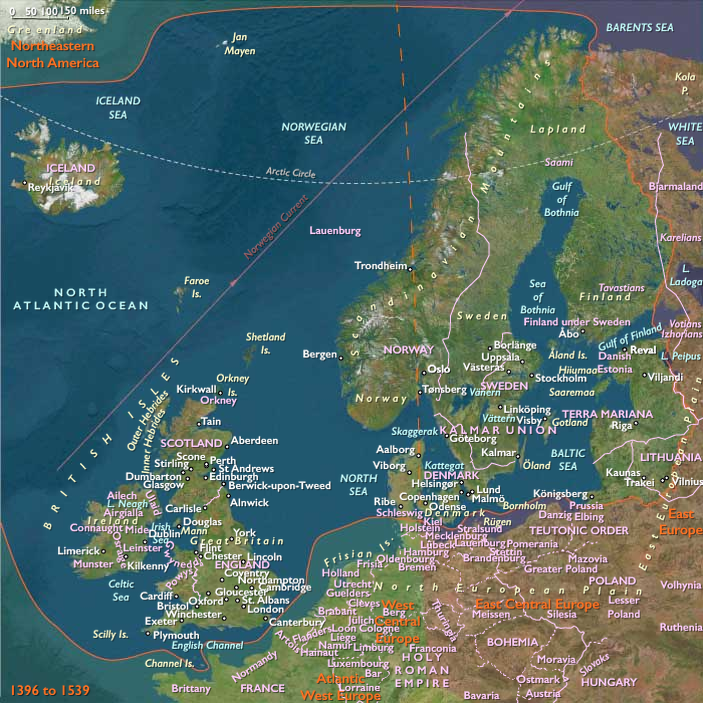
North Europe stretched from the Baltic to the North Atlantic, encompassing the forested and maritime worlds of Scandinavia, the Baltic states, and the British–Irish archipelago.
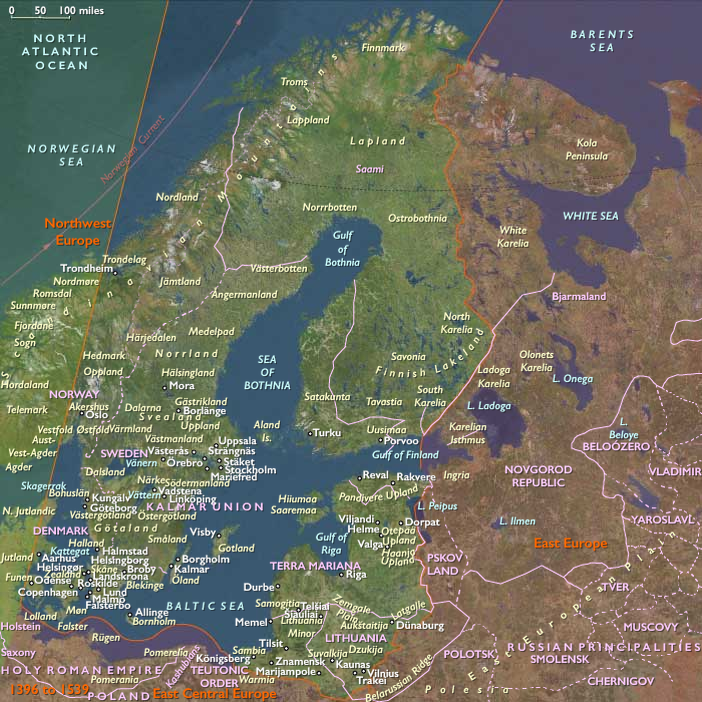
Northeast Europe—Sweden, Finland, Lithuania, Latvia, Estonia, eastern Denmark, and eastern Norway—formed the heart of the Baltic world, where forests, lakes, and grain plains fed into Hanseatic trade.
Northwest Europe—England, Scotland, Ireland, Wales, Iceland, the Faroes, and the Atlantic coasts of Norway and Denmark—looked westward toward fisheries and emerging Atlantic routes. Together, they linked the inland forests and plains to the open seas that defined early modern northern power.
Climate & Environmental Shifts
The Little Ice Age deepened winter severity and shortened growing seasons.
-
Baltic region: Long freezes closed harbors; floods and late thaws alternated with droughts in interior plains.
-
Scandinavia & Finland: Harvests shrank; forests and fisheries provided crucial fallback resources.
-
North Atlantic fringe: Harsher storms and sea-ice reached further south, disrupting cod and herring cycles but enriching fisheries in better years.
-
Britain & Ireland: Cooler, wetter decades challenged crops but spared maritime trade, as fisheries and livestock compensated for shortfalls.
Subsistence & Settlement
-
Baltic lands: Rye, barley, and oats dominated; forests yielded furs, timber, tar, and honey; iron mining in Bergslagen (Sweden) expanded.
-
Scandinavia & Denmark: Mixed grain and stock herding supported towns like Stockholm, Oslo, and Copenhagen.
-
British Isles: England’s open fields produced wheat, rye, and barley; uplands in Scotland, Wales, and Ireland focused on oats, grazing, and dairying; peat and woodland provided vital fuel.
-
Iceland & Faroes: Dependent on sheep, fish, and seabirds, exporting dried cod and wool to Bergen and Hanseatic merchants.
Urban growth centered on London, Stockholm, Copenhagen, Riga, and Tallinn—ports uniting inland grain and iron with sea commerce.
Technology & Material Culture
-
Agriculture: Wooden plows, iron blades, and watermills; three-field rotations in Baltic plains and open-field farming in England.
-
Maritime: Cogs, hulks, and evolving caravels carried timber, grain, and fish; clinker-built vessels remained common in fjords and islands.
-
Industry: Swedish ironworks, English cloth finishing, and Hanseatic shipyards drove regional exchange.
-
Architecture: Brick Gothic churches and fortresses in the Baltic; Perpendicular Gothic cathedrals in England; stave-church legacies in Norway; fortified tower houses in Ireland and Scotland.
-
Print & craft: Printing spread to London, Paris, Copenhagen, and Stockholm after 1476, fostering literacy and trade in books.
Movement & Interaction Corridors
-
Hanseatic League: From Lübeck to Riga and Tallinn, Baltic trade moved furs, tar, wax, and grain outward, bringing textiles, salt, and wine inward.
-
Kalmar Union (1397): United Denmark, Norway, and Sweden under one monarch; internal rebellion and civil wars foreshadowed its collapse.
-
Lithuania & Poland: The Polish–Lithuanian union (1386) extended from the Baltic to the steppe, linking Europe to Muscovy’s frontier.
-
British & Irish seas: Wool, cloth, and salt fish moved between London, Dublin, Bristol, Edinburgh, and continental ports.
-
Atlantic ventures: Bristol merchants probed western seas; John Cabot’s voyage (1497) revealed the cod-rich coasts of Newfoundland.
-
Scandinavian routes: Bergen’s Hanse convoys and Jutland’s cattle exports tied the Atlantic rim to the Baltic core.
Cultural & Symbolic Expressions
-
Faith & reform: Catholic orthodoxy prevailed, though reformist ideas spread via universities and trade. The Lutheran Reformation took root first in Sweden (under Gustav Vasa, 1520s) and Denmark–Norway (after 1536).
-
Literature & learning: Swedish and Danish chronicles, Gaelic bardic poetry, Icelandic sagas, and English and Scots verse (e.g., Dunbar, Henryson) flourished.
-
Urban culture: Baltic guilds sponsored altarpieces and public art; English confraternities built hospitals and chapels; Hanseatic merchants endowed churches across ports.
-
Law & monarchy: English common law matured; Scottish and Danish kings strengthened bureaucracies; Gaelic Brehon law persisted in Ireland.
Environmental Adaptation & Resilience
-
Diversified subsistence: Grain shortages offset by fishing, forestry, and livestock.
-
Storage & trade: Hanseatic and English granaries redistributed food in famine years.
-
Construction: Log and turf houses insulated against cold; seawalls and dikes secured coasts.
-
Mobility: Transhumance, timber floating, and coastal shipping ensured resource flow across fragmented geographies.
Technology & Power Shifts (Conflict Dynamics)
-
Scandinavia:
-
Kalmar Union revolts (1430s–1520s) led to Sweden’s independence under Gustav Vasa (1523) and the start of Lutheran reform.
-
Denmark–Norway retained the Atlantic isles; the Count’s Feud (1534–1536) ended with royal consolidation and Protestant victory.
-
-
Baltic & Steppe:
-
The Livonian Order ruled Estonia and Latvia under Hanseatic influence, declining under pressure from Muscovy.
-
Lithuania fought Moscow’s expansion, maintaining autonomy in the Polish–Lithuanian commonwealth.
-
Teutonic Prussia weakened after Tannenberg (1410), becoming a Polish fief.
-
-
British Isles:
-
The Hundred Years’ War’s close (1453) redirected England inward.
-
Wars of the Roses (1455–1487) culminated in Tudor rule under Henry VII.
-
Flodden (1513) crushed Scottish arms; Ireland remained divided between the English Pale and Gaelic lordships.
-
-
Maritime shifts: Naval gunnery, enclosed shipyards, and state fleets emerged, notably under the Tudors and Danes, signaling northern Europe’s coming naval ascendancy.
Transition (to 1539 CE)
By 1539, North Europe stood divided yet ascendant:
The Hanseatic League waned but its maritime legacy endured; Sweden and Denmark–Norway entered the Protestant era; Lithuania faced the growing might of Muscovy; and the British Isles, stabilized under the Tudors, turned toward the Atlantic.
Iceland and the Faroes remained fishing outposts; the Baltic still pulsed with trade in grain, tar, and timber. Across forests, fjords, and sea-lanes, resilience under cold skies forged the region’s next transformation—from medieval borderlands to early modern maritime powers.
People
- Christian III
- Engelbrekt Engelbrektsson
- Eric of Pomerania
- Gustav I Vasa
- Jogaila (Władysław II)
- Margaret I of Denmark
- Sten Sture the Elder
- Sten Sture the Younger
- Valdemar IV of Denmark
Groups
- Polytheism (“paganism”)
- Finns
- Sami people
- Karelians
- Tavastians
- Estonians
- Balts
- Latvians, or Letts (Eastern Balts)
- Sweden, Kingdom of
- Christians, Roman Catholic
- Riga, Bishopric/Archbishopric of
- Terra Mariana (Livonian Confederation)
- Estonia, Danish
- Ordensstaat (Monastic state of the Teutonic Knights)
- Livonian Order
- Estonian Swedes
- Hanseatic League
- Denmark, Kingdom of (Personal Union of Denmark and Norway)
- Poland of the Jagiellonians, Kingdom of
- Lithuania, Grand Duchy of
- Kalmar Union (of Denmark, Norway and Sweden)
- Protestantism
- Kalmar Union (of Denmark and Norway)
- Denmark-Norway, Kingdom of
Topics
Commodoties
Subjects
Regions
Subregions

Related Events
Showing 10 events out of 43406 total
Years: 1396 - 1539
People
- Christian III
- Engelbrekt Engelbrektsson
- Eric of Pomerania
- Gustav I Vasa
- Jogaila (Władysław II)
- Margaret I of Denmark
- Sten Sture the Elder
- Sten Sture the Younger
- Valdemar IV of Denmark
Groups
- Polytheism (“paganism”)
- Finns
- Sami people
- Karelians
- Tavastians
- Estonians
- Balts
- Latvians, or Letts (Eastern Balts)
- Sweden, Kingdom of
- Christians, Roman Catholic
- Riga, Bishopric/Archbishopric of
- Terra Mariana (Livonian Confederation)
- Estonia, Danish
- Ordensstaat (Monastic state of the Teutonic Knights)
- Livonian Order
- Estonian Swedes
- Hanseatic League
- Denmark, Kingdom of (Personal Union of Denmark and Norway)
- Poland of the Jagiellonians, Kingdom of
- Lithuania, Grand Duchy of
- Kalmar Union (of Denmark, Norway and Sweden)
- Protestantism
- Kalmar Union (of Denmark and Norway)
- Denmark-Norway, Kingdom of
Topics
Commodoties
Subjects
Regions
Subregions