
Northeast Europe (1384–1395 CE): Formation of New …
Years: 1384 - 1395
Northeast Europe (1384–1395 CE): Formation of New Alliances, Territorial Consolidation, and Diplomatic Shifts
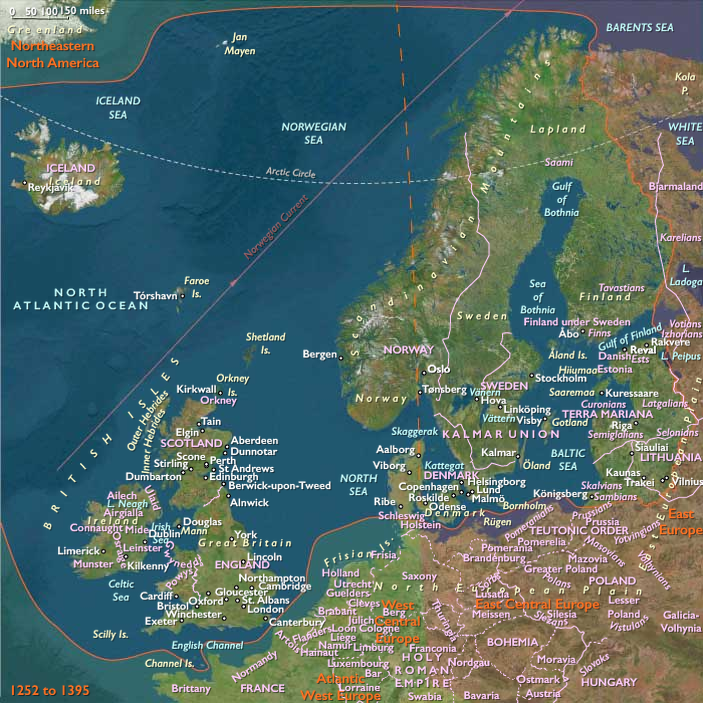
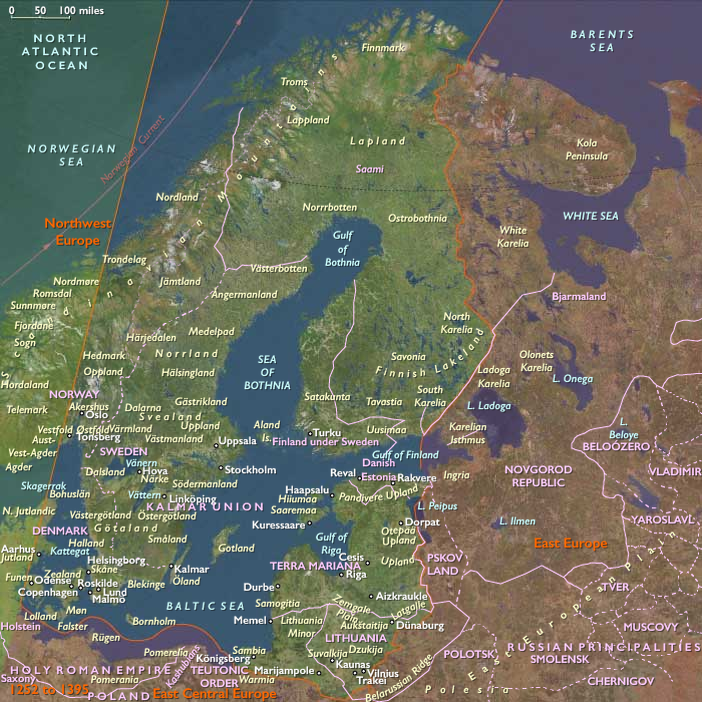
Between 1384 and 1395 CE, Northeast Europe underwent substantial geopolitical realignments, marked by the establishment of significant new unions and alliances, territorial stabilization, and economic recovery. The period saw critical developments including the early stages leading to the formation of the Kalmar Union, strengthened integration between Lithuania and Poland, and sustained control by the Teutonic Order in Estonia and Prussia.
Early Formation of the Kalmar Union
Following the death of King Olaf II in 1387, diplomatic efforts intensified among the kingdoms of Denmark, Norway, and Sweden, driven by shared economic interests, regional security concerns, and efforts to minimize dynastic instability. Margaret I, acting as regent and ruler of Denmark and Norway, skillfully advanced diplomatic negotiations and set in motion critical groundwork that would culminate in the formal establishment of the Kalmar Union in 1397. The gradual diplomatic initiatives during this era helped unite the Scandinavian kingdoms under a single crown, fundamentally altering the region’s political landscape.
Lithuanian-Polish Strategic Alliance
Concurrently, a pivotal event reshaped the eastern part of Northeast Europe. The marriage of Lithuanian Grand Duke Jogaila (later Władysław II Jagiełło) to Queen Jadwiga of Poland in 1386 created a significant personal union between the Grand Duchy of Lithuania and the Kingdom of Poland. This strategic alliance significantly strengthened both realms, enhancing their capacity to counterbalance the influence of neighboring powers, notably the Teutonic Order, and reshaped regional power dynamics, bringing greater geopolitical stability and integration in Eastern Europe.
Continued Stability Under Teutonic Governance
The Teutonic Order sustained its stable governance over territories such as Estonia and Prussia. The Order solidified administrative structures and fortified critical strategic points, including Reval (Tallinn) with its fortifications on Toompea Hill, and major urban centers like Königsberg. These actions enhanced the Order’s defensive posture, maintained economic vitality, and reinforced their regional influence.
Swedish Integration of Finland
During this period, Sweden deepened administrative, military, and ecclesiastical control over southern Finland, reinforcing political cohesion and cultural integration. Enhanced fortifications and strengthened governance frameworks ensured robust defensive capabilities, contributing significantly to regional stability and solidifying Finland’s alignment with broader Swedish geopolitical strategies.
Livonian Confederation’s Stability and Prosperity
The Livonian Confederation, administered from the trading city of Riga, continued to flourish economically and diplomatically. Effective internal governance, reinforced trade networks, and strategic diplomacy allowed the Confederation to successfully navigate complex regional politics, ensuring sustained autonomy and economic prosperity.
Economic Recovery and Urban Resilience
Urban centers including Reval (Tallinn), Riga, Königsberg, and Visby on Gotland enjoyed ongoing economic resurgence, driven by robust maritime commerce, enhanced trade networks, and merchant activity. These cities emerged as resilient economic hubs, significantly contributing to regional economic stability and broader recovery efforts.
Ecclesiastical Influence and Cultural Continuity
Ecclesiastical institutions, notably the Teutonic Order and influential regional bishoprics, played critical roles in fostering education, cultural continuity, and social stability. They sustained Latin Christian traditions, providing essential social services and education, thus reinforcing regional cohesion during an era of significant geopolitical realignment.
Strategic Diplomatic Realignments
Diplomatic interactions intensified among regional powers, including the emerging Scandinavian alliances, the Lithuanian-Polish union, the Teutonic Order, and the Livonian Confederation. Carefully balanced diplomatic initiatives ensured peaceful coexistence, managed regional rivalries, and facilitated cooperative efforts, significantly influencing Northeast Europe's political dynamics.
Legacy of the Era
The era from 1384 to 1395 CE significantly reshaped Northeast Europe through the formation of crucial strategic alliances and unions, territorial stabilization, and economic resurgence. These developments established enduring geopolitical structures, influenced future political alignments, territorial boundaries, and cultural identities, and laid essential groundwork for subsequent historical progress across the region.
People
Groups
- Polytheism (“paganism”)
- Latvians, or Letts (Eastern Balts)
- Denmark, Kingdom of
- Norway, independent Kingdom of
- Hanseatic league (informally organized)
- Sweden, Kingdom of
- Christians, Roman Catholic
- Finland under Swedish rule
- Riga, Bishopric/Archbishopric of
- Terra Mariana (Livonian Confederation)
- Estonia, Danish
- Livonian Order
- Lithuania, Grand Duchy of
- Teutonic Knights of Prussia, or Monastic state of the Teutonic Knights (House of the Hospitalers of Saint Mary of the Teutons in Jerusalem)
- Poland of the later Piasts, Kingdom of
- Lithuania, Grand Duchy of
- Denmark, Kingdom of (Personal Union of Denmark and Norway)
- Poland of the Jagiellonians, Kingdom of
- Lithuania, Grand Duchy of
Commodoties
Subjects
Regions
Subregions
Related Events
Showing 10 events out of 43629 total
Years: 1384 - 1395
People
Groups
- Polytheism (“paganism”)
- Latvians, or Letts (Eastern Balts)
- Denmark, Kingdom of
- Norway, independent Kingdom of
- Hanseatic league (informally organized)
- Sweden, Kingdom of
- Christians, Roman Catholic
- Finland under Swedish rule
- Riga, Bishopric/Archbishopric of
- Terra Mariana (Livonian Confederation)
- Estonia, Danish
- Livonian Order
- Lithuania, Grand Duchy of
- Teutonic Knights of Prussia, or Monastic state of the Teutonic Knights (House of the Hospitalers of Saint Mary of the Teutons in Jerusalem)
- Poland of the later Piasts, Kingdom of
- Lithuania, Grand Duchy of
- Denmark, Kingdom of (Personal Union of Denmark and Norway)
- Poland of the Jagiellonians, Kingdom of
- Lithuania, Grand Duchy of
Commodoties
Subjects
Regions
Subregions