
North Europe (1252–1395 CE): Hanseatic Gateways and …
Years: 1252 - 1395
North Europe (1252–1395 CE): Hanseatic Gateways and North Sea Kingdoms
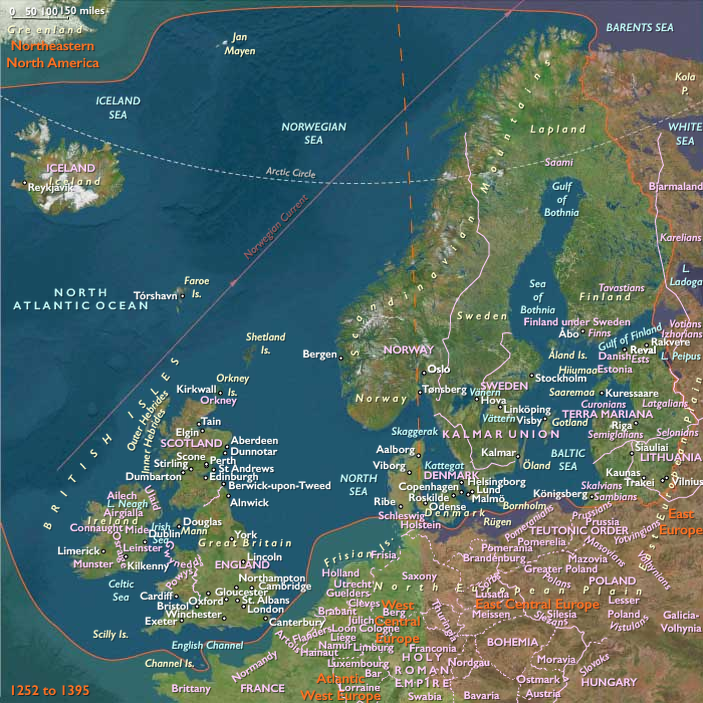
From the ice-bright fjords of Norway to the forested lakes of Finland, from the North Sea harbors of England and Flanders to the timbered ports of Riga and Reval, North Europe in the Lower Late Medieval Age formed a wide arc of coasts and islands bound by ships, winds, and trade. Here, between the Atlantic and the Baltic, urban leagues rose from the cold seas, monarchies forged fragile unions, and frontier societies balanced fishing, farming, and fur in the early chill of the Little Ice Age.
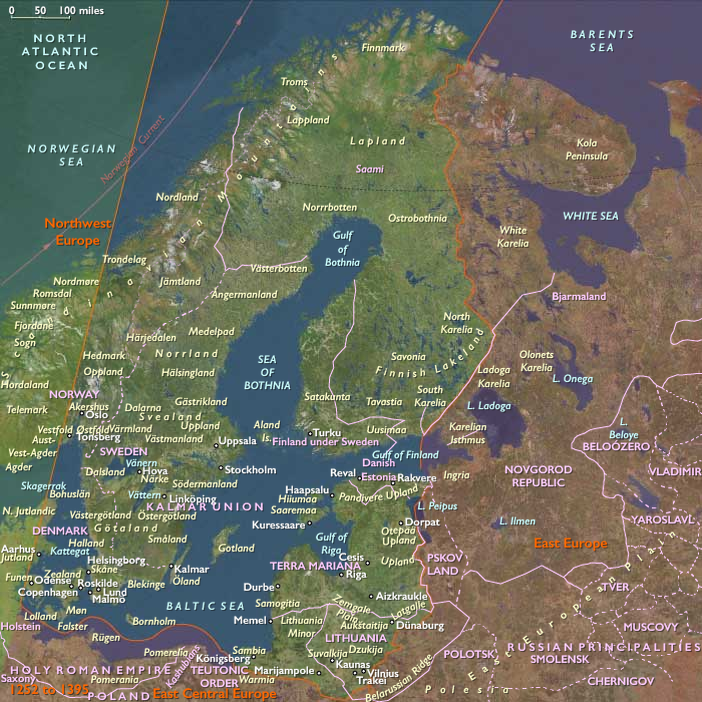
The century after 1250 opened with northern expansion and ended with consolidation. The Baltic world—a mosaic of Scandinavians, Germans, Finnic and Slavic peoples—became Europe’s northern frontier of Christianization, commerce, and state-building. Sweden, extending its reach eastward through the crusades of the mid-13th century, established control over Finland, fortifying Turku and Viipur and planting Latin Christianity along the Gulf of Bothnia. The monarchy strengthened under Magnus Ladulås (r. 1275–1290) but waned amid noble regencies in the 14th century, setting the stage for the Kalmar Union—the later federation of Sweden, Denmark, and Norway that would dominate the north.
Denmark, seated astride the Øresund, rebuilt its Baltic power under Valdemar IV Atterdag (r. 1340–1375). Control of the herring fisheries of Scania and the Sound tolls enriched the crown and the cities of Copenhagen, Malmö, and Helsingør. Across the sea, Norway governed a vast but thinly peopled realm of coasts and islands. The Black Death(1349–1350) cut its population by more than half, reducing royal revenues and leaving the country increasingly dependent on Danish and German merchants. Bergen, however, flourished as a hub of the stockfish trade, exporting dried cod to Lübeck, London, and Bruges, and connecting the Arctic fisheries to the Hanseatic world.
At the same time, Iceland, though under Norwegian rule since 1262, maintained its Althing and sagaliterary traditions, while the Faroe, Shetland, and Orkney islands slipped gradually from Norwegian into Scottish influence. The North Atlantic economy survived on wool, fish, and the resilience of small coastal communities accustomed to harsh climate and long isolation.
Along the southern Baltic, German and Scandinavian merchants transformed the sea into a common highway of trade. The Hanseatic League, led by Lübeck, united more than a hundred cities in a federation of markets and maritime law. Its cogs sailed from Bremen and Hamburg eastward to Visby on Gotland, Riga, Reval (Tallinn), and Novgorod, carrying salt, grain, and cloth north, and returning with timber, furs, tar, and iron. The Livonian Order, a crusading branch of the Teutonic Knights, ruled Estonia and Latvia, founding cathedral towns and fortresses while exacting tribute from the Baltic peoples.
Farther inland, Lithuania expanded westward and southward into Ruthenia, while its Baltic coast remained contested with the Teutonic Knights. The Christianization of Lithuania (1387) and the Union of Krewo (1385) bound it to Poland, drawing the last pagan kingdom of Europe into Latin Christendom. In the far east, the mercantile republic of Novgorod controlled Karelia and the White Sea routes, its boyars growing rich from the fur trade of the Finnic and Sami forests. Tribute flowed from hunters to Novgorod’s markets, then by Hanseatic kontors at Peterhof into the western economy. The Teutonic city of Königsberg (Kaliningrad), founded in 1255, served as a bridge between crusading Prussia and commercial Prussia—half monastery, half market.
The onset of the Little Ice Age after 1300 cooled the Baltic and Atlantic alike. Shorter growing seasons strained grain harvests in Finland and northern Norway, but the sea yielded abundance. The colder waters brought herring and cod in profusion, feeding both local diets and international trade. Mixed economies—small farms, herding, fishing, and trapping—buffered rural societies against famine, while urban ports prospered on maritime redundancy. When one route failed, another port took its place: the resilience of Riga, Reval, and Stockholm mirrored the flexibility of London, Bergen, and Bruges across the North Sea.
In the British Isles, royal wars redefined the landscape. England, unified under the Plantagenets, expanded through the conquest of Wales (1282) but met resistance in Scotland, where William Wallace and Robert the Bruce secured independence after the victory at Bannockburn (1314), later recognized by treaty (1328). The outbreak of the Hundred Years’ War (1337) with France redirected English ambition southward, turning Bordeaux into the principal export port for claret and wool. England’s Model Parliament (1295) and the development of a tax-granting Commons gave its monarchy new fiscal strength, even as plague and war ravaged its towns.
Scotland, emerging from the Wars of Independence, consolidated monarchy under David II and Robert II, fostering Gaelic and Lowland synthesis in court and church. Ireland, fragmented between Anglo-Norman lordships and resurgent Gaelic dynasties, saw the English Pale contract as plague and political crisis reduced royal control. The North Sea economy tied these islands to continental markets through Bristol, Hull, and King’s Lynn, whose fleets traded wool, cloth, wine, and salt fish.
The Hanseatic merchants at London’s Steelyard dominated export finance, while the Calais Staple, established after the English conquest of Calais in 1347, centralized wool trade under royal oversight. Across the channel, Flemish weavers in Bruges and Ghent transformed English wool into Europe’s finest cloth. The same winds that carried wool to Flanders brought herring fleets to Denmark and stockfish convoys to Norway—threads of a single northern economy spun from the sea.
Faith and culture intertwined with commerce. In Uppsala, Turku, and Trondheim, new cathedrals rose from stone quarried from frozen ground; in Westminster and York, Gothic vaults embodied royal piety. Monasteries along the North Sea coast—Lindisfarne, Iona, Bergen, and Nidaros—served as beacons of continuity. In the plague’s aftermath, lay devotion deepened: confraternities tended the sick, while mystics such as Julian of Norwich and Birgitta of Sweden voiced personal revelations of divine mercy amid mortality.
By 1395 CE, North Europe had become a maritime and mercantile sphere of its own. Novgorod still commanded the fur frontier though shadowed by Muscovy’s rise; Sweden and Denmark vied for Baltic supremacy; Livonia and Prussia were knit into the Christian north under the crusading orders; and across the North Sea, England, Scotland, and the Low Countries balanced war with prosperity. Hanseatic fleets and Atlantic merchants together shaped a new northern commonwealth of ports and peoples—resilient, self-confident, and poised to lead Europe’s maritime expansion in the centuries ahead.
Northeast Europe (with civilization) ©2024-25 Electric Prism, Inc. All rights reserved.
People
Groups
- Polytheism (“paganism”)
- Finns
- Sami people
- Balts
- Latvians, or Letts (Eastern Balts)
- Estonians
- Denmark, Kingdom of
- Norway, independent Kingdom of
- Hanseatic league (informally organized)
- Sweden, Kingdom of
- Christians, Roman Catholic
- Novgorod Republic
- Riga, Bishopric/Archbishopric of
- Terra Mariana (Livonian Confederation)
- Dominicans, or Order of St. Dominic
- Estonia, Danish
- Ordensstaat (Monastic state of the Teutonic Knights)
- Livonian Order
- Estonian Swedes
- Hanseatic League
Topics
- Northern Crusades, or Baltic Crusades
- Livonian Crusade
- Little Ice Age, Warm Phase I
- Little Ice Age (LIA)
Commodoties
- Fish and game
- Hides and feathers
- Gem materials
- Domestic animals
- Textiles
- Strategic metals
- Salt
- Beer, wine, and spirits
- Lumber
- Fuels, lubricants and sealants
- Money
Subjects
Regions
Subregions
Years: 1252 - 1395
Northeast Europe (with civilization) ©2024-25 Electric Prism, Inc. All rights reserved.
People
Groups
- Polytheism (“paganism”)
- Finns
- Sami people
- Balts
- Latvians, or Letts (Eastern Balts)
- Estonians
- Denmark, Kingdom of
- Norway, independent Kingdom of
- Hanseatic league (informally organized)
- Sweden, Kingdom of
- Christians, Roman Catholic
- Novgorod Republic
- Riga, Bishopric/Archbishopric of
- Terra Mariana (Livonian Confederation)
- Dominicans, or Order of St. Dominic
- Estonia, Danish
- Ordensstaat (Monastic state of the Teutonic Knights)
- Livonian Order
- Estonian Swedes
- Hanseatic League
Topics
- Northern Crusades, or Baltic Crusades
- Livonian Crusade
- Little Ice Age, Warm Phase I
- Little Ice Age (LIA)
Commodoties
- Fish and game
- Hides and feathers
- Gem materials
- Domestic animals
- Textiles
- Strategic metals
- Salt
- Beer, wine, and spirits
- Lumber
- Fuels, lubricants and sealants
- Money
Subjects
Regions
Subregions