
Northeast Europe (1252 – 1395 CE): Hanseatic …
Years: 1252 - 1395
Northeast Europe (1252 – 1395 CE): Hanseatic Gateways, Swedish and Danish Expansion, and Novgorod’s Northern Reach
Geographic and Environmental Context
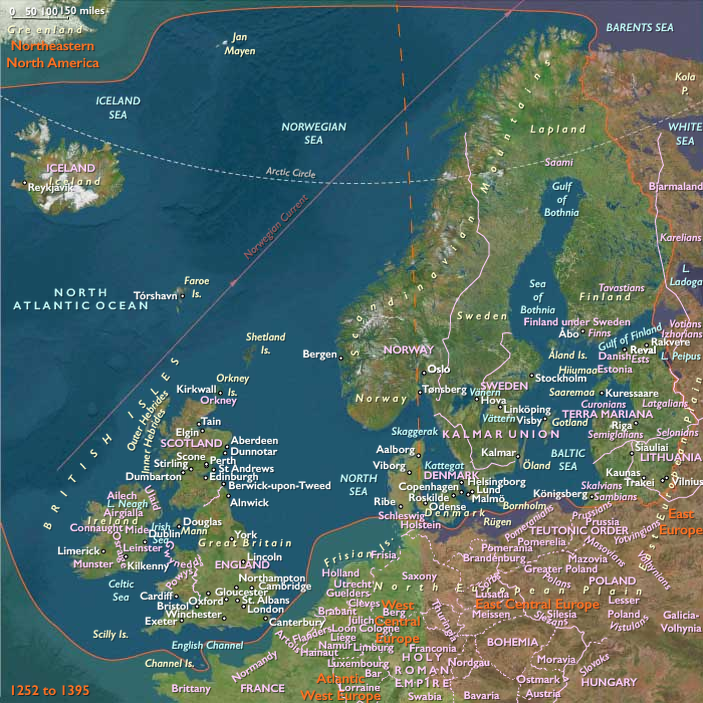
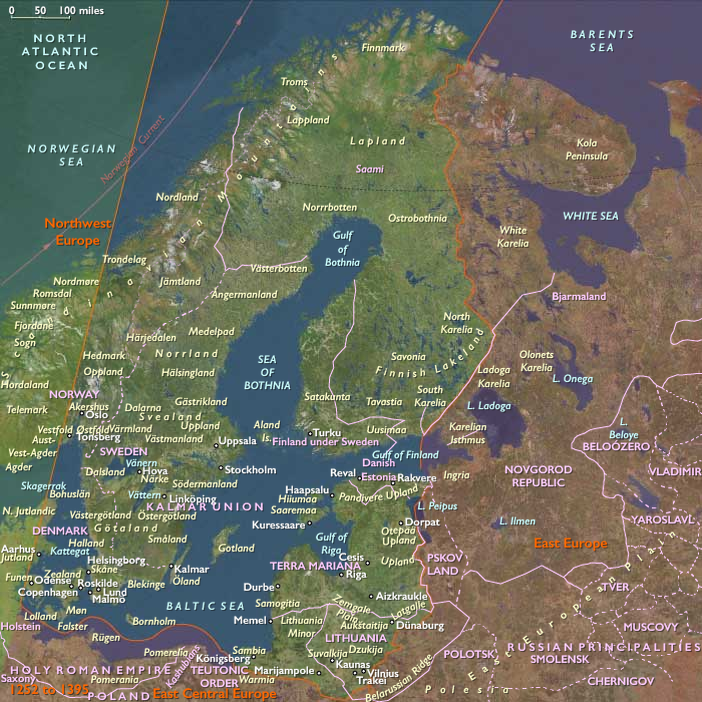
Northeast Europe includes Sweden, Finland, Denmark’s eastern reaches (including Copenhagen and Zealand), Norway’s southeast (Oslofjord), the Baltic States (Estonia, Latvia, Lithuania’s Baltic coast), and the Russian enclave of Kaliningrad.
-
Anchors: the Baltic Sea and its gulfs (Bothnia, Finland, Riga), forest–lake mosaics inland, and trade hubs like Stockholm, Visby, Riga, Tallinn (Reval), and Novgorod.
-
The region served as a northern crossroads between Scandinavia, Rus’, the Hanseatic League, and the Holy Roman Empire.
Climate and Environmental Shifts
-
The onset of the Little Ice Age (c. 1300) shortened growing seasons, cooled the Baltic, and shifted fishing patterns (notably herring).
-
Finland’s inland farmers and Sami reindeer–fishing communities adapted to longer winters; coastal traders thrived on intensified Hanseatic commerce.
Societies and Political Developments
-
Sweden & Finland:
-
Sweden extended dominion eastward into Finland after the Second Swedish Crusade (c. 1249); castles at Turku and Viipuri anchored control.
-
Swedish monarchy consolidated after the Folkunga dynasty and reforms of Magnus Ladulås (r. 1275–1290); by the 14th c., internal noble conflicts and regencies weakened the crown.
-
In 1397, shortly beyond our range, the Kalmar Union would unite Sweden, Denmark, and Norway.
-
-
Denmark & Norway:
-
Denmark dominated southern Scandinavia and the Sound tolls; under Valdemar IV (r. 1340–1375) it revived Baltic power.
-
Norway’s resources centered on fish and timber; Oslo was a royal seat, but plague (1349–50) devastated population and curtailed royal revenues.
-
-
Baltic States:
-
Livonian Order (branch of Teutonic Knights) ruled Estonia and Latvia after the collapse of native polities; Riga and Reval (Tallinn) prospered as Hanseatic cities.
-
Lithuania’s expansion pressed into coastal Samogitia and Courland; Christianization (1387) integrated Lithuania into Latin Europe.
-
-
Novgorod & Kaliningrad:
-
Novgorod retained control over Karelia and the White Sea, extracting tribute in furs from Finnic and Sami communities; Kaliningrad/Königsberg (founded by the Teutonic Knights in 1255) became a major crusading and Hanseatic hub.
-
Novgorod balanced between Hanseatic trade and Lithuanian–Muscovite frontiers.
-
Economy and Trade
-
Agriculture: rye, barley, oats, and livestock herding; limited by short growing seasons in Finland and Karelia.
-
Fur economy: Sami, Finnic, and Novgorodian hunters supplied sable, squirrel, and marten; exported via Novgorod and Hanseatic kontors.
-
Fishing: herring booms in Scania fueled Danish toll revenues and Hanseatic trade.
-
Timber, tar, hemp, flax, and iron exports from Sweden and Finland supplied European markets.
-
Hanseatic League: Visby (Gotland), Riga, Reval, and Novgorod’s Peterhof kontor became central nodes of the Hanseatic trading system.
-
Imports: salt, cloth, wine, and silver coinage (Lübeck, Prussian mints).
Subsistence and Technology
-
Plough agriculture: heavy ploughs and strip fields in southern Sweden; slash-and-burn (svedjeland) in Finnish forests.
-
Castles & towns: stone fortresses (Turku, Reval, Riga, Stockholm); urban guilds organized artisans and trade.
-
Shipping: cog ships carried bulk trade across the Baltic; local clinker-built vessels continued for fishing and cabotage.
-
Reindeer pastoralism: Sami herding, trapping, and fishing persisted alongside tribute obligations to Novgorod and Sweden.
Movement and Interaction Corridors
-
Baltic Sea routes: Hanseatic cogs linked Lübeck to Riga, Reval, Stockholm, Visby, and Novgorod.
-
Novgorod–White Sea–Karelia: tribute and fur trade routes tied Finnic peoples to Novgorodian merchants.
-
Danish Sound tolls: controlled passage between North Sea and Baltic.
-
Land corridors: overland routes connected Prussia and Livonia to Poland–Lithuania and to Muscovite Rus’.
Belief and Symbolism
-
Christianization:
-
Teutonic–Livonian crusades imposed Latin Christianity on Baltic peoples; monastic houses in Riga, Tallinn, and Königsberg anchored faith.
-
Sweden extended Latin Christianity into Finland with bishoprics at Turku.
-
-
Orthodoxy: remained dominant in Novgorod and Karelia.
-
Syncretism: Sami and Finnic animist practices persisted beneath Christian overlays; sacred drums and offering sites honored animal spirits.
-
Royal ideology: Scandinavian kings patronized cathedral-building (Uppsala, Turku) to legitimate rule.
Adaptation and Resilience
-
Trade redundancy: Hanseatic routes allowed grain, salt, and cloth to flow in when harvests failed.
-
Mixed economies: farming, fishing, and fur-trapping buffered ecological shocks.
-
Frontier tribute: Novgorod extracted furs from forest zones even as plague reduced labor in towns.
-
Political layering: Scandinavian monarchies, crusading orders, and city leagues balanced, ensuring continuity amid Black Death depopulation.
Long-Term Significance
By 1395, Northeast Europe was a Hanseatic–crusading frontier integrated into broader European commerce:
-
Novgorod thrived on the fur trade while under pressure from Muscovy and Lithuania.
-
Sweden and Denmark contested Baltic supremacy, with the Kalmar Union on the horizon.
-
Livonia and Prussia consolidated under the Teutonic and Livonian Orders.
-
Hanseatic merchants dominated Baltic exchange, knitting Scandinavia and Rus’ into Europe’s economic system.
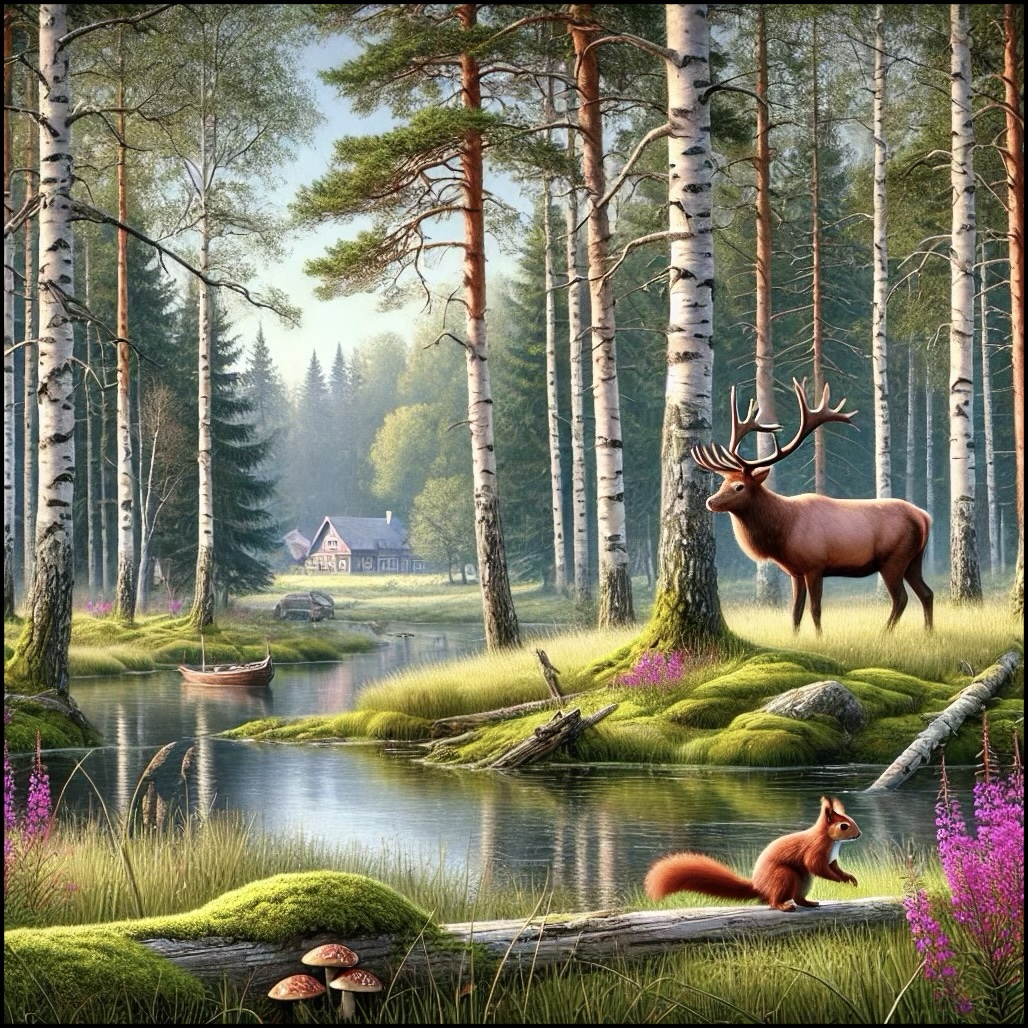
Northeast Europe (with civilization) ©2024-25 Electric Prism, Inc. All rights reserved.
People
Groups
- Polytheism (“paganism”)
- Finns
- Sami people
- Balts
- Latvians, or Letts (Eastern Balts)
- Estonians
- Denmark, Kingdom of
- Norway, independent Kingdom of
- Hanseatic league (informally organized)
- Sweden, Kingdom of
- Christians, Roman Catholic
- Novgorod Republic
- Riga, Bishopric/Archbishopric of
- Terra Mariana (Livonian Confederation)
- Dominicans, or Order of St. Dominic
- Estonia, Danish
- Ordensstaat (Monastic state of the Teutonic Knights)
- Livonian Order
- Estonian Swedes
- Hanseatic League
Topics
- Northern Crusades, or Baltic Crusades
- Livonian Crusade
- Little Ice Age, Warm Phase I
- Little Ice Age (LIA)
Commodoties
- Fish and game
- Hides and feathers
- Gem materials
- Domestic animals
- Textiles
- Strategic metals
- Salt
- Beer, wine, and spirits
- Lumber
- Fuels, lubricants and sealants
- Money
Subjects
Regions
Subregions
Years: 1252 - 1395
Northeast Europe (with civilization) ©2024-25 Electric Prism, Inc. All rights reserved.
People
Groups
- Polytheism (“paganism”)
- Finns
- Sami people
- Balts
- Latvians, or Letts (Eastern Balts)
- Estonians
- Denmark, Kingdom of
- Norway, independent Kingdom of
- Hanseatic league (informally organized)
- Sweden, Kingdom of
- Christians, Roman Catholic
- Novgorod Republic
- Riga, Bishopric/Archbishopric of
- Terra Mariana (Livonian Confederation)
- Dominicans, or Order of St. Dominic
- Estonia, Danish
- Ordensstaat (Monastic state of the Teutonic Knights)
- Livonian Order
- Estonian Swedes
- Hanseatic League
Topics
- Northern Crusades, or Baltic Crusades
- Livonian Crusade
- Little Ice Age, Warm Phase I
- Little Ice Age (LIA)
Commodoties
- Fish and game
- Hides and feathers
- Gem materials
- Domestic animals
- Textiles
- Strategic metals
- Salt
- Beer, wine, and spirits
- Lumber
- Fuels, lubricants and sealants
- Money
Subjects
Regions
Subregions