
Northeastern Eurasia (909 BCE – 819 CE): …
Years: 909BCE - 819
Northeastern Eurasia (909 BCE – 819 CE): Steppe Empires, River Kingdoms, and Forest–Sea Frontiers
Regional Overview
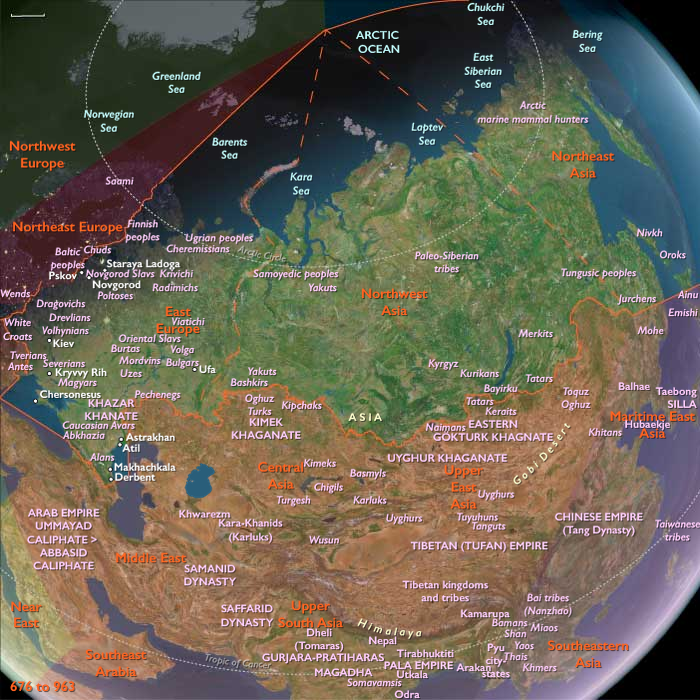
Spanning from the Ural steppes to the Amur River, Northeastern Eurasia was a continental hinge where grasslands, forests, and subarctic coasts met.
It was never a single civilization but an interacting system of three complementary worlds:
-
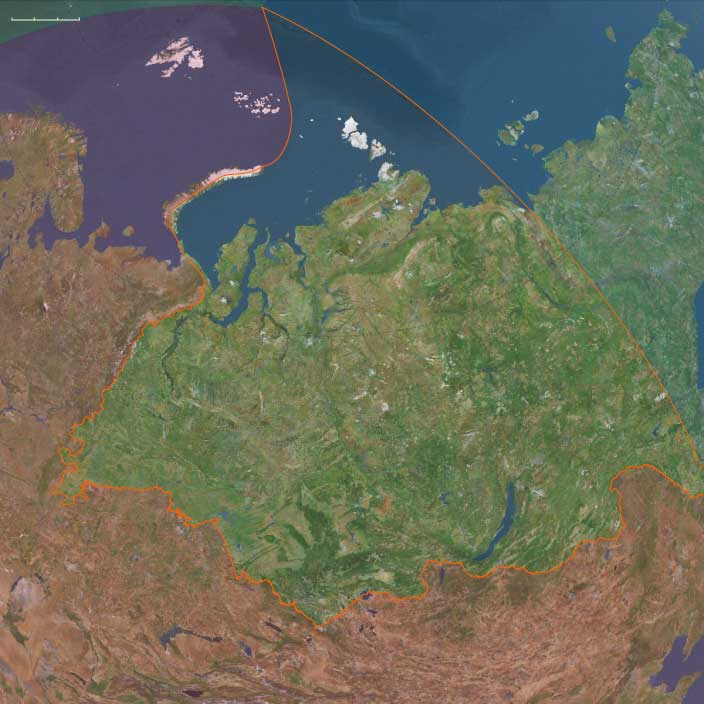
the Northwest Asian steppes—a domain of horse nomads and shifting empires;
-
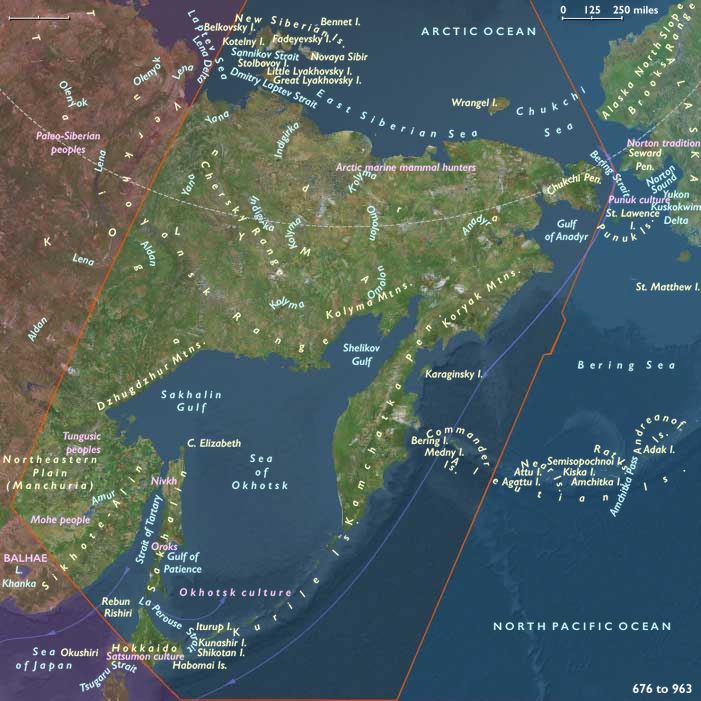
the Northeast Asian river–coastal zone—home to Amur polities, sealers, and proto-Ainu cultivators;
-
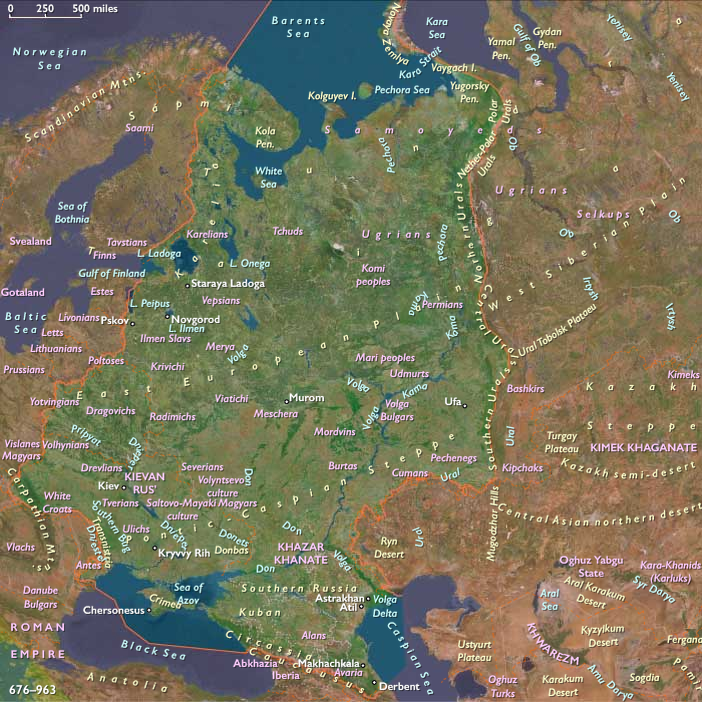
and the East European forest–steppe—a land of Scythians, Greek ports, and Slavic beginnings.
Across these ecotones, mobility, exchange, and adaptation to cold defined life and linked peoples from the Black Sea to the Pacific.
Geography and Environment
The region’s immensity embraced the Ural Mountains, Ob–Yenisei–Lena river systems, Altai–Sayan uplands, and the Amur–Okhotsk basin.
-
In the steppe belt (Northwest Asia and East Europe), open grasslands favored pastoral nomadism and mounted warfare.
-
In the taiga and tundra, dense forests and rivers sustained hunters and trappers.
-
Along the Amur and Okhotsk coasts, salmon rivers and seal rookeries supported maritime specialists.
Cold winters, brief summers, and erratic rainfall required mobility: herding on the plains, riverine storage, and seaborne subsistence at the coasts.
Climatic fluctuations shifted pastures and forest margins, driving the migrations that repeatedly reshaped this vast northern world.
Societies and Political Developments
The Northwest Steppes: Riders and Confederacies
Early Saka–Scythian cultures (1st millennium BCE) pioneered mounted archery, burial mounds, and trade routes linking the Altai to the Black Sea.
Their successors—the Xiongnu, Huns, and Türkic Khaganates—forged nomadic empires between the 3rd century BCE and the 8th century CE, commanding the Eurasian steppe road.
Pastoral clans of Sarmatians, Saka, and later Turks traded horses, felt, and slaves for silk, metalwork, and glass, while Ket, Samoyedic, and Evenki forest peoples maintained autonomy through trapping and fishing.
The East European Forest–Steppe: Traders, Farmers, and Frontiers
Between the Dniester and the Volga, Scythian and later Sarmatian riders ruled the Pontic plains; Greek colonies such as Olbia, Chersonesus, and Bosporus exported grain and slaves to the Mediterranean.
In the forest–steppe, Balts, Finno-Ugrians, and Slavic ancestors lived in mixed economies of farming, beekeeping, and fur trade.
By the early centuries CE, the Chernyakhiv culture bridged steppe and forest zones; later, Goths, Huns, and Avars swept westward, followed by the Khazars, who by the 7th century commanded the lower Volga.
Early Slavic settlements spread through the Dnieper basin, foreshadowing Kyivan Rus’.
The Amur–Okhotsk Northeast: River Chiefdoms and Sea Hunters
In the far east, Sushen/Mohe polities along the Amur taxed fish, furs, and horses, governing plank-built towns with storage pits and palisades.
Coastal Okhotsk communities specialized in sealing, whaling, and oil rendering, while inland clans hunted elk and reindeer.
On northern Hokkaidō, the Epi-Jōmon culture gave way to early Satsumon societies, incorporating iron tools and small-scale cultivation—precursors to later Ainu identity.
These eastern networks interacted with the Korean and Chinese frontiers, feeding iron, silk, and ceramics into local economies.
Economy and Exchange
Trade and mobility united the region more than empire or language.
Three great corridors structured movement:
-
The Steppe Road, carrying silk, metals, and horses between China, Persia, and the Black Sea.
-
The River Arteries, where the Ob, Yenisei, and Volga funneled furs, wax, and fish to southern markets.
-
The Amur–Okhotsk–Sakhalin Circuit, exchanging seal oil, ivory, and iron among coastal peoples.
Greek ports, Turkic caravan cities, and Amur villages each served as nodes of this transcontinental traffic.
Technology and Material Culture
Iron transformed toolkits across all zones: swords and plowshares in the steppe, adzes and awls in the taiga, harpoons and knives on the coast.
The stirrup and saddle revolutionized steppe warfare; dugout canoes and skin boats extended inland and maritime reach.
Pottery traditions remained diverse—black-burnished wares in the steppe, cord-impressed in the forest, thick-walled cooking jars in the Amur basin.
Animal-style art, petroglyphs, and totemic carvings reveal a shared aesthetic of motion and metamorphosis across peoples separated by thousands of kilometers.
Belief and Symbolism
Religion everywhere mirrored ecology.
-
Steppe nomads worshiped the Sky-God Tengri and honored ancestors through kurgan burials.
-
Forest and river peoples followed shamanic cosmologies tied to animals, trees, and water spirits.
-
Along the Amur and Okhotsk coasts, bear-sending rituals and first-salmon feasts expressed reciprocity with nature.
Greek colonies introduced Mediterranean cults, while Khazar and Bulgar elites later adopted Judaism and Islam—diversity without uniformity.
Adaptation and Resilience
Survival depended on mobility, diversity, and exchange.
Nomads tracked rainfall across steppe belts; hunters stored dried fish and smoked meat; sealers preserved oil in skin bags for the long winter.
The integration of horse, reindeer, and dog traction multiplied travel options; iron tools extended fuel and housing resources.
Polities rose and fell with climate and trade, yet the regional system endured through flexible kin alliances and shared environmental knowledge.
Regional Synthesis and Long-Term Significance
By 819 CE, Northeastern Eurasia was a mature transcontinental world:
-
The Northwest steppes had evolved from Scythian to Türkic empires, perfecting cavalry and steppe diplomacy.
-
The East European forests and rivers nurtured Slavic and Finno-Ugric communities, integrating them into the Khazar and Bulgar trade webs.
-
The Northeast river–coastal arc blended Amur chiefdoms, Okhotsk sealers, and proto-Ainu cultivators, joining the Asian mainland to the North Pacific.
This tri-zonal equilibrium—steppe mobility, forest production, maritime specialization—defined the ecological and cultural balance of northern Eurasia.
Out of it would emerge the medieval Turkic and Mongolic empires, the Rus’ river states, and the Ainu and Japanese North Pacific frontier, each inheriting the mobility, adaptability, and cosmopolitan exchange first forged in this early age.
Groups
- Chukchi
- Koryaks
- Evens, or Eveny
- Yukaghirs
- Emishi
- Yamato people
- Japan, Yayoi Period
- Japan, Yamato Kofun Period
- Okhotsk culture
- Japan, Yamato Hakuho (Late Asuka) Period
Commodoties
Subjects
Regions
Subregions
Years: 909BCE - 819
Groups
- Chukchi
- Koryaks
- Evens, or Eveny
- Yukaghirs
- Emishi
- Yamato people
- Japan, Yayoi Period
- Japan, Yamato Kofun Period
- Okhotsk culture
- Japan, Yamato Hakuho (Late Asuka) Period
Commodoties
Subjects
Regions
Subregions