
Northeast Asia (49,293 – 28,578 BCE): Upper …
Years: 49293BCE - 28578BCE
Northeast Asia (49,293 – 28,578 BCE): Upper Paleolithic I — Mammoth-Steppe, Sheltered Coasts, and First Long Ranges
Geographic and Environmental Context
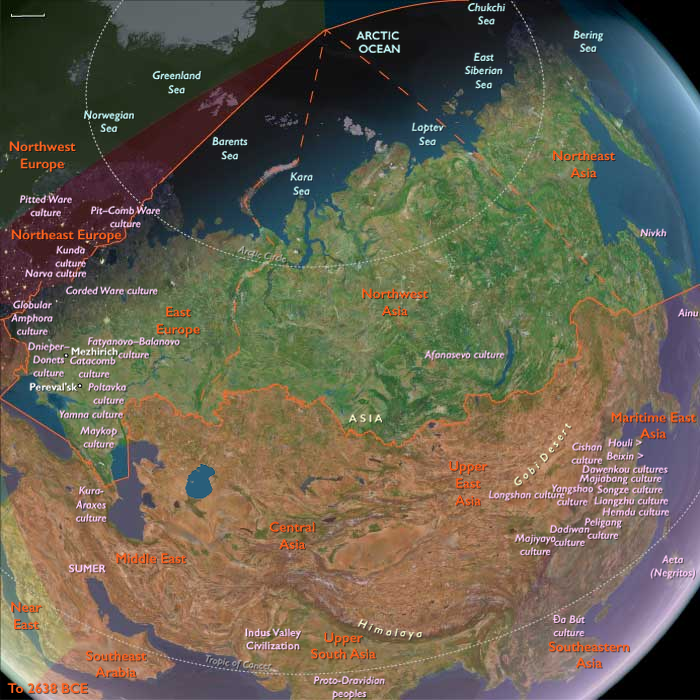
Northeast Asia includes eastern Siberia east of the Lena River to the Pacific, the Russian Far East (excluding the southern Primorsky/Vladivostok corner), northern Hokkaidō (above its southwestern peninsula), and extreme northeastern Heilongjiang.
-
Anchors: the Lower/Middle Amur and Ussuri basins, the Sea of Okhotsk littoral (Sakhalin, Kurils), Kamchatka, the Chukchi Peninsula (with Wrangel Island offshore), northern Hokkaidō, and seasonally emergent shelves along the Bering Sea and northwest Pacific.
Ancient North Siberians and the Deep Eurasian Split
The earliest securely identified human population associated with Northeast Asia belongs to a previously unknown lineage now termed the Ancient North Siberians (ANS). Genomic evidence from the Yana River sites (Yana RHS) indicates that these peoples were established in northeastern Siberia by at least 38,000 years ago, well before the Last Glacial Maximum.
The ANS diverged from Western Eurasians shortly after Western Eurasians themselves separated from East Asians, placing the ANS at a pivotal early junction in Eurasian population history. Culturally and biologically distinct, they adapted to extreme high-latitude environments long before the formation of later Siberian populations.
Crucially, these early inhabitants are not ancestral to most later Siberians and do not represent a continuous population into the Holocene. Instead, they form an early, now largely vanished branch of Eurasian humanity whose genetic legacy survives only in diluted form.
Climate and Environmental Shifts
-
Last Glacial Maximum (c. 26,500–19,000 BCE) dominated the latter half of this interval: colder, drier conditions; permafrost pushed south; sea level ~100 m lower exposed broad coastal plains.
-
Inland mammoth-steppe mosaics (grass–forb) alternated with open larch; coastlines were wider, with ice-edge polynyas supporting marine life.
Subsistence and Settlement
-
Big-game foraging focused on mammoth, woolly rhinoceros, horse, bison, and reindeer on river terraces (Aldan–Amur–Anadyr).
-
Coastal scouts used intertidal flats and pack-ice edges to take seals, walrus, seabirds, and winter fish.
-
Camps clustered at confluences, aeolian bluffs, and paleo-shorelines; repeated seasonal use left dense knapping scatters and hearths.
Technology and Material Culture
-
Blade and microblade industries from local obsidian (e.g., Hokkaidō, Kamchatka) and high-quality chert; hafted composite points for thrusting/spear-throwing.
-
Bone/antler/ivory harpoons, awls, eyed needles; tailored cold-weather clothing and boots.
-
Personal adornment: drilled tooth/shell pendants, beads, engraved bone; ochre widely used.
Movement and Interaction Corridors
-
River highways: Lena–Aldan–Amur trunks guided seasonal migrations.
-
Shelf-edge “kelp highway” along the Okhotsk–Bering coasts supported over-ice travel in winter and nearshore voyaging in summer.
-
Wrangel–Chukchi–Beringia arcs linked Northeast Asia to the sub-glacial refugium on the far side of the strait.
Cultural and Symbolic Expressions
-
Carved animal figurines and engraved bones reflect close predator–prey cosmologies.
-
Ochre burials and hearth-centered activity zones suggest shared Upper Paleolithic mortuary and domestic traditions.
Environmental Adaptation and Resilience
-
High mobility between coast–river–upland zones diversified diets and buffered risk.
-
Cold-weather tailoring, layered shelters (snow/skin windbreaks), and fuel provisioning enabled wintering at high latitudes.
Genetic and Linguistic Legacy
-
Ice-age Northeast Asian groups contributed key ancestry to Beringian populations; these, in turn, fed the founding gene pool of the First Americans.
-
Deep links formed here between Arctic–sub-Arctic foragers that later radiated across the North Pacific rim.
Transition Toward the Next Epoch
By 28,578 BCE, foragers in Northeast Asia had mastered periglacial ecologies and coastal shelves. As climate wobble and deglaciation approached, river and shoreline corridors would become even more crucial for movement, exchange, and eventual trans-Beringian dispersals.
Topics
Commodoties
Subjects
Regions
Subregions

Related Events
Showing 10 events out of 69706 total
Years: 49293BCE - 28578BCE
Topics
Commodoties
Subjects
Regions
Subregions