
Northeast Asia (7,821 – 6,094 BCE): Early …
Years: 7821BCE - 6094BCE
Northeast Asia (7,821 – 6,094 BCE): Early Holocene — Salmon Villages, First Pottery Expansion, and Forest Mosaics
Geographic and Environmental Context
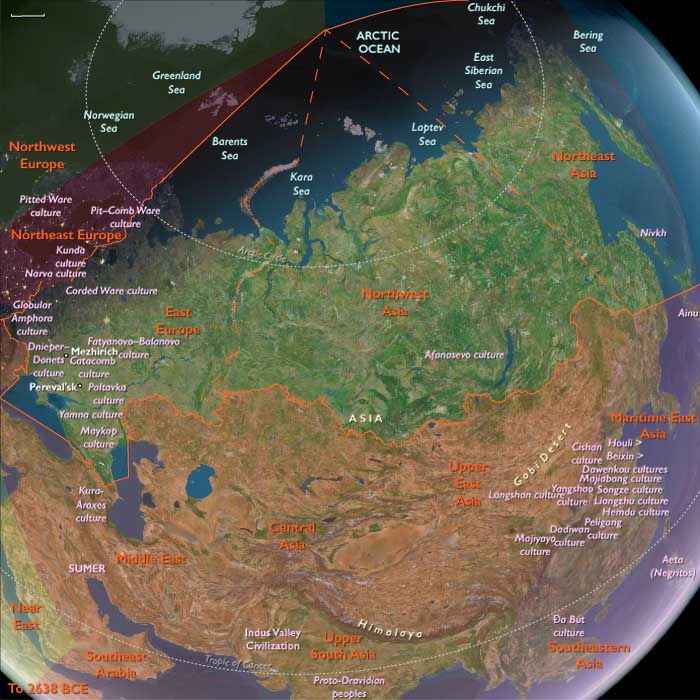
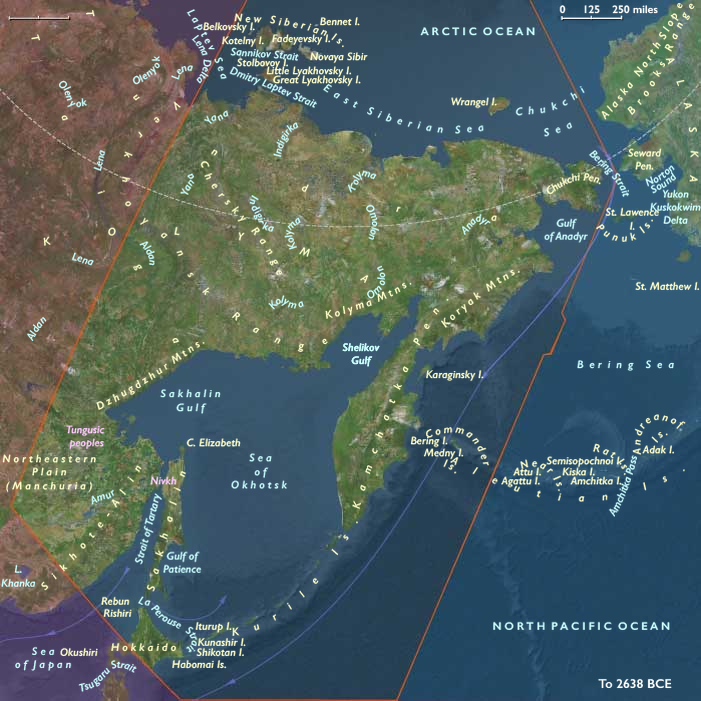
Northeast Asia includes eastern Siberia east of the Lena River to the Pacific, the Russian Far East (excluding the southern Primorsky/Vladivostok corner), northern Hokkaidō (above its southwestern peninsula), and extreme northeastern Heilongjiang.
-
Anchors: the Lower/Middle Amur and Ussuri basins, the Sea of Okhotsk littoral (Sakhalin, Kurils), Kamchatka, the Chukchi Peninsula (with Wrangel Island offshore), northern Hokkaidō, and seasonally emergent shelves along the Bering Sea and northwest Pacific.
Formation of Ancient Paleosiberians and Proto-Amerindian Isolation
By the early Holocene, the Ancient Paleosiberians (AP) had become a distinct population across parts of northeastern Siberia. A key representative comes from a ~9,800 BCE individual from the Kolyma River, whose genome reveals close affinity to the ancestors of Native Americans.
At this stage, the populations ancestral to Native Americans and those remaining in Northeast Asia were still closely related, sharing a mixed ancestry composed of:
-
Ancient North Eurasian (ANE) components of largely West Eurasian origin
-
A deeply diverged East Eurasian lineage, related to but separate from modern East Asians, which had split from their ancestors around 25,000 years ago
This period marks the height of genetic continuity between Siberian and proto-American populations, just before their historical trajectories diverged.
Climate & Environmental Shifts
-
Early Holocene stability: fuller taiga expansion, high river discharges, productive estuaries and nearshore kelp forests.
-
Sea level rising toward modern shorelines created drowned river-mouths ideal for salmon runs.
Subsistence & Settlement
-
Salmon-focused semi-sedentism: repeated aggregation at confluences and tidal flats; smoke-drying and oil rendering supported storage.
-
Broad-spectrum foraging: elk/reindeer, waterfowl, nuts/berries, intertidal shellfish; pinnipeds seasonally.
Technology & Material Culture
-
Early pottery (fiber- and plant-tempered) spread throughout the Lower Amur and coastal basins; soot-blackened cooking jars for fish broths.
-
Ground-stone adzes for woodworking and hollowing logs; composite harpoons; barbed bone fishhooks; net sinkers and floats.
-
Personal ornaments in shell/antler; ochre-rubbed burials.
Movement & Interaction Corridors
-
Amur–Sungari waterway linked interior and coast; short-hop voyaging along Sakhalin–Kurils–Hokkaidō.
-
Seasonal over-ice travel persisted on inner bays; summer canoe movement expanded.
Cultural & Symbolic Expressions
-
First-salmon rites inferred from patterned discard; bear and sea-mammal treatment suggests ritual respect for “animal masters.”
Environmental Adaptation & Resilience
-
Storage + mobility strategy buffered lean runs; multi-habitat rounds (river–coast–upland) diversified risk.
Transition
Toward 6,094 BCE, stable salmon ecologies and expanding early pottery paved the way for larger pit-house villages and richer coastal networks.
Groups
- Chukchi
- Koryaks
- Ulch people
- Nivkh people
- Evens, or Eveny
- Ainu people
- Mohe people
- Khitan people
- Okhotsk culture
- Balhae (Bohai, or Pohai), Kingdom of
- Satsumon culture
- Japan, Heian Period
- Itelmens
- Nanai people
- Evenki
- Liao Dynasty, or Khitan Empire
Commodoties
- Fish and game
- Weapons
- Hides and feathers
- Gem materials
- Domestic animals
- Grains and produce
- Ceramics
- Strategic metals
- Manufactured goods
- Spices
Subjects
Regions
Subregions
Related Events
Showing 10 events out of 69350 total
Years: 7821BCE - 6094BCE
Groups
- Chukchi
- Koryaks
- Ulch people
- Nivkh people
- Evens, or Eveny
- Ainu people
- Mohe people
- Khitan people
- Okhotsk culture
- Balhae (Bohai, or Pohai), Kingdom of
- Satsumon culture
- Japan, Heian Period
- Itelmens
- Nanai people
- Evenki
- Liao Dynasty, or Khitan Empire
Commodoties
- Fish and game
- Weapons
- Hides and feathers
- Gem materials
- Domestic animals
- Grains and produce
- Ceramics
- Strategic metals
- Manufactured goods
- Spices
Subjects
Regions
Subregions