
Northeast Asia (1804–1815 CE) Expansion, Exploration, …
Years: 1804 - 1815
Northeast Asia (1804–1815 CE)
Expansion, Exploration, and Economic Intensification
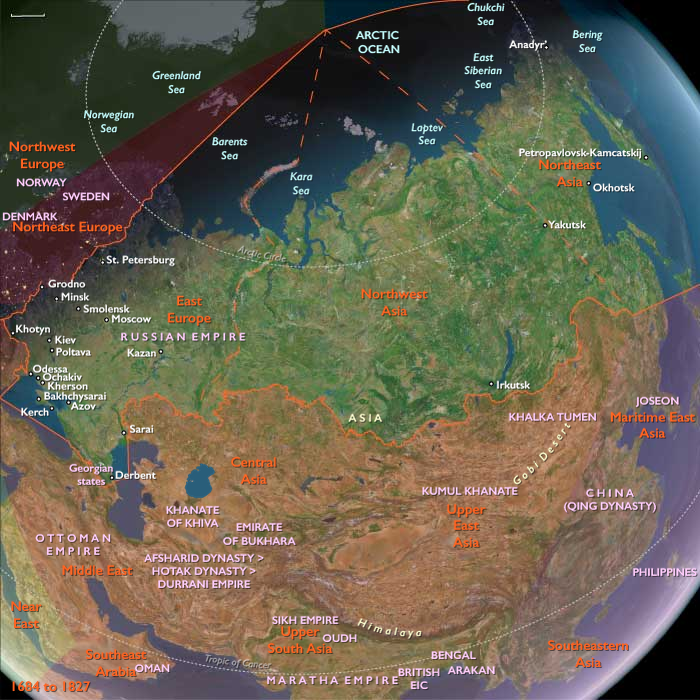
Between 1804 and 1815, Northeast Asia saw the continued expansion of Russian influence, facilitated by the economic activities of the Russian-American Company and ongoing maritime fur trading. The company, founded in 1799, solidified its position in the region, using Kamchatka and the Aleutian Islands as pivotal points in its extensive trade networks.
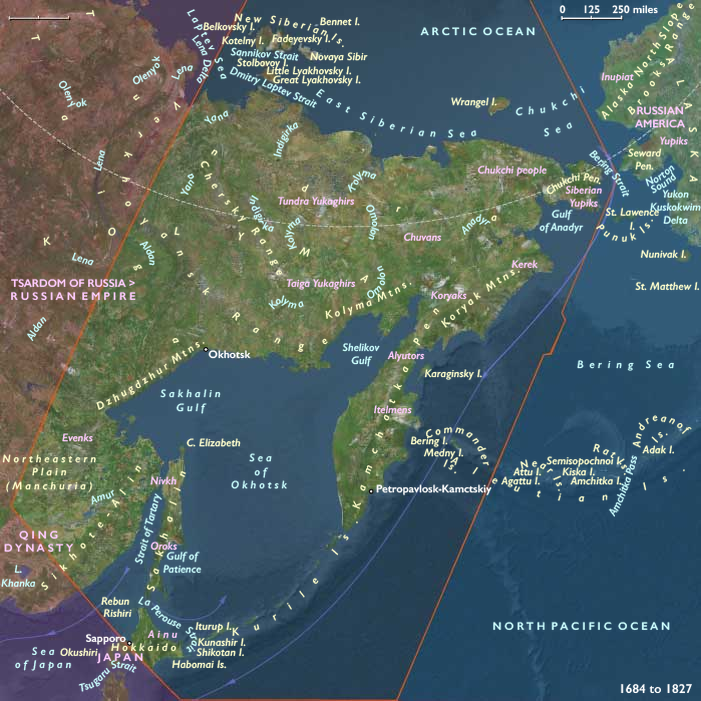
Petropavlovsk-Kamchatsky increasingly became an essential administrative and logistical center due to its strategic position and superior port facilities, overshadowing the older port of Okhotsk. Nevertheless, Okhotsk continued its critical role as the main supply route for the Kamchatka Peninsula and Russian settlements in North America, despite persistent challenges posed by its harsh climate and limited agricultural productivity.
The harbor at Okhotsk was ice-free from May to November, but the sailing season was restricted to only four months, June through September. The town, located on a low, narrow spit blocking the mouths of two rivers, faced significant logistical difficulties. Most of the harbor became a mud flat during low water, limiting access for large ships to high tides and favorable winds. Ice-choked waters during the spring breakup frequently caused flooding—20 incidents recorded between 1723 and 1813—and high surf posed additional hazards. In 1810, the Okhota River, blocked by ice, cut a new channel through the spit and isolated the town site. Consequently, the town was relocated in 1815 to a new site east of the harbor mouth, requiring goods to be unloaded and ferried across the harbor. This shallow harbor necessitated that Yakut laborers wade with heavy loads from shore to barge, and freshwater supplies had to be transported from two and a half miles away.
Russian exploratory ventures during this era included detailed mapping of coastal areas, improving navigation and bolstering trade routes. These expeditions contributed significantly to geographic knowledge and facilitated safer and more efficient maritime operations across the northern Pacific.
The exploitation of fur-bearing animals, particularly sea otters and fur seals, continued to intensify, placing significant pressure on local ecosystems. Furs gathered in these regions were transported via Okhotsk and Petropavlovsk, destined primarily for trade with China through the border trading post at Kyakhta, underscoring the global significance of this regional trade.
Russian encroachments from the north prompted the Tokugawa shogunate to extend direct rule to Hokkaidō, Sakhalin, and the Kuriles in 1807, though Japan continued its broader policy of exclusion.
Intercultural exchanges also marked this period. Russian interactions with indigenous peoples, including the Ainu, Itelmen, and Chukchi, ranged from cooperative trade alliances to occasional conflict, driven by Russian economic ambitions and indigenous resistance to territorial encroachments.
Throughout this period, the Russian Empire steadily consolidated its administrative infrastructure in Northeast Asia, laying the foundations for further territorial and economic expansion. This included establishing additional fortified settlements and trade outposts, which became instrumental in maintaining control over the region's vast and challenging landscape.
Groups
- Koryaks
- Chukchi
- Nivkh people
- Evens, or Eveny
- Yukaghirs
- Ainu people
- Buddhism
- Japanese people
- Itelmens
- Siberian Yupiks
- Evenks
- Yakuts
- Alyutors
- Kereks
- Japan, Tokugawa, or Edo, Period
- Russian Empire
- Russian America
- Russian-American Company
Topics
Commodoties
Subjects
Regions
Subregions
Years: 1804 - 1815
Groups
- Koryaks
- Chukchi
- Nivkh people
- Evens, or Eveny
- Yukaghirs
- Ainu people
- Buddhism
- Japanese people
- Itelmens
- Siberian Yupiks
- Evenks
- Yakuts
- Alyutors
- Kereks
- Japan, Tokugawa, or Edo, Period
- Russian Empire
- Russian America
- Russian-American Company
Topics
Commodoties
Subjects
Regions
Subregions