
Northeast Asia (1780–1791 CE) Expansion of …
Years: 1780 - 1791
Northeast Asia (1780–1791 CE)
Expansion of Russian Influence and Maritime Commerce
From 1780 to 1791, Russian maritime exploration and commercial activities in Northeast Asia accelerated further, consolidating Russian presence and administrative control. Fur traders and explorers expanded their voyages throughout the Aleutian Islands, reaching further into Alaskan territories, and intensifying interactions with indigenous peoples. The resulting trade networks significantly impacted local economies, often exploiting indigenous labor and resources.
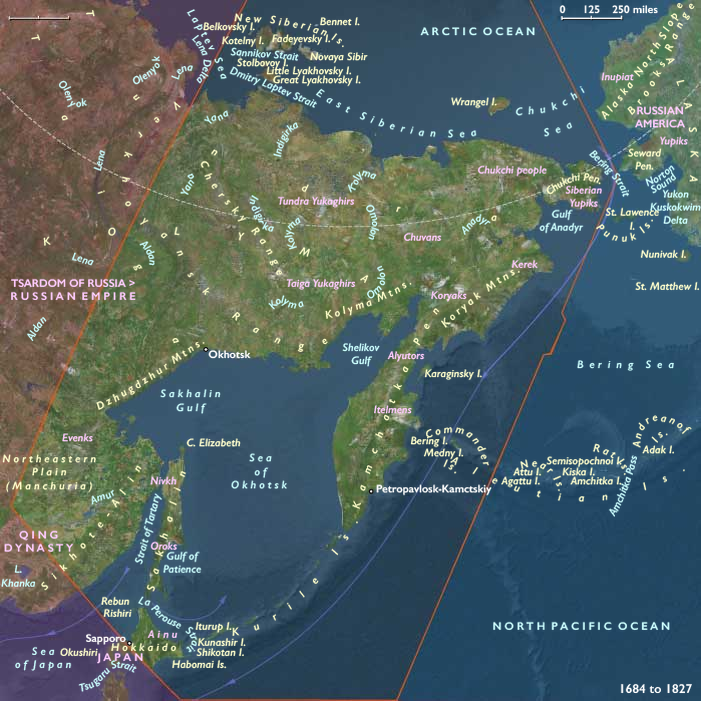
The strategic port of Okhotsk continued to serve as the main logistical hub despite its inherent disadvantages, including harsh climate conditions, limited agricultural productivity, and challenging terrain. Nevertheless, it remained critical for the supply and provisioning of distant Russian settlements and fur-trading expeditions throughout the region.
Ships typically stopped at the Commander Islands during the early decades of the maritime fur trade, largely to slaughter and preserve the meat of Steller's sea cows, whose range was limited to those islands. This large sirenian mammal had been discovered in 1741 by German naturalist Georg Wilhelm Steller, who was traveling with Vitus Bering. The species, driven rapidly to extinction by overhunting, was completely wiped out by 1768, underscoring the ecological strain placed on local wildlife by European traders.
The continued exploitation of natural resources placed increasing ecological strain on local wildlife populations, particularly the prized sea otters, fur seals, and various fox species, further altering the ecological balance of the region.
This period also saw remarkable intercultural encounters. In 1787, the Japanese castaway Daikokuya Kōdayū and eight other survivors, stranded for five years in the Aleutian Islands, reached Kamchatka after sailing a driftwood craft for a month and a half. Initially disbelieved by Russian officials, their story eventually gained recognition through the writings of French diplomat Barthélemy de Lesseps.
Meanwhile, French explorer Jean François de Galaup, comte de Lapérouse, explored the Northeast Asian coast, reaching the island of Oku-Yeso (modern-day Sakhalin Island), where the indigenous Ainu people provided crucial geographic information. Lapérouse then sailed through what became known as La Pérouse Strait (between Sakhalin and Hokkaidō), further charting the area and interacting with additional Ainu communities in the Kuril Islands. He reached Petropavlovsk on the Kamchatka Peninsula in September 1787, where he enjoyed Russian hospitality. Lapérouse's expedition would later dispatch Barthélemy de Lesseps on a significant overland journey across Siberia and Russia to carry expedition records back to France.
Russian officials during this period began to emphasize a more structured administrative presence, establishing fortified outposts and trading posts to reinforce control over fur-rich territories. These outposts became key nodes in Russia’s expanding Pacific trade, with furs transported inland to be exchanged primarily at the Chinese border trading town of Kyakhta, maintaining a steady flow of luxury goods and profits.
This era laid a significant foundation for the sustained Russian presence in Northeast Asia and set the stage for deeper engagement and eventual settlement efforts in subsequent decades.
People
Groups
- Koryaks
- Chukchi
- Nivkh people
- Yukaghirs
- Evens, or Eveny
- Buddhism
- Ainu people
- Japanese people
- Itelmens
- Siberian Yupiks
- Evenks
- Kereks
- Alyutors
- Russia, Tsardom of
Topics
Commodoties
Subjects
Regions
Subregions
Years: 1780 - 1791
People
Groups
- Koryaks
- Chukchi
- Nivkh people
- Yukaghirs
- Evens, or Eveny
- Buddhism
- Ainu people
- Japanese people
- Itelmens
- Siberian Yupiks
- Evenks
- Kereks
- Alyutors
- Russia, Tsardom of
Topics
Commodoties
Subjects
Regions
Subregions