
Northeast Asia (1732–1743 CE) Russian Maritime …
Years: 1732 - 1743
Northeast Asia (1732–1743 CE)
Russian Maritime Initiatives, Bering's Expedition, and the Origins of Maritime Fur Trade
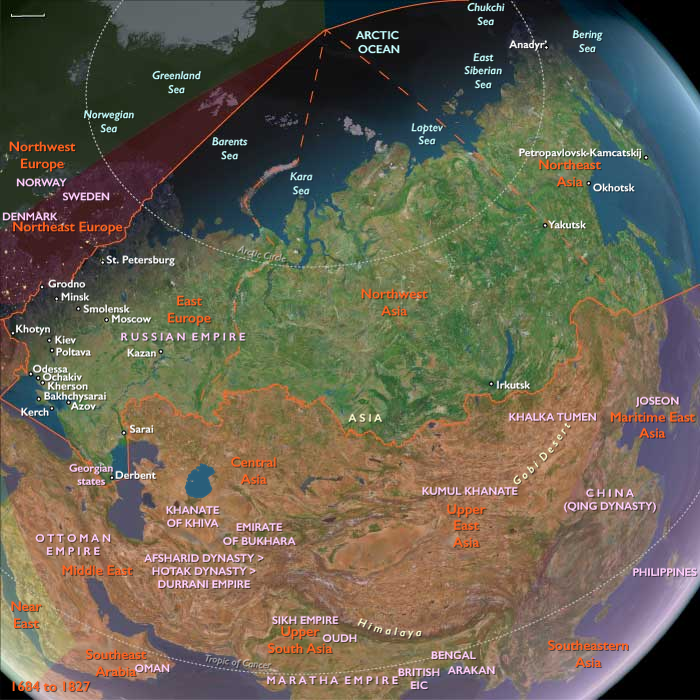
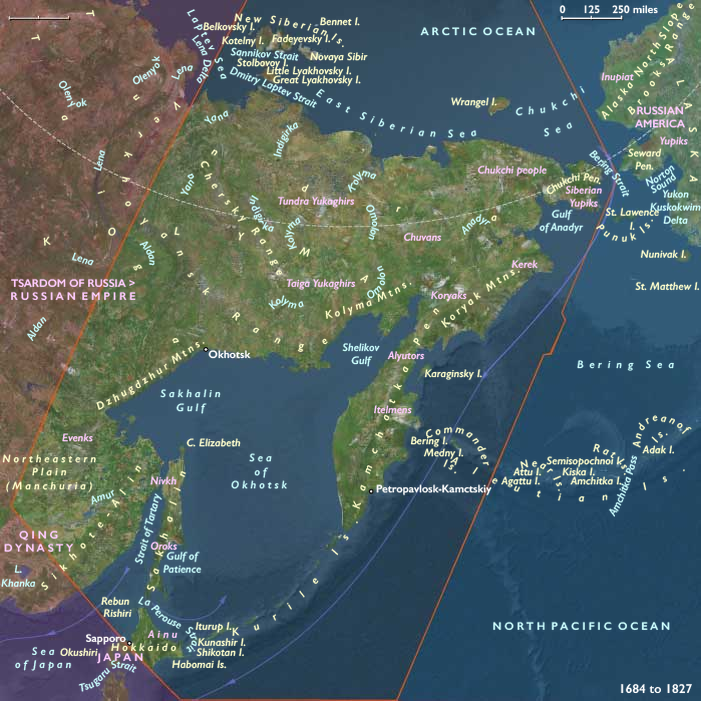
Between 1732 and 1743, Northeast Asia—a region encompassing the easternmost areas of Siberia (east of 130°E), the extreme northeastern portion of China's Heilongjiang province, the northern half of Russia's Primorsky Krai, and most of the island of Hokkaido (excluding its southwestern portion)—saw significant developments in Russian maritime exploration, colonization, and the emergence of an extensive fur-trading network.
In 1736, the strategically important Russian outpost of Okhotsk was relocated approximately two miles downstream to a spit at the mouth of the Okhota River, transitioning it from a basic ostrog (wooden fort) into a fully functional port. Nevertheless, Okhotsk remained ill-suited as a permanent settlement due to its challenging inland access, inadequate harbor, harsh climate, and limited agricultural potential. These deficiencies severely hampered operations of the ongoing Second Kamchatka Expedition, led by Vitus Bering.
By the mid-1730s, the expedition’s local administrator, Grigory Skornyakov-Pisarev, had made insufficient progress on essential infrastructure in Okhotsk, resulting in extensive delays and resource shortfalls. Despite these impediments, Bering’s Danish lieutenant Martin Shpanberg managed to ready the expedition's vessels. By the end of 1737, Shpanberg had successfully refitted the vessel Gabriel and constructed two new ships: the Archangel Michael and the Nadezhda. These ships were rapidly prepared for voyages aimed at exploring the Kuril Islands and establishing Russia's first sea contact with Japan.
Also in 1737, Vitus Bering himself arrived and established his residence at Okhotsk, overseeing operations during what was now the expedition’s fifth year. By this time, it was clear that initial financial estimates for the project had been vastly underestimated. Original budgets projected costs around twelve thousand rubles, but expenses had already risen dramatically to approximately three hundred thousand rubles, bringing economic hardship to the entire region.
On October 16, 1737, a devastating earthquake with an estimated magnitude of 9.3 struck off the coast of Kamchatka, triggering massive tsunamis reaching heights of sixty meters (approximately two hundred feet) in the northern Pacific Ocean. This catastrophic event further complicated the already strained logistical situation of Russian maritime operations.
Despite setbacks, Shpanberg departed from Okhotsk on June 29, 1738, sailing to the Kuril Islands. He successfully explored this island chain—one island, Shikotan, would eventually be renamed "Shpanberg" by the Russians in 1796—and confirmed the existence of a viable maritime route to Japan, substantially enhancing Russia’s geographic knowledge and maritime capabilities in Northeast Asia.
Following the landmark exploratory voyages of Bering and Aleksei Chirikov in 1741–1742, which conclusively demonstrated that Asia and North America were separate continents, Russian maritime fur trading began in earnest. Bering's voyages proved that extended sea travel in the North Pacific was feasible and revealed the region's abundant fur resources. Private fur traders, primarily promyshlenniki, launched expeditions from Kamchatka targeting nearby islands, particularly the Commander Islands. These maritime operations required greater capital than typical Siberian fur ventures, drawing investment from merchants based in distant cities such as Irkutsk, Tobolsk, and even European Russia.
An early and notably successful trader, Emilian Basov, initiated extensive trade activities in 1743 on Bering Island, harvesting significant numbers of sea otter, fur seal, and blue arctic fox pelts. Basov's profitable voyages to Bering and Medny Island within the Commander Islands group demonstrated the tremendous commercial potential of the region’s maritime fur resources. His successes inspired further Russian maritime expeditions and firmly established a thriving fur trade in the northern Pacific, reshaping the economic landscape of Northeast Asia for generations to come.
People
Groups
- Koryaks
- Chukchi
- Nivkh people
- Yukaghirs
- Evens, or Eveny
- Ainu people
- Buddhism
- Itelmens
- Siberian Yupiks
- Evenks
- Kereks
- Alyutors
- Russia, Tsardom of
- Japan, Tokugawa, or Edo, Period
Topics
- Russian Colonization of Siberia
- Maritime Fur Trade
- Great Northern Expedition or Second Kamchatka expedition
Commodoties
Subjects
Regions
Subregions
Related Events
Showing 10 events out of 27621 total
Years: 1732 - 1743
People
Groups
- Koryaks
- Chukchi
- Nivkh people
- Yukaghirs
- Evens, or Eveny
- Ainu people
- Buddhism
- Itelmens
- Siberian Yupiks
- Evenks
- Kereks
- Alyutors
- Russia, Tsardom of
- Japan, Tokugawa, or Edo, Period
Topics
- Russian Colonization of Siberia
- Maritime Fur Trade
- Great Northern Expedition or Second Kamchatka expedition
Commodoties
Subjects
Regions
Subregions