
Northeast Asia (1684–1827 CE): Imperial Frontiers, …
Years: 1684 - 1827
Northeast Asia (1684–1827 CE): Imperial Frontiers, Salmon Rivers, and Expanding Maritime Worlds
Geography & Environmental Context
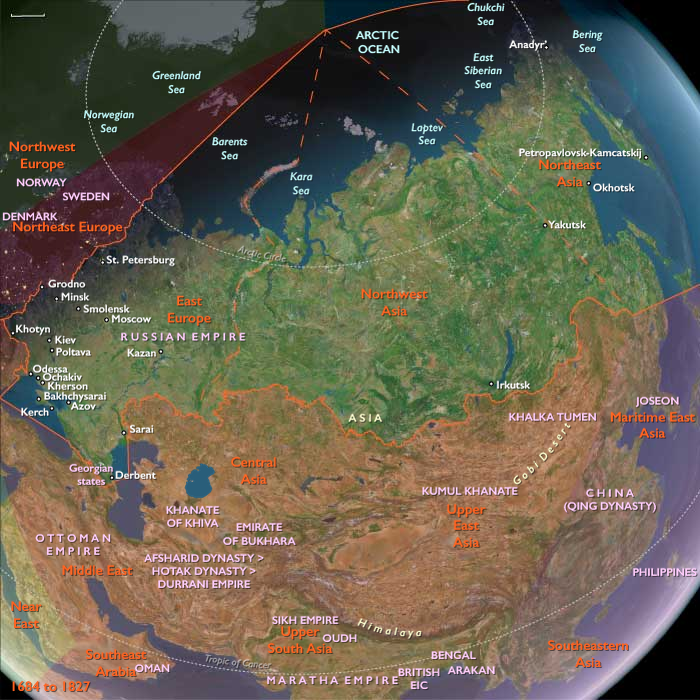
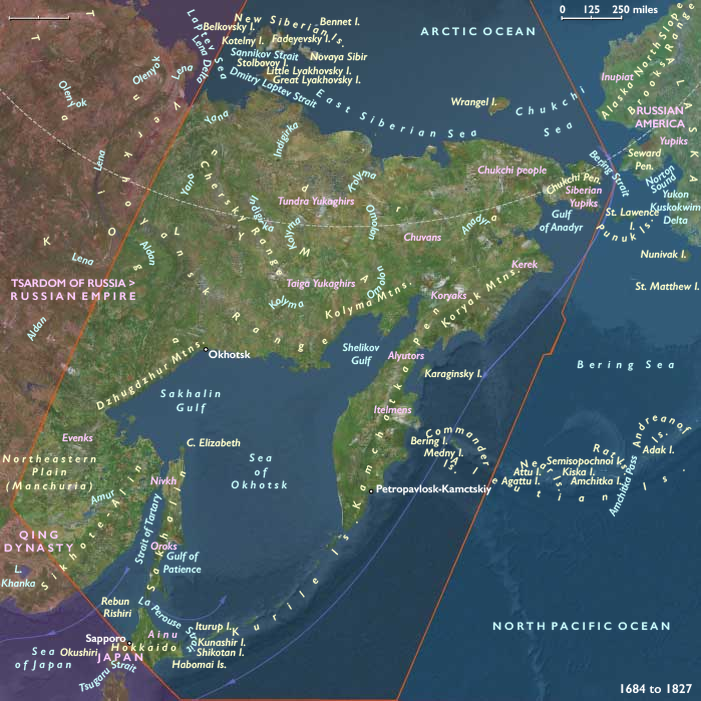
Northeast Asia encompasses the Lena–Indigirka–Kolyma river basins and the New Siberian Islands; the Chukchi Peninsula, Wrangel Island, and Anadyr basin; the Sea of Okhotsk rim from Magadan to Okhotsk; the Uda–Amur–Ussuri lowlands (including extreme northeastern Heilongjiang); the Sikhote–Alin and Primorye uplands; Sakhalin and the lower Amur mouth; and Hokkaidō (all but the southwestern corner). These lands stretch from permafrosted tundra and taiga to salmon-filled rivers, storm-beaten Arctic coasts, and the oak–birch forests of Hokkaidō. Their contrasts created a vast frontier between Arctic barrens, Amur floodplains, and the resource-rich Okhotsk and Japan Seas.
Climate & Environmental Shifts
The Little Ice Age remained in force, with long winters and shortened growing seasons. Permafrost deepened across the Lena and Kolyma basins, constraining cultivation but preserving winter travel routes over frozen rivers. The Sea of Okhotsk froze extensively, limiting navigation to brief summer months, while its ice-edge fisheries remained highly productive. Hokkaidō endured cold, snowy winters but maintained rich salmon and herring runs. Volcanic eruptions in Kamchatka occasionally cast ash over the subregion, while harsh storms along the Okhotsk and Chukchi coasts tested seafaring communities.
Subsistence & Settlement
-
High Arctic and Chukchi Peninsula: Chukchi herders expanded large-scale reindeer pastoralism, while coastal communities pursued whale and walrus hunting. Siberian Yupik and Yukaghir relied on fishing and seal hunting, moving seasonally between tundra and shore.
-
Taiga and River Basins (Lena–Indigirka–Kolyma): Evenki and Even followed seasonal hunting and fishing rounds, combining fur trapping with mobile herding. Russian settlers established wintering posts and small farming colonies along rivers.
-
Amur–Ussuri–Sakhalin: Daur, Nanai, Nivkh, and Udege cultivated millet and beans, alongside intensive salmon and sturgeon fishing. Villages lined riverbanks, with smokehouses and storehouses prominent features.
-
Hokkaidō: Ainu relied on salmon runs, deer and bear hunting, and limited agriculture, while Japanese settlers under the Matsumae domain controlled trade posts on the southwestern fringe.
Settlements multiplied with Russian forts and villages along the Lena and Okhotsk coasts, while Qing garrisons appeared in the Amur to police frontiers after the Treaty of Nerchinsk (1689).
Technology & Material Culture
Traditional toolkits remained vital—bows, harpoons, fish weirs, sledges, and birch-bark canoes—but new materials entered rapidly. Russian firearms, iron traps, and metal tools spread along fur routes. The yakut horse and cattle breeds supported Russian colonists, while imported crops like rye and barley were planted near river posts. Ainu artisans continued to carve ritual sticks (ikupasuy) and wooden inau, while Matsumae trade introduced lacquerware, sake, and rice. Along the Amur, iron cauldrons, ceramics, and silks filtered in through both Russian and Qing channels.
Movement & Interaction Corridors
-
Frozen rivers (Lena, Aldan, Indigirka, Kolyma, Anadyr) functioned as winter highways, enabling Russian Cossack expansion and indigenous trade.
-
Amur corridor: A contested artery where Daur, Nanai, and Qing forces intersected. After 1689, the Treaty of Nerchinsk fixed a negotiated border, limiting Russian access.
-
Sea of Okhotsk coast: Became Russia’s maritime lifeline, with Okhotsk town (founded 1649, expanded in the 18th century) serving as the staging point for Pacific expeditions.
-
Hokkaidō littoral: Canoe routes linked Ainu villages; Matsumae intermediaries funneled trade to Honshu.
-
Global links: Vitus Bering’s expeditions (1728, 1741) pushed Russian presence into the Pacific; fur traders later reached Alaska, with Northeast Asia as their base.
Cultural & Symbolic Expressions
Shamanism remained vital among Evenki, Chukchi, and Yukaghir, with trance rituals, drums, and spirit journeys mediating between human and natural realms. Ainu bear-sending ceremonies (iomante) continued as the centerpiece of ritual life, blending ecological reverence with social cohesion. Russian Orthodoxy arrived with missions, erecting chapels at Yakutsk, Okhotsk, and in scattered forts. In the Amur basin, ancestor shrines, wooden masks, and ritual feasts bound communities to rivers and forests. Cross-cultural encounters layered new symbols: icons and crosses, lacquer bowls, firearms reinterpreted as prestige items, and silk robes entering indigenous ritual circuits.
Environmental Adaptation & Resilience
Adaptations reflected deep ecological knowledge:
-
Reindeer pastoralists adjusted migration routes as pasture zones shifted with snow cover.
-
Salmon management in Amur and Hokkaidō was reinforced with taboos and regulated weir use.
-
Stone and wooden fish traps in Okhotsk rivers provided secure seasonal harvests.
-
Cache systems—smoked fish, dried venison, rendered oils—sustained households through long winters.
-
Kinship-based exchange systems, tribute obligations (yasak), and cross-cultural alliances distributed surpluses and buffered shortages.
Transition
Between 1684 and 1827, Northeast Asia transformed from a largely indigenous frontier into an imperial crossroads. Russian forts, settlers, and traders advanced along rivers and the Okhotsk coast, seeking furs and Pacific access. The Qing consolidated Amur defenses after Nerchinsk, enforcing borders with patrols and alliances. The Matsumae domain tightened control over Ainu trade, sowing tensions that would later erupt into conflict. At the same time, Vitus Bering’s voyages linked Northeast Asia to the Americas, beginning a Pacific system of trade and empire. Indigenous lifeways remained resilient, but their landscapes were now arenas where empires tested boundaries and reshaped the seascape of northern Eurasia.
People
- James Cook
- Jean François de Galaup, comte de Lapérouse
- John Dundas Cochrane
- Peter the Great
- Vitus Bering
- Ōshio Heihachirō
Groups
- Koryaks
- Chukchi
- Nivkh people
- Evens, or Eveny
- Yukaghirs
- Buddhism
- Ainu people
- Itelmens
- Siberian Yupiks
- Evenks
- Alyutors
- Kereks
- Russia, Tsardom of
- Japan, Tokugawa, or Edo, Period
- Chinese Empire, Qing (Manchu) Dynasty
- Russian Empire
Topics
Commodoties
Subjects
Regions
Subregions
Years: 1684 - 1827
People
- James Cook
- Jean François de Galaup, comte de Lapérouse
- John Dundas Cochrane
- Peter the Great
- Vitus Bering
- Ōshio Heihachirō
Groups
- Koryaks
- Chukchi
- Nivkh people
- Evens, or Eveny
- Yukaghirs
- Buddhism
- Ainu people
- Itelmens
- Siberian Yupiks
- Evenks
- Alyutors
- Kereks
- Russia, Tsardom of
- Japan, Tokugawa, or Edo, Period
- Chinese Empire, Qing (Manchu) Dynasty
- Russian Empire
Topics
Commodoties
Subjects
Regions
Subregions