
Polynesia (6,093 – 4,366 BCE): Middle Holocene …
Years: 6093BCE - 4366BCE
Polynesia (6,093 – 4,366 BCE): Middle Holocene — Reef Highstands and Wetland Worlds
Geographic & Environmental Context
During the Middle Holocene, Polynesia lay fully within the tropical Pacific’s zone of climatic stability, a realm of volcanic high islands, coral-fringed atolls, and emergent reef terraces that would one day host the most far-flung human oceanic network on Earth.
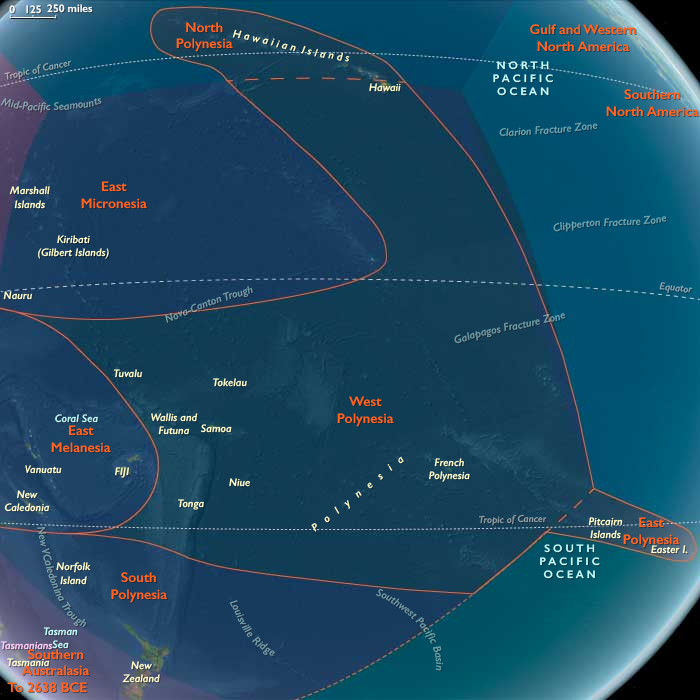
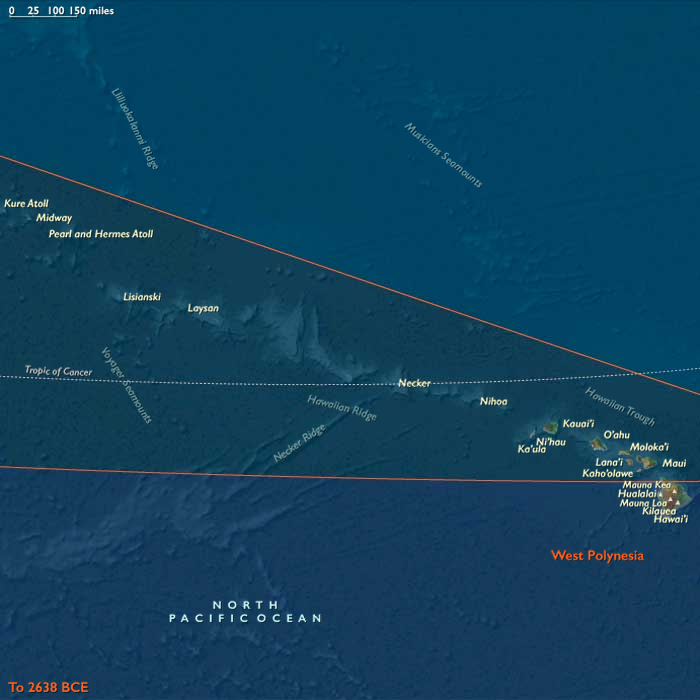
Its principal sectors—North Polynesia (the Hawaiian Islands chain north of Hawaiʻi Island and Midway Atoll), West Polynesia (from Hawaiʻi Island and Tonga through Samoa, Tuvalu, Tokelau, the Cook Islands, the Society Islands, and the Marquesas), and East Polynesia (the Pitcairn group and Rapa Nui)—shared a geography shaped by rising seas, maturing reefs, and widening lagoons.
A global Hypsithermal warm phase elevated sea levels several meters above modern, drowning coastal flats and converting valley mouths into estuarine embayments and back-reef wetlands. Barrier reefs stabilized into continuous arcs; headlands were planed by surf; and new island shelves accumulated sand and coralline rubble that would, millennia later, become settlement plains, loʻi fields, and canoe landings.
Climate & Environmental Shifts
The Middle Holocene brought warm, humid stability punctuated by episodic extremes.
Trade-wind systems strengthened, but Kona-type storms occasionally brought heavy rainfall and flash floods to leeward coasts.
Sea-surface temperatures across the equatorial Pacific were slightly higher than today; ENSO variability remained subdued, maintaining predictably wet windward slopes and calmer leeward seasons.
Reef productivity surged as carbonate accretion kept pace with sea-level rise, while newly flooded coastal depressions matured into perennial wetland complexes of reeds, sedges, and brackish pools.
Biota & Baseline Ecology (Before Human Arrival)
No humans yet inhabited these islands, but ecological succession reached a remarkable equilibrium.
-
Back-reef lagoons and estuaries teemed with mullet, milkfish, gobies, prawns, and mollusks.
-
Dune–strand vegetation—Scaevola, Heliotropium, pandanus, and grasses—anchored beaches against the swell.
-
Montane forests of Metrosideros, Cheirodendron, and tree ferns blanketed the volcanic uplands of the high islands.
-
Seabird rookeries flourished on outer islets and atolls, their guano fertilizing leeward flats and enriching nearshore reefs.
-
In East Polynesia, the young volcanic soils of Rapa Nui and the Pitcairn group supported early colonization by ferns, mosses, and coastal scrub, forming self-sustaining nutrient cycles long before human arrival.
The result was a ridge-to-reef continuum—mountain cloud forest, mid-slope woodland, coastal wetland, reef crest, and open ocean—all functioning in dynamic balance.
Geomorphological Processes and Marine Systems
Across the Polynesian arc, reef highstands defined this era.
Raised coral terraces ringed older islands; back-reef ponds became permanent lagoons; and valley mouth wetlands expanded behind natural barrier bars.
Sediment from intensified rainfall and vegetation expansion enriched lagoons with fine silts, building natural levees later ideal for agriculture.
The alignment of tidal channels, reef passes, and sand spits fixed the geographic templates for the fishponds, irrigated taro basins, and canoe channels that would appear millennia later.
Movement & Interaction Corridors (of Nature, Not Yet of Humans)
Though human navigation had not yet reached Polynesia, the Pacific’s biological highways were already in motion.
Pelagic fish, marine turtles, and migratory seabirds linked these archipelagos ecologically; floating pumice, driftwood, and seeds rode trans-oceanic currents between the Marquesas, Tuamotus, and Hawaiʻian waters, maintaining genetic exchange among reef and shoreline species.
The same predictable wind and current systems that structured these movements—the trades, the westerlies, and the counter-equatorial flow—would later serve as the navigational framework for human voyagers.
Environmental Adaptation & Resilience
These mid-Holocene island ecosystems demonstrated extraordinary resilience.
When storm surges breached spits or hurricanes leveled strand vegetation, rapid recolonization by pioneer plantsrestored dunes within a few seasons.
Reefs self-repaired through coral regrowth, while inland wetlands re-established drainage after flood scouring.
Interlinked food webs—from seabirds to reef fish to mangrove detritivores—created ecological redundancy that stabilized productivity through climatic oscillations.
Long-Term Significance
By 4,366 BCE, Polynesia had achieved its modern physiographic and ecological foundations.
Sea-level highstands had sculpted enduring lagoon and wetland systems; volcanic slopes and reef platforms had matured into stable, fertile environments.
Though unpeopled, the region already embodied the structural harmony—ridge-to-reef integration, lagoon fertility, and predictable marine corridors—that would later underlie the success of Polynesian agriculture, aquaculture, and navigation.
In these centuries, the ocean prepared its own stage: reef, tide, and wind composing the geography of future voyaging and settlement.
Topics
Subjects
Regions
Subregions
Years: 6093BCE - 4366BCE
Topics
Subjects
Regions
Subregions