
North Polynesia (1924–1935 CE) Economic Challenges …
Years: 1924 - 1935
North Polynesia (1924–1935 CE)
Economic Challenges and Adaptation
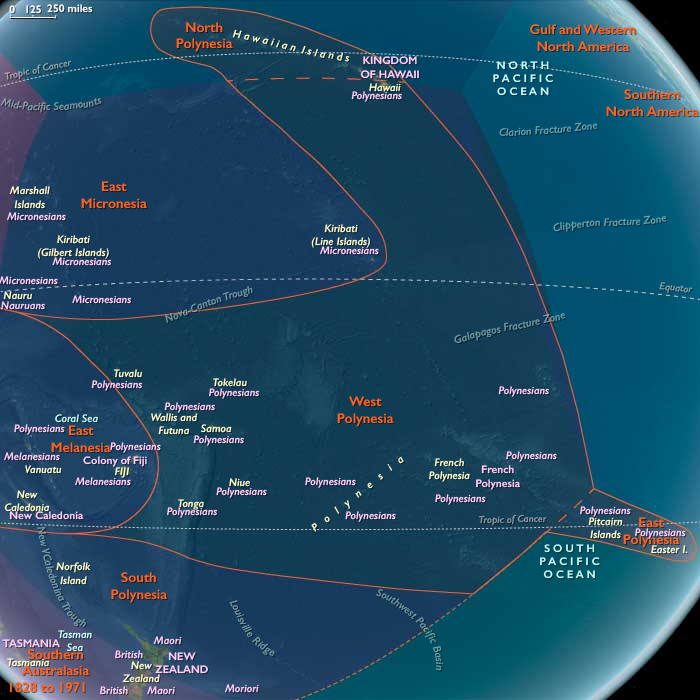
From 1924 to 1935, North Polynesia, primarily the Territory of Hawaii, encountered significant economic challenges following the global economic downturn of the Great Depression. Sugarcane and pineapple plantations, the backbone of the islands’ economy, faced reduced demand and plummeting prices. To mitigate losses, large plantation enterprises like Dole Food Company diversified production and optimized operations, introducing new agricultural techniques and scaling down employment to maintain viability.
Shifts in Demographics and Labor Relations
Immigration patterns changed significantly during this period, as restrictive immigration policies enacted by the U.S. federal government sharply curtailed the influx of Asian laborers. Nevertheless, the established immigrant communities from Japan, China, the Philippines, Korea, and Portugal continued to solidify their presence, reshaping Hawaii’s demographic and cultural landscape. Despite reductions in contract labor, tensions persisted as laborers increasingly asserted their rights, setting the stage for future activism.
Growth of Labor Movements
Labor activism intensified in response to harsh economic conditions, culminating in several significant strikes, including notable plantation labor actions in the late 1920s and early 1930s. These protests demonstrated heightened class solidarity, with Filipino, Japanese, and Portuguese laborers uniting to demand better wages and working conditions. Though strikes were often suppressed, they contributed substantially to heightened labor awareness and laid the groundwork for lasting labor reforms.
Cultural Renaissance and Hawaiian Identity
This era witnessed an intensified cultural renaissance, as efforts to preserve and revive traditional Hawaiian culture gained momentum. Prominent figures and organizations actively promoted indigenous traditions such as hula, chants, music, and native crafts. Educational initiatives and cultural festivals grew increasingly popular, reinforcing Hawaiian cultural identity in the face of persistent Americanization pressures.
Educational Developments and Cultural Preservation
Educational reforms continued, emphasizing Americanization through English-language instruction while slowly incorporating elements of Hawaiian history and culture. Although English remained dominant, advocates succeeded in introducing Hawaiian culture and history into school curricula, fostering greater cultural awareness and pride among students.
Political Advocacy and the Hawaiian Sovereignty Movement
Political advocacy strengthened significantly, led by Hawaiian and immigrant community leaders who intensified demands for increased political representation and civil rights. This era marked the early stages of what would later evolve into the Hawaiian sovereignty movement, as activists increasingly highlighted issues of disenfranchisement, discrimination, and the need for self-governance and autonomy within the territorial structure.
Public Health Advances
Public health initiatives continued robustly, building upon earlier sanitation and disease-prevention measures. New hospitals and clinics were established, and vaccination programs expanded, notably reducing the incidence of diseases such as tuberculosis and influenza. These health measures improved overall life expectancy and significantly raised living standards across the islands.
Military and Strategic Expansion
The strategic importance of North Polynesia, especially Pearl Harbor, further intensified. The United States significantly expanded naval and military infrastructure, fortifications, and personnel, enhancing its Pacific defense posture. By 1935, Pearl Harbor had evolved into a primary Pacific naval hub, underscoring Hawaii's crucial role in American military strategy.
Urban Growth and Infrastructure Improvement
Urbanization accelerated, especially in Honolulu, which rapidly developed into a modern city. Infrastructure projects, including extensive road paving, electrical grid expansion, water and sewer system enhancements, and public transit improvements, transformed urban life, accommodating the expanding population and burgeoning economic activities.
Conclusion of the Era
Between 1924 and 1935, North Polynesia navigated significant economic turbulence while simultaneously experiencing important social, cultural, and political transformations. The resilience and adaptability demonstrated during this challenging period set the stage for profound developments in the following decades, significantly shaping the trajectory of Hawaii's evolution within the United States.
People
Groups
- Korean people
- Japanese people
- Chinese (Han) people
- Portuguese people
- Hawaiians, Native
- Protestantism
- Americans
- United States of America (US, USA) (Washington DC)
- Filipinos
- Midway Atoll (unincorporated territory of the United States)
- Hawaii, Territory of (U.S.A.)
- Hawaiian Pineapple Company
Commodoties
Subjects
- Commerce
- Performing Arts
- Public health
- Labor and Service
- Faith
- Government
- Scholarship
- Custom and Law
- Catastrophe
- workers' movement
Regions
Subregions
Years: 1924 - 1935
People
Groups
- Korean people
- Japanese people
- Chinese (Han) people
- Portuguese people
- Hawaiians, Native
- Protestantism
- Americans
- United States of America (US, USA) (Washington DC)
- Filipinos
- Midway Atoll (unincorporated territory of the United States)
- Hawaii, Territory of (U.S.A.)
- Hawaiian Pineapple Company
Commodoties
Subjects
- Commerce
- Performing Arts
- Public health
- Labor and Service
- Faith
- Government
- Scholarship
- Custom and Law
- Catastrophe
- workers' movement
Regions
Subregions