
North Polynesia (1876–1887 CE) Economic Growth …
Years: 1876 - 1887
North Polynesia (1876–1887 CE)
Economic Growth and the Kalākaua Era
Following the succession crisis and brief reign of King Lunalilo, King David Kalākaua (reigned 1874–1891), the first monarch of the House of Kalākaua, significantly reshaped Hawaii's political, economic, and cultural landscape during this era.
Kalākaua, often called the "Merrie Monarch" for his love of music, dance, and traditional Hawaiian culture, actively promoted Hawaiian identity. He sought to strengthen the monarchy, revive native cultural practices, and pursue modernization through international diplomacy and economic partnerships.
Reciprocity Treaty and Economic Expansion
One of Kalākaua's most significant achievements was the Reciprocity Treaty of 1875 with the United States, allowing Hawaiian sugar and rice to enter the U.S. duty-free, significantly boosting Hawaii's sugar industry. In exchange, Hawai'i ceded Pearl Harbor, including Ford Island (Moku'ume'ume), to the U.S. This treaty marked a pivotal economic turning point, greatly expanding agricultural production, attracting foreign investment, and significantly increasing immigration to meet labor demands.
The high water requirements for growing sugarcane resulted in extensive water works projects on all major islands, diverting streams from wet windward slopes to dry lowlands.
Cultural Renaissance and Global Presence
Under Kalākaua, a cultural revival featured traditional hula performances, chant, and indigenous practices previously suppressed under missionary influence. The king's cultural patronage extended to significant landmarks, notably ʻIolani Palace, completed in 1882, which symbolized the kingdom's modern aspirations and national pride.
In 1881, Kalākaua embarked on a notable global diplomatic tour, becoming the first monarch to circumnavigate the globe. His journey strengthened diplomatic ties, encouraged immigration, and secured international recognition for Hawaii's sovereignty. During this tour, Kalākaua met with leaders including Emperor Meiji of Japan, Queen Victoria, and U.S. President Chester A. Arthur.
Kalākaua also commissioned the Kamehameha Statue in 1883, honoring the kingdom's first monarch, Kamehameha I. Initially lost at sea, the original statue was later recovered and erected alongside its replacement.
Immigration and Labor Dynamics
The rapid growth of the sugar industry necessitated significant labor imports. Thousands of contract laborers arrived from China, Japan, Portugal, and later Korea, dramatically altering Hawaii's demographics and culture. The first significant wave of Portuguese immigrants arrived aboard the ship Priscilla in 1878 from Madeira, shaping Hawaii’s social and cultural fabric significantly.
Political Tensions and the Bayonet Constitution
Despite Kalākaua's popularity, political tensions escalated, particularly with the influential Missionary Party, comprised predominantly of descendants of American missionaries and businessmen. They opposed Kalākaua’s attempts to reinforce monarchical power and favored a government with power primarily vested in the legislature.
In 1886, Kalākaua's ambitions to establish a Polynesian confederation, particularly with Sāmoa under Malietoa Laupepa, alarmed opponents. Additionally, an opium bribery scandal damaged his standing.
These tensions culminated in the forced adoption of the 1887 Bayonet Constitution, imposed by the armed Hawaiian League, primarily foreign residents and wealthy Hawaiian-born individuals of foreign descent. The constitution severely limited royal authority, shifted power toward the legislature, and disenfranchised many native Hawaiians and Asian immigrants by instituting restrictive property and income requirements for voting. It also enabled the U.S. to establish a naval base at Pearl Harbor in November 1887.
Infrastructure and Urban Development
Honolulu continued to modernize under Kalākaua's rule. Notable infrastructure projects included road expansions, harbor improvements, and electrification. Kalākaua notably arranged for ʻIolani Palace to receive electric lighting in 1886, predating even the White House.
Additionally, the Hawaiian Hotel, opened in 1872, served increasing numbers of international visitors and officials, reflecting Hawaii's growing prominence.
Conclusion of the Era
Between 1876 and 1887, North Polynesia, particularly Hawaii, experienced significant growth and transformation. Economic prosperity driven by sugar cultivation, cultural revitalization, and notable demographic shifts characterized the period. However, these developments coincided with heightened political instability, leading to diminished monarchical authority and increased foreign influence, setting the stage for dramatic shifts in subsequent decades.
People
Groups
- Japanese people
- Chinese (Han) people
- Portuguese people
- Hawaiians, Native
- Christians, Roman Catholic
- Protestantism
- United States of America (US, USA) (Washington DC)
- Britain (United Kingdom of Great Britain and Ireland)
- Hawaii, Kingdom of
- Midway Atoll (unincorporated territory of the United States)
- Japan, Empire of (Meiji Period)
Commodoties
Subjects
Regions
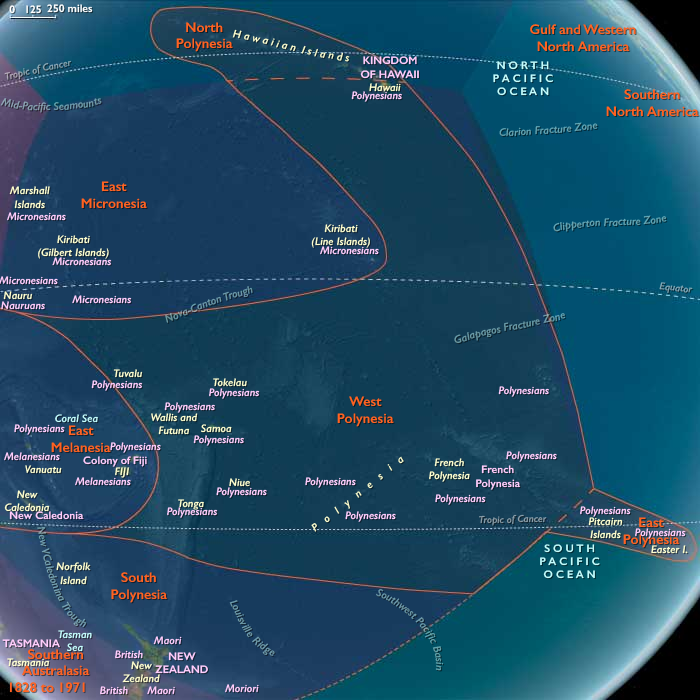
Subregions
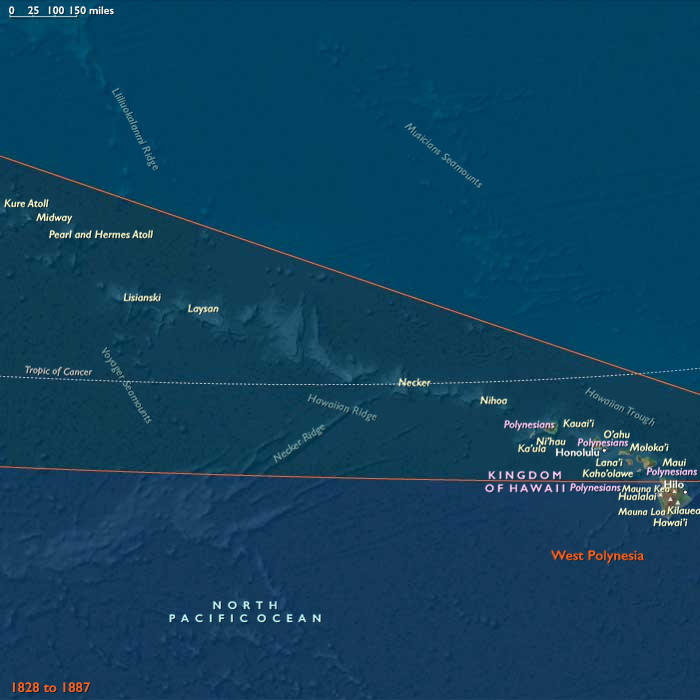
Years: 1876 - 1887
People
Groups
- Japanese people
- Chinese (Han) people
- Portuguese people
- Hawaiians, Native
- Christians, Roman Catholic
- Protestantism
- United States of America (US, USA) (Washington DC)
- Britain (United Kingdom of Great Britain and Ireland)
- Hawaii, Kingdom of
- Midway Atoll (unincorporated territory of the United States)
- Japan, Empire of (Meiji Period)
Commodoties
Subjects
Regions
Subregions