
North Polynesia (1828–1971 CE): Colonial Annexations, U.S. …
Years: 1828 - 1971
North Polynesia (1828–1971 CE): Colonial Annexations, U.S. Statehood, and Islander Diasporas
Geography & Environmental Context
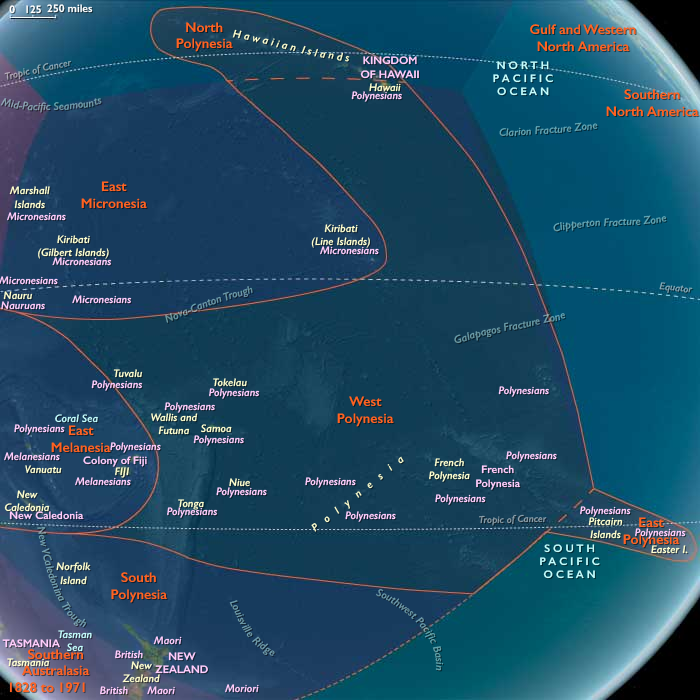
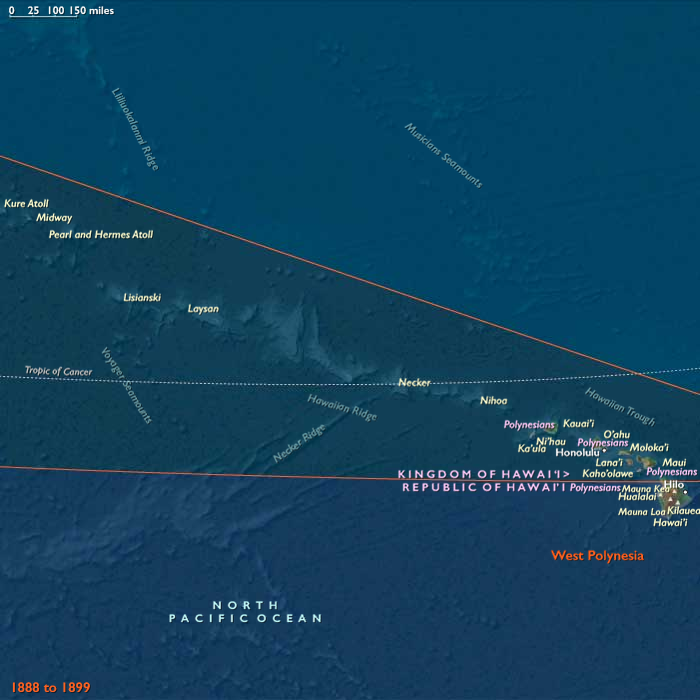
North Polynesia includes the Hawaiian Islands (except the Big Island, which belongs to West Polynesia) and Midway Atoll. Anchors include the volcanic islands of O‘ahu, Maui, Kaua‘i, Moloka‘i, Ni‘ihau, and atolls like Midway. The environment combined high-island volcanic soils and lush valleys with fragile atoll ecologies. A subtropical climate moderated by trade winds supported sugarcane and pineapple plantations, while reefs and fisheries underpinned subsistence.
Climate & Environmental Shifts
Seasonal rainfall sustained taro terraces and plantation crops, though droughts occasionally affected leeward coasts. Hurricanes, while less frequent than further south, periodically damaged crops and settlements. After 1900, deforestation, plantation expansion, and urban sprawl around Honolulu altered ecosystems. By the mid-20th century, military bases and tourism reshaped landscapes, and nuclear testing fallout from the Marshalls (to the southwest) touched North Polynesian waters.
Subsistence & Settlement
-
Traditional lifeways: Taro terraces, breadfruit groves, fishing, and pig husbandry persisted in rural valleys, often alongside plantations.
-
Plantations: Sugarcane (from early 19th century) and later pineapple dominated economies; plantations relied on immigrant labor—Chinese, Japanese, Portuguese, Filipino.
-
Urban centers: Honolulu expanded into a port, capital, and tourist hub; Pearl Harbor became a naval anchor. Smaller towns like Lahaina and Hilo supported plantations and fisheries.
-
Midway: Guano mining (19th century), later a cable and air station, then a key U.S. naval base.
Technology & Material Culture
-
19th century: Whaling fleets used Honolulu as a provisioning hub; missionary presses introduced literacy, Bibles, and Western schooling.
-
20th century: Railroads and trucks hauled cane; irrigation ditches transformed valleys; radios, sewing machines, and later televisions spread into households. Hotels, hula shows, and surf culture created hybrid modern traditions.
-
Military infrastructure: Airstrips, bunkers, and shipyards transformed O‘ahu and Midway, especially during WWII.
Movement & Interaction Corridors
-
Whaling & trade: Honolulu became a central provisioning port for Pacific fleets.
-
Labor migration: Thousands of workers from Asia and Portugal reshaped demographics and culture.
-
Tourism: From the early 20th century, Honolulu developed into a Pacific resort, accelerated after WWII with jet travel.
-
Military corridors: Pearl Harbor became the linchpin of U.S. Pacific defense; Midway’s naval base was decisive in WWII. Postwar, Hawai‘i remained a hub for Cold War deployments.
Cultural & Symbolic Expressions
-
Hawaiian monarchy: Retained sovereignty until U.S. overthrow of Queen Lili‘uokalani (1893). Hawaiian language, hula, and chants preserved heritage amid missionary and settler suppression.
-
Hybrid culture: Immigrant traditions blended with Native Hawaiian life—Japanese bon dances, Portuguese malasadas, Filipino music, all mixing with hula and slack-key guitar.
-
Religion: Christianity dominated after missionary efforts, but Hawaiian cosmologies endured in rural practice and revivals.
-
Nationalism: Hawaiian sovereignty movements persisted underground after annexation, resurfacing in the mid-20th century.
Environmental Adaptation & Resilience
-
Traditional strategies: Irrigated taro terraces and fishponds maintained food security, especially in valleys beyond plantation zones.
-
Plantation adaptation: Immigrant households cultivated backyard gardens, mixing taro, rice, bananas, and pigs for resilience.
-
Tourism & military: Hawaiians adapted by merging traditions with new economies—hula in hotels, lei-making for visitors, land leased for bases.
Political & Military Shocks
-
Colonial encounters:
-
1820s–1890s: Missionaries, whalers, and traders eroded Hawaiian sovereignty.
-
1893: Overthrow of Hawaiian monarchy by American planters and U.S. Marines.
-
1898: Annexation by the United States.
-
-
Territorial status: Hawai‘i governed as U.S. territory (1900–1959).
-
World War II: Pearl Harbor attacked (1941); Hawai‘i under martial law until 1944; Midway battle (1942) pivotal in Pacific war.
-
Statehood: Hawai‘i became the 50th U.S. state in 1959, with booming tourism, military, and government jobs.
Transition
Between 1828 and 1971, North Polynesia transformed from a Hawaiian kingdom into a U.S. state at the crossroads of empire and the Pacific. Plantation labor, immigration, and missionary schooling reshaped demographics and culture; Pearl Harbor and Midway thrust it into world war and Cold War geopolitics. Hawaiian traditions endured amid suppression and commodification, fueling mid-20th-century revival. By 1971, North Polynesia was both a strategic military bastion and a tourism-driven economy—its Indigenous sovereignty constrained but its culture resilient, and its identity increasingly central to Pacific politics.
People
Groups
- Papal States (Republic of St. Peter)
- Hawaiians, Native
- Christians, Roman Catholic
- Protestantism
- Congregation of the Sacred Hearts of Jesus and Mary
- United States of America (US, USA) (Washington DC)
- Hawaii, Kingdom of
- Hawaii, Republic of
- Hawaii, Territory of (U.S.A.)
- Hawaii, State of (U.S.A.)
Topics
Commodoties
- Fish and game
- Hides and feathers
- Domestic animals
- Oils, gums, resins, and waxes
- Grains and produce
- Fibers
- Salt
- Sweeteners
- Tobacco
Subjects
Regions
Subregions
Related Events
Showing 10 events out of 19829 total
Years: 1828 - 1971
People
Groups
- Papal States (Republic of St. Peter)
- Hawaiians, Native
- Christians, Roman Catholic
- Protestantism
- Congregation of the Sacred Hearts of Jesus and Mary
- United States of America (US, USA) (Washington DC)
- Hawaii, Kingdom of
- Hawaii, Republic of
- Hawaii, Territory of (U.S.A.)
- Hawaii, State of (U.S.A.)
Topics
Commodoties
- Fish and game
- Hides and feathers
- Domestic animals
- Oils, gums, resins, and waxes
- Grains and produce
- Fibers
- Salt
- Sweeteners
- Tobacco
Subjects
Regions
Subregions