
North Polynesia (1540–1683 CE) Fishpond States, kapu …
Years: 1540 - 1683
North Polynesia (1540–1683 CE) Fishpond States, kapu Order, and Inter-Island Rivalry
Geography & Environmental Context
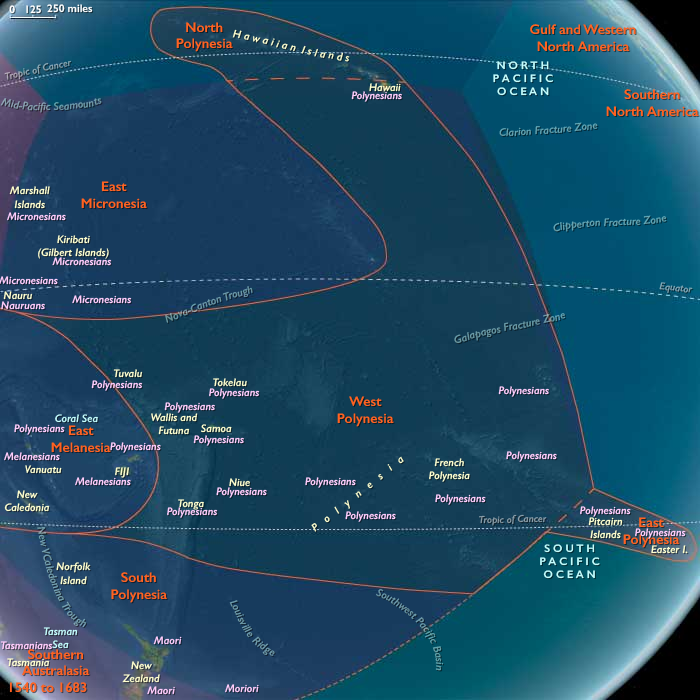
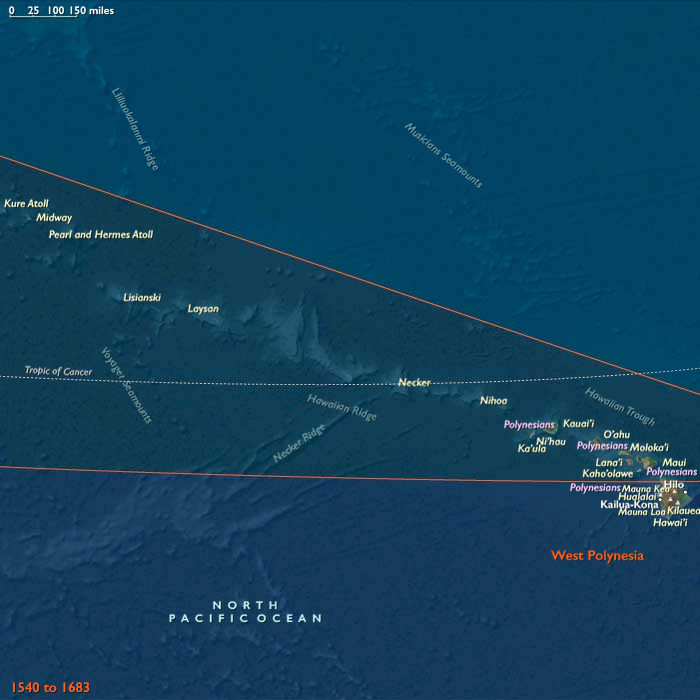
North Polynesia includes the Hawaiian Islands chain (except the Big Island of Hawai‘i)—that is, Maui, O‘ahu, Kaua‘i, Moloka‘i, Lāna‘i, Ni‘ihau, Kaho‘olawe—together with Midway Atoll. Anchors of this subregion include the Ko‘olau and Wai‘anae ranges on O‘ahu, the West Maui and East Maui (Haleakalā) volcanoes, the Nā Pali cliffs of Kaua‘i, the Moloka‘i sea cliffs, and the coral atolls and reefs of Midway. These islands combine volcanic high islands with fertile valleys and arable plains, dry leeward coasts, and rich fishing grounds in surrounding seas.
Climate & Environmental Shifts
The subtropical climate was marked by seasonal oscillations between wet northeasterly trade winds and drier leeward conditions. Periodic droughts tested irrigation systems in O‘ahu and Maui, while storms and high surf reshaped coastal settlements and fishpond walls. Midway Atoll, more exposed, shifted with storm surges and rising seas, supporting seabird colonies and maritime gathering rather than agriculture. The broader Little Ice Age had modest effects here, with cooler ocean conditions altering fish migrations and perhaps intensifying winter rains.
Subsistence & Settlement
Communities across O‘ahu, Kaua‘i, Maui, and Moloka‘i practiced intensive wet-rice-style irrigated taro cultivation (lo‘i kalo) in valley bottoms and dryland systems of sweet potatoes, yams, and gourds on leeward slopes. Fishponds (loko i‘a) along sheltered coasts of O‘ahu and Moloka‘i represented highly developed aquaculture, maintaining mullet and milkfish stocks. Coastal villages balanced fishing, canoe-building, and shoreline gathering with inland agriculture. Ni‘ihau and Kaho‘olawe, drier and smaller, supported pastoral-scale agriculture, fishing, and bird hunting. Midway’s role was marginal, limited to seasonal resource use. Settlements clustered around chiefly centers (ali‘i nui), marked by heiau (temples) and large irrigated landscapes, with O‘ahu and Maui emerging as particularly powerful political centers.
Technology & Material Culture
Material culture was highly adapted to the oceanic environment. Double-hulled canoes (wa‘a kaulua) enabled inter-island voyaging, warfare, and fishing expeditions. Stone adzes and chisels carved from volcanic basalt provided tools for construction and carving. Fishhooks, nets, and lines made from bone, fiber, and shell diversified fishing technologies. Feather cloaks (‘ahu ‘ula) and helmets (mahiole) symbolized chiefly status, while tapa cloth production, decorated with plant dyes, supplied garments and ceremonial items. Stone temple platforms and agricultural terraces reflected both engineering skill and the organization of labor under chiefly authority.
Movement & Interaction Corridors
Inter-island voyaging linked O‘ahu, Kaua‘i, Maui, Moloka‘i, Lāna‘i, and Ni‘ihau, with canoes exchanging tribute, surplus harvests, and warriors. Channels such as the Kaiwi (between O‘ahu and Moloka‘i) and the ʻAlenuihāhā (between Maui and Hawai‘i Island) were both conduits and barriers, navigated by expert canoe pilots. Kaua‘imaintained its own chiefly lineages and at times resisted domination by O‘ahu and Maui, while Moloka‘i functioned as a place of spiritual training and diplomacy. Midway remained peripheral, known only as a distant atoll within the broader seascape. Long-distance Polynesian voyages to or from beyond Hawai‘i had ceased by this era, making the Hawaiian chain relatively isolated compared to earlier epochs.
Cultural & Symbolic Expressions
Religious and symbolic life revolved around the kapu system, which regulated hierarchy, gender roles, and access to resources. Large heiau temples on O‘ahu and Maui were dedicated to gods such as Kū (warfare) and Lono (fertility and agriculture), anchoring political and ritual authority. Chants (mele) preserved genealogies and heroic exploits, reinforcing chiefly legitimacy. Feathered regalia, tapa textiles, and carved wooden images embodied both sacred power (mana) and social stratification. Ceremonies tied to the Makali‘i (Pleiades) marked the new year and the onset of agricultural cycles, binding cosmology to subsistence rhythms.
Environmental Adaptation & Resilience
Communities demonstrated remarkable adaptation to island ecologies. Irrigation systems captured and redirected streams in steep valleys, while dryland field systems managed fragile leeward soils with mulching and stone alignments. Fishponds stabilized protein supply and buffered against fluctuations in marine catches. On resource-limited Ni‘ihau and Kaho‘olawe, seasonal movement, careful water use, and inter-island exchange sustained survival. Chiefs managed redistribution of surplus through tribute and ritual feasting, which reinforced resilience and hierarchy simultaneously. Even in times of drought or storm disruption, these systems maintained regional continuity and growth.
Transition
Between 1540 and 1683, North Polynesia remained a largely autonomous world shaped by intensive agriculture, aquaculture, and hierarchical chiefly authority. Inter-island rivalries, especially among O‘ahu, Maui, and Kaua‘i, framed politics, while shared ritual practices sustained unity within the chain. Though no Europeans reached the Hawaiian Islands in this period, distant maritime worlds were already stirring to the south and west. By the century’s end, the intricate balance of kapu, irrigation, and fishpond systems sustained dense populations, but subtle pressures of resource management and political competition set the stage for transformations to come in the following centuries.
Groups
Commodoties
Subjects
Regions
Subregions
Years: 1540 - 1683
Groups
Commodoties
Subjects
Regions
Subregions