
North Africa (772–783 CE) Muhallabid Prosperity, …
Years: 772 - 783
North Africa (772–783 CE)
Muhallabid Prosperity, Berber State Flourishing, and Regional Autonomy
Between 772 and 783 CE, North Africa experiences a period marked by continued Muhallabid administration in Ifriqiya, the consolidation of indigenous Berber states, and economic vibrancy driven by flourishing trade networks. This era showcases both Arab administrative achievements and the expanding independence of Berber political entities across the Maghreb.
From their base in Kairouan (Al Qayrawan), the Muhallabid dynasty, governors appointed by the Abbasid caliphs in Baghdad, maintain a largely autonomous but effective rule over Ifriqiya. Under Muhallabid stewardship, notably from Umar ibn Hafs al-Muhallabi (appointed governor in 771 CE), the region witnesses significant agricultural and economic growth, fostered by major expansions in irrigation and infrastructure projects. This economic revitalization secures relative prosperity and stability in Ifriqiya, despite persistent Berber discontent and sporadic uprisings along the periphery.
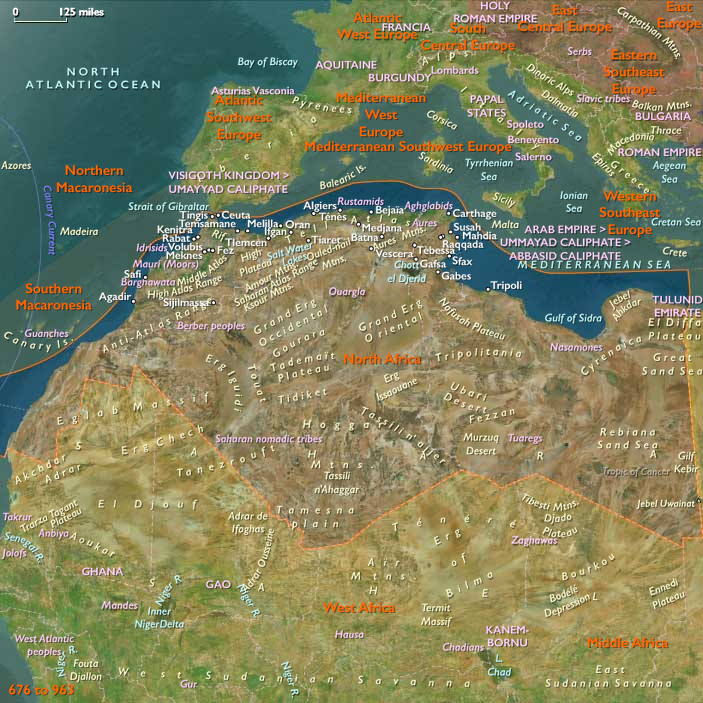
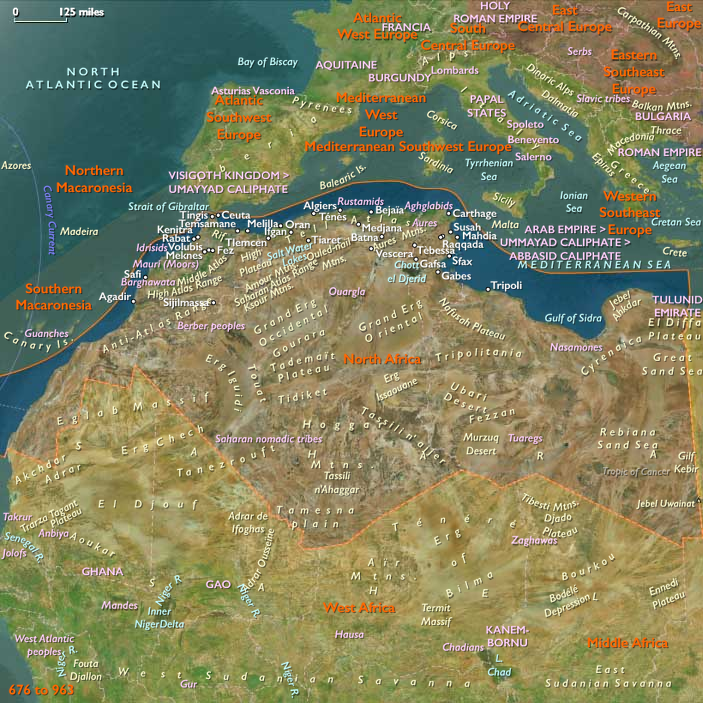
Concurrently, the Rustamid Dynasty, firmly established in the central Maghreb at Tahert (Tiaret) under Ibadi Kharijite principles, continues to mature into a prominent center of scholarship, religious learning, and trade. Its position as an elective imamate promoting justice and intellectual exchange significantly enhances its reputation, attracting merchants, scholars, and settlers across the region. Rustamid governance, recognized for its integrity and fairness, provides a stable alternative to direct Abbasid or Muhallabid control, further strengthening Berber regional autonomy.
Further west, in what is now Morocco, the Barghawata confederation consolidates its independent political and religious identity, combining indigenous Berber traditions with a unique interpretation of Islam. The city-state of Sijilmasa, strategically located on lucrative trans-Saharan trade routes controlled primarily by influential Tuareg tribes, similarly continues to thrive as a prosperous and autonomous economic hub, bolstered by flourishing trade connections with sub-Saharan Africa.
Despite their local successes, the Muhallabids in Ifriqiya find their regional authority constrained. They maintain stable governance within their immediate jurisdiction, but their ability to project power westward is limited. They remain unable to impede the solidification of independent states like the Rustamids, Barghawata, or the emergent Arab-led Idrisid Dynasty, founded by Idris I in 788 CE, whose early formation and influence begin to take shape toward the end of this era.
By the close of 783 CE, North Africa stands defined by a diverse political and economic mosaic. Muhallabid prosperity in Ifriqiya contrasts with—and exists alongside—the robust independence of increasingly influential Berber-led states. This dynamic blend of central stability and peripheral autonomy sets the stage for subsequent periods of vibrant regional interplay and cultural synthesis.
People
Groups
- Arab people
- Berber people (also called Amazigh people or Imazighen, "free men", singular Amazigh)
- Tuaregs, or Touareg, people
- Islam
- Muslims, Sunni
- Muslims, Kharijite
- Muslims, Ibadi
- Barghawata Confederacy (Masmuda Berber tribal confederacy)
- Ifriqiya, Kharijite Berber
- Rustamid Dynasty of Algeria
- Abbasid Caliphate (Baghdad)
- Ifriqiya, Muhallabid Dynasty of
Subjects
Regions
Subregions
Related Events
Showing 10 events out of 55098 total
Years: 772 - 783
People
Groups
- Arab people
- Berber people (also called Amazigh people or Imazighen, "free men", singular Amazigh)
- Tuaregs, or Touareg, people
- Islam
- Muslims, Sunni
- Muslims, Kharijite
- Muslims, Ibadi
- Barghawata Confederacy (Masmuda Berber tribal confederacy)
- Ifriqiya, Kharijite Berber
- Rustamid Dynasty of Algeria
- Abbasid Caliphate (Baghdad)
- Ifriqiya, Muhallabid Dynasty of
Subjects
Regions
Subregions