
North Africa (676–819 CE) Islamic Expansion, …
Years: 676 - 819
North Africa (676–819 CE)
Islamic Expansion, Berber Revolts, and the Rise of Indigenous Muslim Dynasties
Final Arab Conquests and Collapse of Byzantine Authority (676–698 CE)
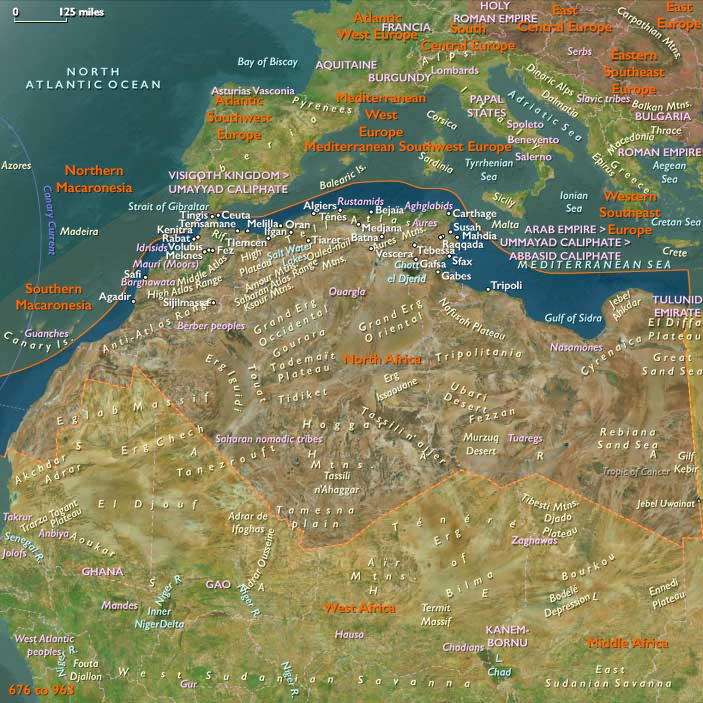
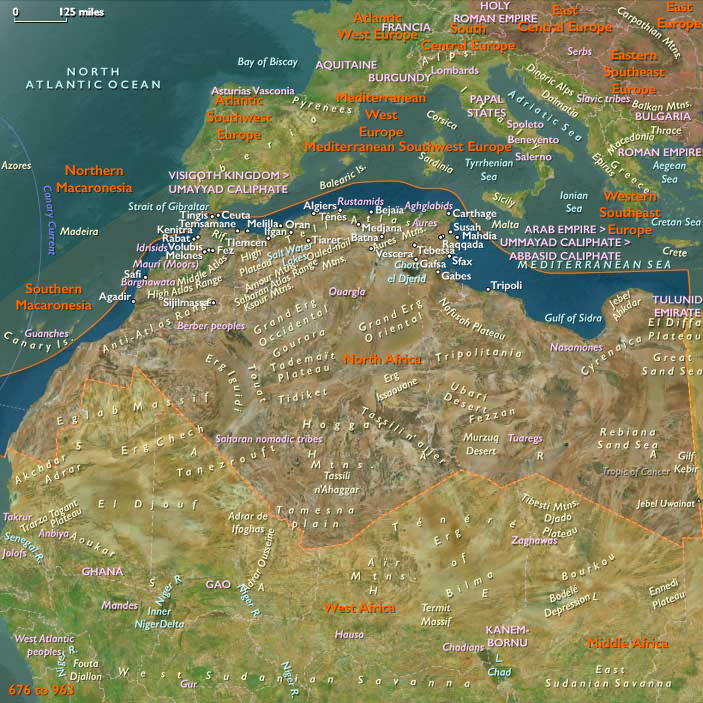
Between 676 and 698 CE, North Africa experiences the decisive culmination of Arab-Islamic conquest, ending centuries of Byzantine rule. The Umayyad Caliphate intensifies its westward military campaigns from the established Arab stronghold of Kairouan (Al Qayrawan), founded in 670 CE. Led by commanders such as Uqba ibn Nafi and his successors, Arab armies steadily overcome fragmented Byzantine coastal defenses. The city of Carthage, a significant symbol of Byzantine authority, falls definitively in 698 CE, marking the effective end of Byzantine rule in North Africa.
Berber resistance remains fierce, notably among tribes such as the Aurès, Austoriani, and Leutae. Berber groups in the Arzugitana region and the aggressive Laguatan tribes mount significant resistance, complicating Arab consolidation.
Early Islamic Rule and Berber Resistance (699–740 CE)
Following Carthage’s fall, the Umayyad Caliphate establishes Ifriqiya as the administrative core of Islamic North Africa, governed from Kairouan. Berber groups initially support or accept Islam, but oppressive taxation, discriminatory treatment, and slavery lead to widespread Berber alienation. This culminates in the significant Great Berber Revolt of 739–743 CE, led by various Berber confederations under the egalitarian Kharijite banner. Fired by puritanical Kharijite preachers in Tangiers in 740, the revolt quickly spreads throughout the Maghreb and even crosses into al-Andalus (Spain). The Umayyads manage to retain control of the core of Ifriqiya and al-Andalus, but fail to recover the rest of the Maghreb, which fragments into small Berber statelets ruled by tribal chieftains and Kharijite imams, marking the first successful secession from the Arab caliphate and initiating Morocco's lasting independence from eastern caliphal control.
Establishment of Indigenous Islamic Dynasties (741–788 CE)
Following the Berber Revolt, independent indigenous dynasties emerge, notably the Rustamid Dynasty (761–909 CE) at Tahert, founded by Abd ar Rahman ibn Rustam, and the Idrisid Dynasty (788 CE onward) in Morocco, founded by Idris I. The Rustamid imamate, governed by Ibadi Kharijite principles, earns a reputation for piety, justice, and scholarship, though it lacks a standing army, leaving it vulnerable to later threats.
Additionally, the Kharijite sect establishes various theocratic tribal kingdoms, including economically significant trade centers at Sijilmasa and Tilimsan, flourishing due to strategic positions on major trade routes.
Economic, Cultural, and Tribal Transformations (789–819 CE)
Between 789 and 819 CE, North Africa undergoes profound economic and cultural transformations. Tuareg tribesdominate trans-Saharan trade, connecting sub-Saharan Africa to Mediterranean markets, fostering economic prosperity and urban growth. The influential Aghlabid Dynasty (800–909 CE), established by Ibrahim ibn al Aghlab under the Abbasid Caliphate, significantly rebuilds regional prosperity by restoring Roman-era irrigation systems and agricultural productivity, enhancing urban vitality in cities like Kairouan, Tunis, and Tripoli. The Aghlabids actively engage in Mediterranean politics, contesting Byzantine influence and conquering Sicily.
The Saharan region, historically more habitable and culturally vibrant, sees significant demographic shifts due to climatic changes and overuse of resources. Proto-Berber peoples such as the Bafour gradually migrate southward, displaced by successive waves of northern Berber tribes arriving first around the 3rd and 4th centuries CE, intensified by the introduction of the camel. Subsequent migrations in the 7th and 8th centuries further reshape the region, driven by the Arab conquest of the Maghreb.
Orthodox Christianity persists in isolated communities, dwindling under Islamic influence. Jewish communities remain influential, engaging in commerce, governance, and crafts within major urban centers. Indigenous Berber groups maintain significant autonomy and influence, often converting to Islam while resisting centralized Arab authority.
Conclusion: North Africa in Transition (819 CE)
By the end of 819 CE, North Africa has transitioned decisively from Byzantine rule to Islamic governance, shaped by profound indigenous resistance, Berber autonomy, and cultural synthesis. Independent Berber dynasties like the Rustamids and Idrisids solidify their power, while the Aghlabids foster regional prosperity. North Africa emerges as a dynamic, culturally diverse Islamic region, significantly transformed by economic vitality, tribal autonomy, and deep religious integration.
People
Groups
- Polytheism (“paganism”)
- Arab people
- Bafour
- Berber people (also called Amazigh people or Imazighen, "free men", singular Amazigh)
- Numidians
- Tuaregs, or Touareg, people
- Africa proconsularis (Roman province)
- Laguatan (Libyan tribal confederation)
- Africa Byzacena (Roman province)
- Christianity, Chalcedonian
- Africa, praetorian prefecture of
- Tripolitania (Roman province)
- Roman Empire, Eastern: Heraclian dynasty
- Islam
- Muslims, Sunni
- Muslims, Kharijite
- Umayyad Caliphate (Damascus)
- Muslims, Ibadi
- Ifriqiya, Ummayad
- Umayyad Caliphate (Harran)
- Ifriqiya, Fihrid Emirate of
- Abbasid Caliphate (Kufa)
- Ifriqiya, Kharijite Berber
- Rustamid Dynasty of Algeria
- Ifriqiya, Abassid
- Abbasid Caliphate (Baghdad)
- Ifriqiya, Muhallabid Dynasty of
- Idrisid dynasty (independent)
- Ifriqiya, Abassid
- Ifriqiya, Aghlabid Emirate of
Topics
Commodoties
Subjects
Regions
Subregions
Years: 676 - 819
People
Groups
- Polytheism (“paganism”)
- Arab people
- Bafour
- Berber people (also called Amazigh people or Imazighen, "free men", singular Amazigh)
- Numidians
- Tuaregs, or Touareg, people
- Africa proconsularis (Roman province)
- Laguatan (Libyan tribal confederation)
- Africa Byzacena (Roman province)
- Christianity, Chalcedonian
- Africa, praetorian prefecture of
- Tripolitania (Roman province)
- Roman Empire, Eastern: Heraclian dynasty
- Islam
- Muslims, Sunni
- Muslims, Kharijite
- Umayyad Caliphate (Damascus)
- Muslims, Ibadi
- Ifriqiya, Ummayad
- Umayyad Caliphate (Harran)
- Ifriqiya, Fihrid Emirate of
- Abbasid Caliphate (Kufa)
- Ifriqiya, Kharijite Berber
- Rustamid Dynasty of Algeria
- Ifriqiya, Abassid
- Abbasid Caliphate (Baghdad)
- Ifriqiya, Muhallabid Dynasty of
- Idrisid dynasty (independent)
- Ifriqiya, Abassid
- Ifriqiya, Aghlabid Emirate of
Topics
Commodoties
Subjects
Regions
Subregions