
North Africa (484–495 CE) Vandal Religious …
Years: 484 - 495
North Africa (484–495 CE)
Vandal Religious Persecution, Dynastic Instability, and Frontier Conflict
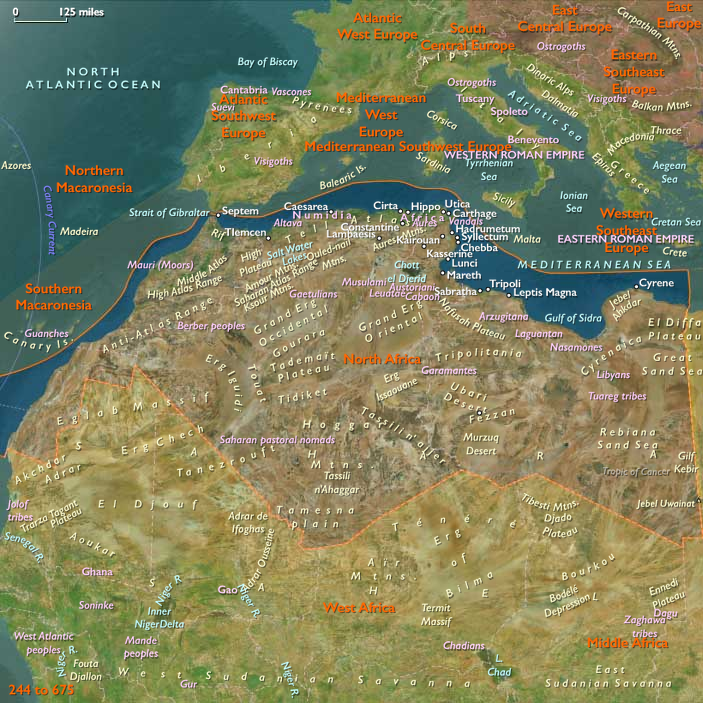
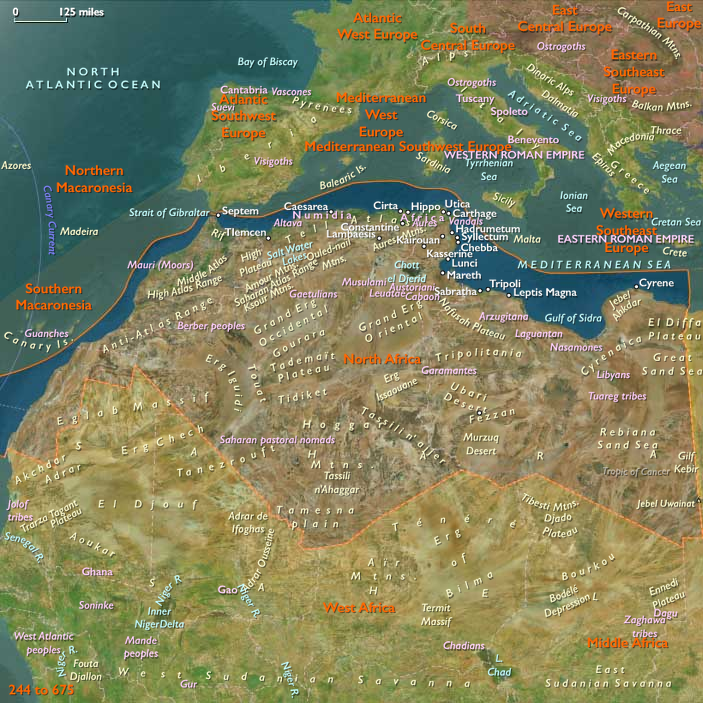
Between 484 and 495 CE, North Africa endures profound internal turmoil marked by intensified religious persecution, dynastic instability within the Vandal Kingdom, and continued frontier tensions.
In 484 CE, King Hunneric dramatically escalates his campaign against the region’s orthodox Christian majority. He convenes the notorious Council of Carthage (484 CE), intending to impose Arian doctrine upon orthodox clergy. When the orthodox bishops steadfastly refuse, Hunneric initiates severe punitive measures: orthodox clergy are systematically imprisoned, exiled, or executed; churches are seized or destroyed; and widespread persecution spreads across urban and rural communities. This violent repression profoundly reshapes North Africa’s religious landscape, driving orthodox Christianity underground yet inadvertently solidifying its adherents’ resistance and unity.
The death of Hunneric in 484 CE ushers in rapid dynastic succession and instability. His successors—Gunthamund (484–496 CE) among them—attempt cautious moderation in religious policies, slightly easing repression against orthodox communities in efforts to restore stability. Gunthamund notably adopts a more pragmatic approach, allowing limited restoration of orthodox worship and reducing open persecution, though still clearly maintaining Arian dominance.
Economically, North Africa maintains relative stability through continued Mediterranean trade, with Carthage still serving as the vibrant capital and commercial heart of the Vandal Kingdom. The region’s agricultural economy, particularly grain and olive oil production, remains crucial despite the social upheavals, supporting ongoing economic activity in key cities such as Leptis Magna and Caesarea (Cherchell).
Nevertheless, persistent dynastic uncertainty within the Vandal royal house weakens central governance, emboldening local elites and fostering regional decentralization. Roman cultural influence and orthodox Christianity persist covertly, subtly resisting complete Vandal assimilation, particularly within urban populations and among dispossessed Roman aristocratic families.
Frontier areas experience continuous tensions as autonomous Berber tribes capitalize on weakened central authority, regularly challenging Vandal control through raids and localized rebellions. The Vandals' attempts at asserting tighter territorial authority often falter against resilient Berber resistance, resulting in ongoing instability and periodic conflicts in rural and frontier regions.
By the end of 495 CE, North Africa remains economically active but politically fragile, with religious persecution temporarily lessened but not resolved. Persistent dynastic uncertainties and frontier conflicts continue to undermine the region’s stability, foreshadowing further volatility as the century draws to a close.
People
Groups
- Berber people (also called Amazigh people or Imazighen, "free men", singular Amazigh)
- Numidians
- Africa proconsularis (Roman province)
- Vandals (East Germanic tribe)
- Mauretania Caesariensis (Roman province)
- Mauretania Tingitana (Roman province)
- Africa Byzacena (Roman province)
- Libya Superior, or Cyrenaica (Roman province)
- Christianity, Arian
- Christianity, Nicene
- Vandals and the Alans, Kingdom of the
- Christianity, Chalcedonian
- Sardinia, Vandal
- Roman Empire, Eastern: Leonid dynasty
Topics
Commodoties
Subjects
Regions
Subregions
Years: 484 - 495
People
Groups
- Berber people (also called Amazigh people or Imazighen, "free men", singular Amazigh)
- Numidians
- Africa proconsularis (Roman province)
- Vandals (East Germanic tribe)
- Mauretania Caesariensis (Roman province)
- Mauretania Tingitana (Roman province)
- Africa Byzacena (Roman province)
- Libya Superior, or Cyrenaica (Roman province)
- Christianity, Arian
- Christianity, Nicene
- Vandals and the Alans, Kingdom of the
- Christianity, Chalcedonian
- Sardinia, Vandal
- Roman Empire, Eastern: Leonid dynasty
Topics
Commodoties
Subjects
Regions
Subregions