
North Africa (472–483 CE) Transition of …
Years: 472 - 483
North Africa (472–483 CE)
Transition of Power, Religious Turmoil, and Persistent Instability
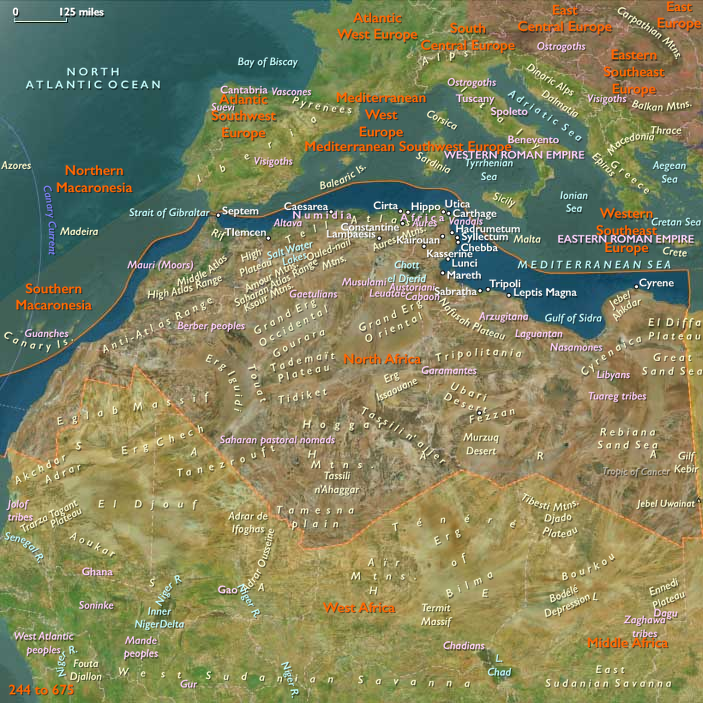
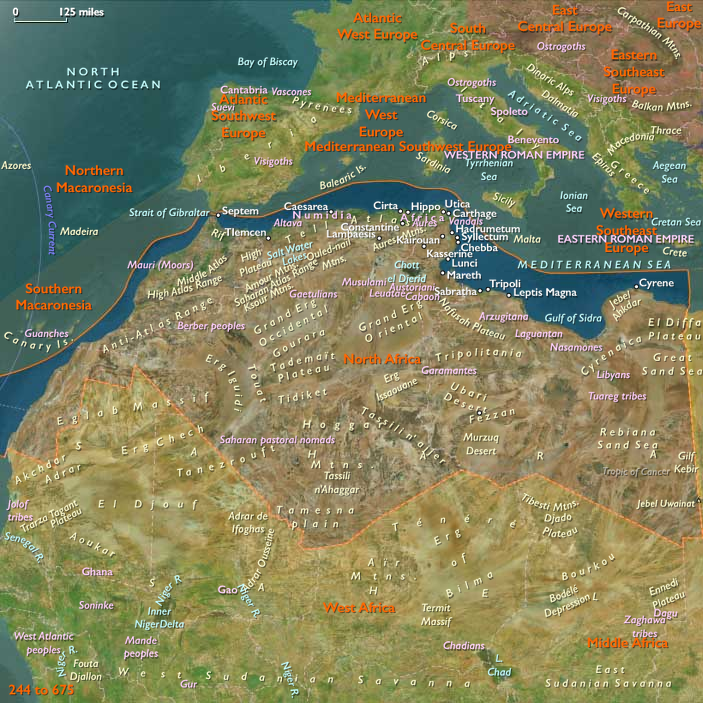
Between 472 and 483 CE, North Africa navigates significant internal challenges and power shifts within the established Vandal Kingdom. This era is marked by the passing of the influential King Genseric in 477 CE, triggering a transition of leadership and subsequent internal struggles that impact regional stability and governance.
Upon Genseric’s death, his son Hunneric ascends the throne, inheriting a prosperous but religiously and socially fragmented kingdom. Hunneric initially attempts a degree of moderation, but quickly resumes and intensifies persecution against the orthodox Christian majority who resist conversion to the Vandals' official faith, Arian Christianity. This renewed persecution is notably harsh: orthodox bishops and clergy face severe repression, including exile, imprisonment, forced conversions, and the confiscation of property. The scale and intensity of these actions exacerbate tensions, fostering resistance and resentment that further polarize Vandal society.
Economically, Hunneric attempts to maintain the prosperity established by Genseric through stable agricultural management and maritime trade. Carthage continues serving as the economic and political heart of the Vandal Kingdom, maintaining active Mediterranean trade networks. Agricultural exports, especially grain and olive oil, continue to underpin regional economic stability, though the severity of religious persecution creates instability and unrest, indirectly affecting economic productivity.
Major urban centers such as Leptis Magna and Caesarea (Cherchell) experience periods of relative stability, adapting to new realities under increasingly stringent Vandal rule. Nevertheless, these cities witness demographic changes as the Roman elite and orthodox Christian populations face marginalization, resulting in significant social shifts and economic adjustments.
On the frontier and in rural areas, autonomous Berber tribes remain assertively independent, capitalizing on internal Vandal divisions to reinforce their territorial autonomy. Vandal efforts to impose centralized control frequently result in fierce tribal resistance, making frontier management difficult and sporadic conflicts common.
By the end of 483 CE, North Africa remains economically robust yet socially and religiously fractured. Hunneric’s aggressive policies have deepened internal divisions, setting the stage for ongoing instability. The region thus enters a period characterized by fragile authority, intensified religious conflicts, and the enduring challenge of independent Berber resistance, foreshadowing further turbulence in the decades ahead.
People
Groups
- Berber people (also called Amazigh people or Imazighen, "free men", singular Amazigh)
- Numidians
- Africa proconsularis (Roman province)
- Vandals (East Germanic tribe)
- Mauretania Caesariensis (Roman province)
- Mauretania Tingitana (Roman province)
- Africa Byzacena (Roman province)
- Christianity, Arian
- Christianity, Nicene
- Roman Empire, Western (Ravenna)
- Vandals and the Alans, Kingdom of the
- Christianity, Chalcedonian
- Sardinia, Vandal
- Roman Empire, Eastern: Leonid dynasty
Topics
Commodoties
Subjects
Regions
Subregions
Related Events
Showing 10 events out of 58557 total
Years: 472 - 483
People
Groups
- Berber people (also called Amazigh people or Imazighen, "free men", singular Amazigh)
- Numidians
- Africa proconsularis (Roman province)
- Vandals (East Germanic tribe)
- Mauretania Caesariensis (Roman province)
- Mauretania Tingitana (Roman province)
- Africa Byzacena (Roman province)
- Christianity, Arian
- Christianity, Nicene
- Roman Empire, Western (Ravenna)
- Vandals and the Alans, Kingdom of the
- Christianity, Chalcedonian
- Sardinia, Vandal
- Roman Empire, Eastern: Leonid dynasty
Topics
Commodoties
Subjects
Regions
Subregions