
North Africa (460–471 CE) Vandal Consolidation, …
Years: 460 - 471
North Africa (460–471 CE)
Vandal Consolidation, Mediterranean Influence, and Internal Tensions
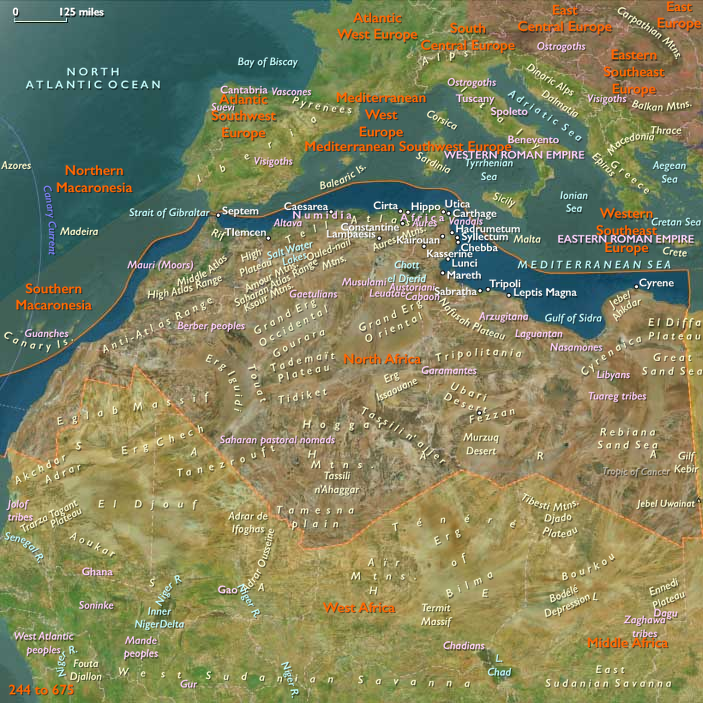
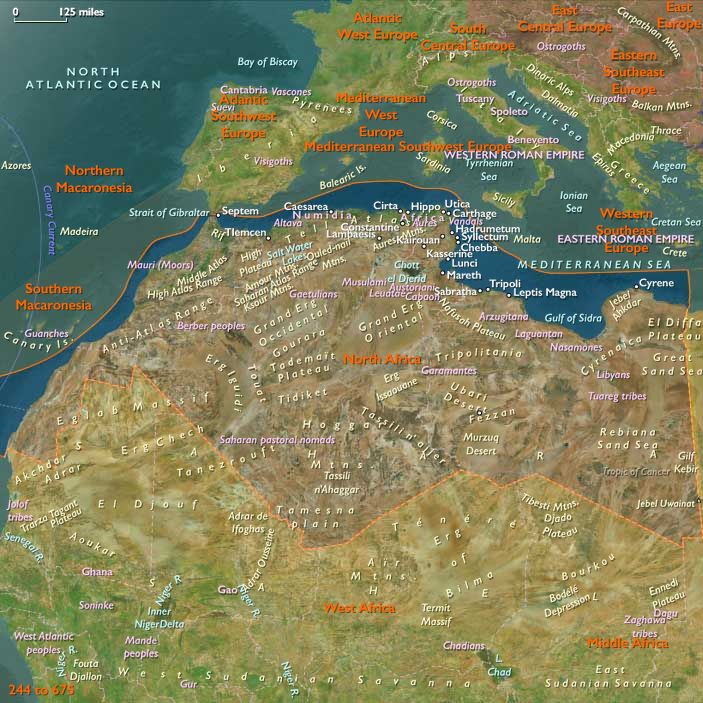
Between 460 and 471 CE, the Vandal Kingdom solidifies its position in North Africa, exerting formidable maritime influence across the Mediterranean and further embedding itself into the region's social, religious, and economic fabric.
Under the rule of King Genseric, Vandal naval dominance remains unchallenged, granting the kingdom substantial leverage in Mediterranean politics and commerce. Utilizing Carthage as a strategic naval base and capital, Genseric orchestrates frequent maritime raids against coastal settlements and Roman-controlled territories, including Italy, Sicily, and other Mediterranean islands. These actions underscore the Vandals’ crucial role in destabilizing Roman maritime authority and further weakening the already beleaguered Western Roman Empire.
Religious persecution under Vandal rule continues with intensity, especially targeting orthodox Christians who reject Arian Christianity, the Vandals' state-sanctioned faith. Orthodox bishops face exile, imprisonment, and severe restrictions on worship, forcing many orthodox communities underground. Despite these hardships, orthodox Christians persist resiliently, maintaining their doctrinal traditions covertly, thus preserving an influential spiritual and social presence in North Africa.
Economic conditions within the Vandal Kingdom become increasingly stable during this era. Genseric implements organized administrative structures to effectively manage agricultural resources—particularly grain and olive oil exports—vital for sustaining economic stability and maritime dominance. Expropriation of Roman estates continues, reallocating land and resources to loyal Vandal nobility, fundamentally reshaping rural landholding patterns.
Urban centers such as Leptis Magna and Caesarea (Cherchell) successfully adapt to Vandal administration, maintaining relative commercial prosperity through adjusted Mediterranean trade networks. Nevertheless, their traditional elite structures shift significantly as Roman aristocratic influence diminishes in favor of new, Vandal-appointed authorities.
In the hinterlands, Berber tribes maintain substantial independence, regularly contesting Vandal authority and periodically disrupting economic activities and territorial control. Vandal efforts to fully integrate or subdue these tribal groups meet persistent resistance, resulting in ongoing frontier tensions and regional instability.
By the end of 471 CE, the Vandal Kingdom has achieved significant consolidation of its political and economic power. Though internal religious conflicts and persistent Berber opposition continue, North Africa firmly stands as a formidable maritime power, having definitively transformed from a Roman province into a central player in the late antique Mediterranean geopolitical landscape.
People
Groups
- Berber people (also called Amazigh people or Imazighen, "free men", singular Amazigh)
- Numidians
- Africa proconsularis (Roman province)
- Vandals (East Germanic tribe)
- Mauretania Tingitana (Roman province)
- Mauretania Caesariensis (Roman province)
- Africa Byzacena (Roman province)
- Libya Superior, or Cyrenaica (Roman province)
- Christianity, Arian
- Christianity, Nicene
- Roman Empire, Western (Ravenna)
- Vandals and the Alans, Kingdom of the
- Christianity, Chalcedonian
- Sardinia, Vandal
- Roman Empire, Eastern: Leonid dynasty
Topics
Commodoties
Subjects
Regions
Subregions
Years: 460 - 471
People
Groups
- Berber people (also called Amazigh people or Imazighen, "free men", singular Amazigh)
- Numidians
- Africa proconsularis (Roman province)
- Vandals (East Germanic tribe)
- Mauretania Tingitana (Roman province)
- Mauretania Caesariensis (Roman province)
- Africa Byzacena (Roman province)
- Libya Superior, or Cyrenaica (Roman province)
- Christianity, Arian
- Christianity, Nicene
- Roman Empire, Western (Ravenna)
- Vandals and the Alans, Kingdom of the
- Christianity, Chalcedonian
- Sardinia, Vandal
- Roman Empire, Eastern: Leonid dynasty
Topics
Commodoties
Subjects
Regions
Subregions