
North Africa (424–435 CE) Vandal Arrival, …
Years: 424 - 435
North Africa (424–435 CE)
Vandal Arrival, Roman Decline, and Shifting Power Dynamics
Between 424 and 435 CE, North Africa undergoes dramatic transformations, culminating in the significant weakening of Roman authority and paving the way for the establishment of Vandal power.
Imperial control in the region continues to deteriorate, with reduced military resources, internal administrative inefficiencies, and persistent religious divisions—particularly between orthodox Christians and resilient Donatist communities. The influential bishop Augustine of Hippo remains an intellectual and spiritual leader until his death in 430 CE, advocating church unity and increasingly supporting imperial suppression of heretical movements. Augustine's death coincides symbolically with the end of sustained Roman cultural and spiritual dominance in the region.
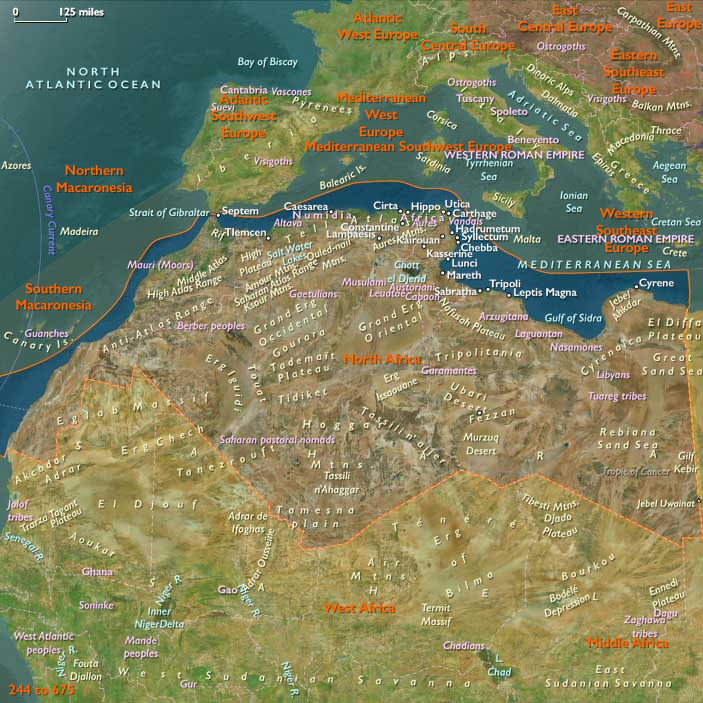
The decisive turning point of this era occurs in 429 CE, when approximately eighty thousand Vandals, led by their ambitious and capable King Genseric, cross from Spain into Roman North Africa. Exploiting weakened imperial defenses, the Vandals advance rapidly and encounter minimal resistance. By 430 CE, they lay siege to the city of Hippo Regius, which, despite fierce resistance, eventually falls, marking a significant symbolic and strategic loss for Roman North Africa.
In 435 CE, recognizing their inability to expel the invaders entirely, Roman authorities negotiate a treaty with Genseric, formally ceding extensive territories in Numidia and Mauretania to Vandal control. This agreement, while temporarily containing the Vandals within defined boundaries, effectively legitimizes their presence in North Africa and signifies Rome's waning influence in the region.
Throughout this tumultuous period, major cities, including Carthage, Leptis Magna, and Caesarea (Cherchell), maintain economic activity but experience increasing pressures as traditional trade networks and agricultural systems are disrupted. Rural areas and small towns, increasingly vulnerable to Vandal incursions and opportunistic Berber tribal movements, suffer considerable dislocation and economic hardship.
By the end of 435 CE, North Africa stands at a critical juncture. Roman political authority has significantly diminished, Vandal power is firmly established, and the region faces profound uncertainty, marking the beginning of a new and markedly different era of governance, culture, and religion.
People
Groups
- Berber people (also called Amazigh people or Imazighen, "free men", singular Amazigh)
- Numidians
- Tripolitania (Roman province)
- Africa proconsularis (Roman province)
- Vandals (East Germanic tribe)
- Mauretania Tingitana (Roman province)
- Mauretania Caesariensis (Roman province)
- Africa Byzacena (Roman province)
- Libya Superior, or Cyrenaica (Roman province)
- Christianity, Arian
- Mauretania Sitifensis (Roman province)
- Christianity, Nicene
- Roman Empire: Theodosian dynasty (Constantinople)
- Vandals and the Alans, Kingdom of the
Topics
- Migration Period
- Fall of the Western Roman Empire
- Vandal Raids on the Roman Empire
- Hippo Regius, Sack of
Commodoties
Subjects
Regions

Subregions
Related Events
Showing 10 events out of 59010 total
Years: 424 - 435
People
Groups
- Berber people (also called Amazigh people or Imazighen, "free men", singular Amazigh)
- Numidians
- Tripolitania (Roman province)
- Africa proconsularis (Roman province)
- Vandals (East Germanic tribe)
- Mauretania Tingitana (Roman province)
- Mauretania Caesariensis (Roman province)
- Africa Byzacena (Roman province)
- Libya Superior, or Cyrenaica (Roman province)
- Christianity, Arian
- Mauretania Sitifensis (Roman province)
- Christianity, Nicene
- Roman Empire: Theodosian dynasty (Constantinople)
- Vandals and the Alans, Kingdom of the
Topics
- Migration Period
- Fall of the Western Roman Empire
- Vandal Raids on the Roman Empire
- Hippo Regius, Sack of
Commodoties
Subjects
Regions
Subregions