
North Africa (388–531 CE) Imperial Shifts, …
Years: 388 - 531
North Africa (388–531 CE)
Imperial Shifts, Vandal Conquest, and Cultural Resilience
Late Roman Administration and Regional Stability (388–429 CE)
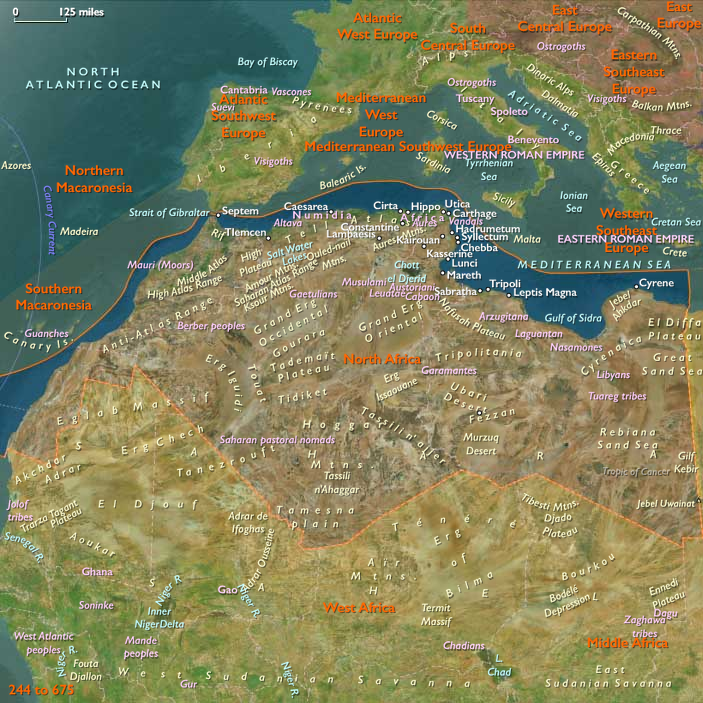
Between 388 and 429 CE, North Africa experiences relative stability despite growing pressures on the Western Roman Empire. Effective regional governance, supported by established urban centers and robust agricultural productivity, helps maintain economic vitality and social cohesion.
Christianity continues to flourish, although internal conflicts, notably the persistent Donatist schism, significantly shape religious and social landscapes. The Donatist controversy, characterized as a struggle between opponents and supporters of the Roman system, sees its most articulate critic in Augustine, bishop of Hippo Regius. Augustine maintains that the validity of the sacraments is unaffected by the unworthiness of a minister, as their true minister is Jesus Christ. He evolves a theory advocating the right of orthodox Christian rulers to use force against heretics and schismatics. Although officially resolved by an imperial commission in 411, Donatist communities persist into the sixth century.
Persistent frontier defenses, especially against Berber tribes and Saharan nomads, maintain security. Prominent urban hubs, including Carthage, Leptis Magna, and Caesarea (Cherchell), thrive through sustained Mediterranean commerce and agricultural exports. Additionally, the province of Africa Byzacena, located to the southeast of Carthage, emerges as a key agricultural and economic region, noted for its olive oil production and vibrant trade networks.
Vandal Invasion and Establishment of the Kingdom (429–477 CE)
In 429 CE, approximately eighty thousand Vandals, led by King Genseric, cross into North Africa from Spain. The invaders quickly advance, encountering limited resistance, reaching and laying siege to Hippo Regius in 430, where Augustine dies during the siege. Initially, in 435 CE, an agreement restricts Vandal control to Numidia and Mauretania; however, by 439 CE, Genseric conquers and pillages Carthage and much of Roman Africa, including Africa Byzacena.
The establishment of the Vandal Kingdom significantly disrupts Roman administrative and economic structures. Trade declines, weakening Roman influence. Independent kingdoms emerge in mountainous and desert regions, towns suffer invasions, and displaced Berbers reclaim territories previously marginalized by Roman expansion.
Vandal rule introduces Arian Christianity, creating tensions with the predominantly Orthodox and Donatist local populations. Religious conflicts lead to intermittent persecutions, confiscations of church property, and the exile of Orthodox bishops.
Vandal Consolidation and Cultural Integration (477–531 CE)
Between 477 and 531 CE, successive Vandal kings consolidate power, maintaining Mediterranean trade and contributing to broader economic networks despite persistent religious and social tensions. Cultural interactions among Vandals, Romans, Berbers, and Jewish populations shape the region's complex social fabric. Berber tribes assert independence, frequently challenging Vandal rule.
Christianity remains divided, with Arian Vandals governing predominantly Orthodox and Donatist populations. Religious fragmentation significantly influences social dynamics and governance throughout this period.
Cultural Resilience and Persistent Challenges
Throughout this era, North Africa demonstrates impressive cultural resilience, integrating diverse traditions, including Roman, Berber, Vandal, Jewish, and early Byzantine influences. Urban centers remain vibrant, agricultural productivity endures robustly, and trans-Saharan trade networks persist, involving pastoral communities such as the Mauri (Moors).
The Roman partition of 395 CE assigns Libya to the eastern empire, while Tripolitania remains under the western empire. Christianity, introduced among Libya's Jewish community, spreads rapidly among urban populations and slaves, reaching Berber tribes in the hinterland. Churches in Tripolitania and Cyrenaica develop distinct characteristics; the former aligns with the Latin patriarch in Rome, while the latter comes under the jurisdiction of the Coptic patriarch of Alexandria. Religious dissent becomes a channel for social revolt amidst political deterioration and economic decline.
Conclusion: Strategic Importance and Complex Legacy (531 CE)
By 531 CE, North Africa remains strategically critical, having endured profound imperial shifts, military invasions, and religious conflicts. Despite these challenges, the region retains economic vitality, resilient urbanism, and cultural complexity, solidifying its enduring importance within the broader Mediterranean world.
People
Groups
- Polytheism (“paganism”)
- Berber people (also called Amazigh people or Imazighen, "free men", singular Amazigh)
- Numidians
- Jews
- Africa proconsularis (Roman province)
- Vandals (East Germanic tribe)
- Mauretania Caesariensis (Roman province)
- Mauretania Tingitana (Roman province)
- Africa Byzacena (Roman province)
- Libya Superior, or Cyrenaica (Roman province)
- Christianity, Arian
- Donatism
- Mauretania Sitifensis (Roman province)
- Christianity, Nicene
- Roman Empire: Valentinian dynasty (Rome)
- Roman Empire: Theodosian dynasty (Constantinople)
- Roman Empire, Western (Milan)
- Roman Empire, Western (Ravenna)
- Vandals and the Alans, Kingdom of the
- Christianity, Chalcedonian
- Coptic Orthodox Church of Alexandria
- Roman Empire, Eastern: Leonid dynasty
- Roman Empire, Eastern: Justinian dynasty
Topics
- Migration Period
- Fall of the Western Roman Empire
- Vandal Raids on the Roman Empire
- Hippo Regius, Sack of
- Migration Period Pessimum
- Roman War with the Vandals
Commodoties
Subjects
Regions
Subregions
Related Events
Showing 10 events out of 59517 total
Years: 388 - 531
People
Groups
- Polytheism (“paganism”)
- Berber people (also called Amazigh people or Imazighen, "free men", singular Amazigh)
- Numidians
- Jews
- Africa proconsularis (Roman province)
- Vandals (East Germanic tribe)
- Mauretania Caesariensis (Roman province)
- Mauretania Tingitana (Roman province)
- Africa Byzacena (Roman province)
- Libya Superior, or Cyrenaica (Roman province)
- Christianity, Arian
- Donatism
- Mauretania Sitifensis (Roman province)
- Christianity, Nicene
- Roman Empire: Valentinian dynasty (Rome)
- Roman Empire: Theodosian dynasty (Constantinople)
- Roman Empire, Western (Milan)
- Roman Empire, Western (Ravenna)
- Vandals and the Alans, Kingdom of the
- Christianity, Chalcedonian
- Coptic Orthodox Church of Alexandria
- Roman Empire, Eastern: Leonid dynasty
- Roman Empire, Eastern: Justinian dynasty
Topics
- Migration Period
- Fall of the Western Roman Empire
- Vandal Raids on the Roman Empire
- Hippo Regius, Sack of
- Migration Period Pessimum
- Roman War with the Vandals
Commodoties
Subjects
Regions
Subregions