
North Africa (273–262 BCE) Carthaginian Maritime …
Years: 273BCE - 262BCE
North Africa (273–262 BCE)
Carthaginian Maritime Dominance and the Onset of the First Punic War
Expansion and Consolidation of Carthaginian Influence
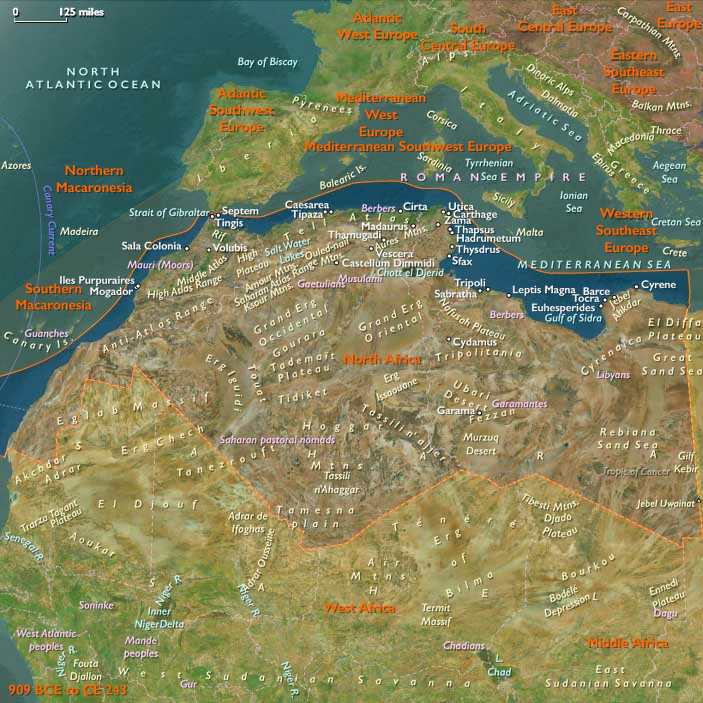
From 273 to 262 BCE, Carthage, originating as a Phoenician colony near modern Tunis, firmly establishes itself as the preeminent naval power in the western Mediterranean. The city's civilization expands its hegemony extensively along the North African coast, deeply into its hinterland, and also encompasses the Balearic Islands, Sardinia, Corsica, southern Spain, and the western half of Sicily.
Economic exchanges and alliances with interior Berber tribes reinforce Carthage's prosperity, securing a steady flow of resources necessary to sustain its extensive network of territories. Prominent coastal trading hubs, particularly Leptisand Oea (modern Tripoli), continue flourishing, deepening economic interdependence with inland Berber communities.
Diplomatic Challenges and the Emergence of Conflict with Rome
Diplomatic tensions culminate in the outbreak of the First Punic War in 264 BCE, triggered by mutual interventions by Rome and Carthage in Messana, Sicily, a strategically located city near the Italian peninsula. This initiates a twenty-year struggle for supremacy primarily over Sicily and its surrounding waters, and to a lesser extent North Africa itself.
Despite the escalating conflict, Carthage strategically navigates alliances with Greek city-states and cautiously maintains diplomatic channels with other Mediterranean powers to safeguard its territorial and economic interests.
Cyrenaica’s Economic Stability Amid Regional Unrest
The Greek Pentapolis—Cyrene, Barce (Al Marj), Euhesperides (Benghazi), Teuchira (Tukrah), and Apollonia (Susah)—maintains economic strength through sustained exports of grain, fruit, horses, and the valuable medicinal plant Silphium. Cyrene continues investing in civic infrastructure and religious institutions, highlighting its economic resilience and political autonomy.
Cyrenaica adeptly manages external pressures, carefully preserving its Greek cultural identity and maintaining independence amidst the broader geopolitical volatility.
Berber Integration and Continued Stability
Berber communities further integrate economically within Carthaginian trade networks, adopting advanced agricultural methods, maritime expertise, and artisanal practices. Coastal cities like Oea (Tripoli) remain vital economic centers, significantly contributing to regional prosperity and stability.
Inland Berber tribes retain their autonomy, preserving traditional governance structures and cultural identities, benefiting indirectly from prosperous coastal trade and the economic stability it brings.
Cultural Syncretism and Artistic Development
Interactions among Berber, Carthaginian, and Greek populations enrich cultural practices, notably in pottery, textiles, and metalwork. Religious syncretism continues to evolve, integrating indigenous Berber traditions harmoniously with Phoenician and Greek religious practices, further enhancing the region's cultural diversity.
Robust Foundations Amid Growing Conflict
By 262 BCE, North Africa maintains considerable political stability and economic vitality, despite the challenges posed by the First Punic War. Carthage’s strategic maritime strength, Cyrenaica’s diplomatic resilience, and cohesive Berber integration collectively ensure the region's continued prominence, even amidst emerging conflicts with Rome.
Groups
- Berber people (also called Amazigh people or Imazighen, "free men", singular Amazigh)
- Carthage, Kingdom of
- Greeks, Classical
- Syracuse, Corinthian city-state of
- Cyrene
- Roman Republic
Topics
Commodoties
Subjects
Regions
Subregions
Related Events
Showing 10 events out of 63980 total
Years: 273BCE - 262BCE
Groups
- Berber people (also called Amazigh people or Imazighen, "free men", singular Amazigh)
- Carthage, Kingdom of
- Greeks, Classical
- Syracuse, Corinthian city-state of
- Cyrene
- Roman Republic
Topics
Commodoties
Subjects
Regions
Subregions